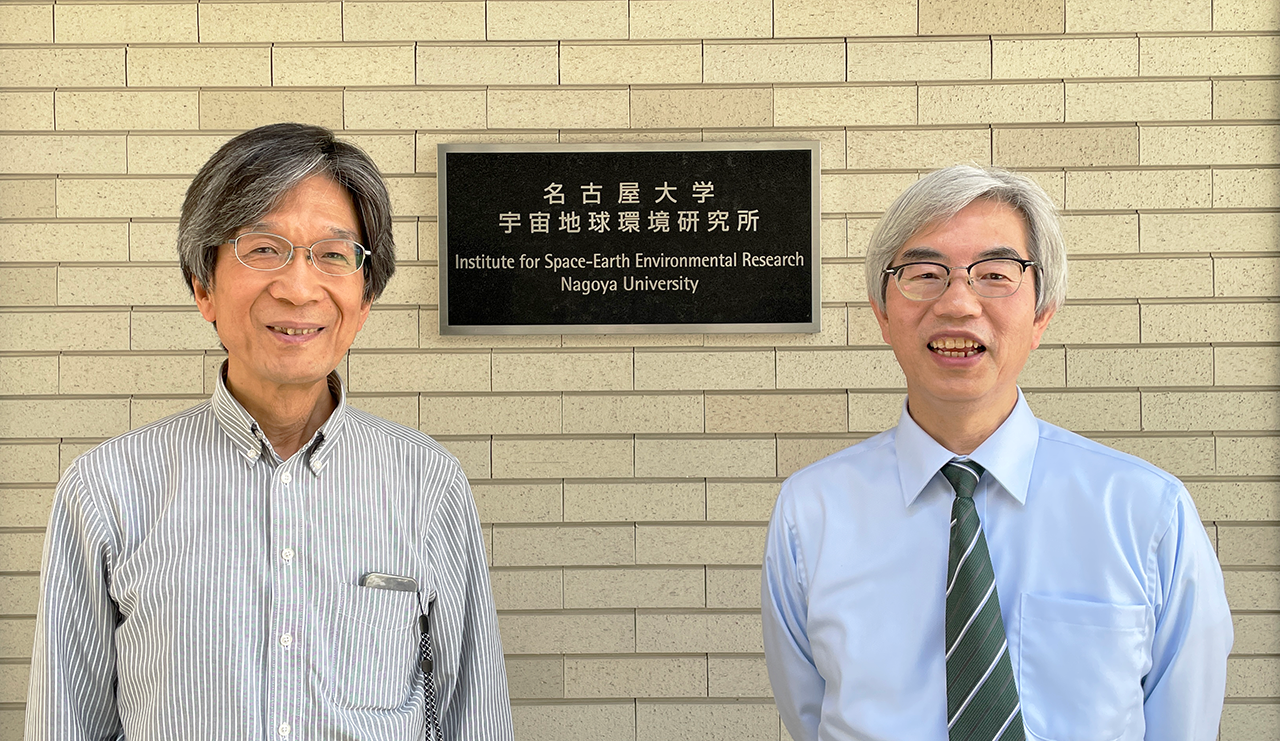
Interview and text: Megumi Maruyama (URA, Planning and Project Development Division, Academic Research & Industry-Academia-Government Collaboration)
“If you take maternity or childcare leave, you can’t extend your term to make up for it.”
A researcher asked, “Is that really true?” A university research administrator (URA) stood by her. This is their story.
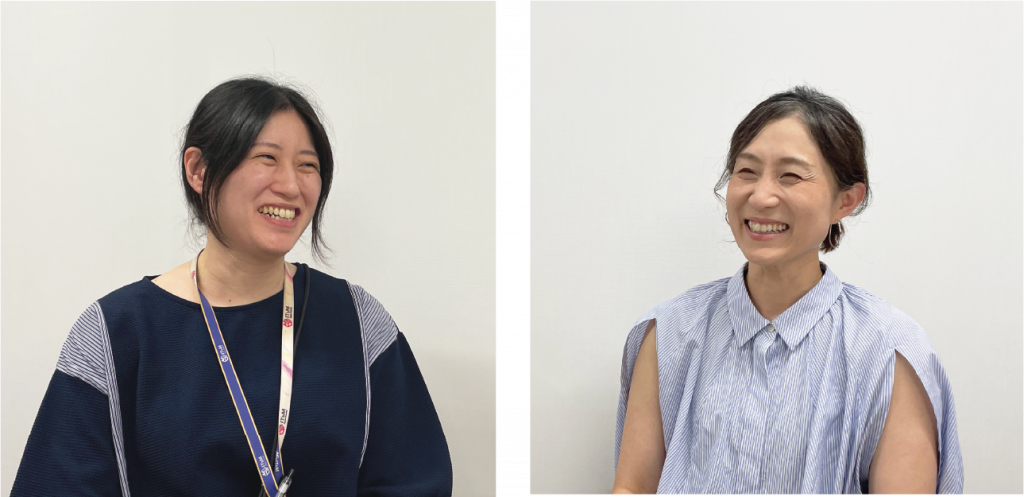
Researcher (JSPS Post-Doc), Institute for Transformative Bio-Molecules (ITbM)ーinformally known as a “Gakushin PD”
Specializes in plant nutrition; currently researches plant growth and regeneration. After completing her master’s degree, she worked at a private company before earning her PhD while working. She joined Nagoya University in 2021. Describes herself as someone who “goes all in once switched on.”
Tomoe Tsuboi (Right)
Research Administrator, Research Support & Personnel Development Division
Helps early-career researchers (Gakushin PD fellows and others) grow and succeed in their careers. After working as a biochemistry faculty member at another university, she joined Nagoya University’s URA team in 2024. Like Ukai, she also earned her PhD while working. Her own experience drives her commitment to creating an environment where researchers do not have to choose between their research and major life events.
One casual remark from Ukai started something big. It led Nagoya University to revise its employment regulations for the researchers called “Gakushin PD” and “Gakushin RPD.” As a result, these researchers can now extend their appointment terms to cover periods of leave. Here’s what happened behind the scenes, in their own words.
⸻This came up at a recent all-staff meeting, where your report drew many positive comments. First, what exactly are “Gakushin PD” and “Gakushin RPD”?
Tsuboi: Both are Research Fellowships from the Japan Society for the Promotion of Science (JSPS) — a program that supports early-career researchers. PD and RPD are just different categories, depending on eligibility.
Gakushin PD/RPD fellowships are highly competitive: in fiscal year 2026, there were 1,705 applicants nationwide, of whom 424 were selected. Nagoya University currently hosts about 40 PD/RPD fellows, and Tsuboi helps prepare their research environment and supports their research activities and careers. Their official job titles at Nagoya University are “Researcher (JSPS Post-Doc)” and “Researcher (JSPS Restart Post-Doc).”
⸻How long are the appointments?
Tsuboi: Three years for both Gakushin PD and RPD, in principle. I’ve never held either fellowship myself, so I just assumed that if fellows took maternity or childcare leave, their appointments could be extended accordingly. So when Ukai asked me, “Is it true you can’t extend it?” I was like, “Wait, what?”
⸻Where did you hear that, Ukai?
Ukai: After I was selected as a Gakushin PD fellow in 2024, I found that in the materials Nagoya University gave me. I thought, “Is that really true, even now?” So I checked another source, and it said extensions were possible. I was confused.
⸻What was actually going on?
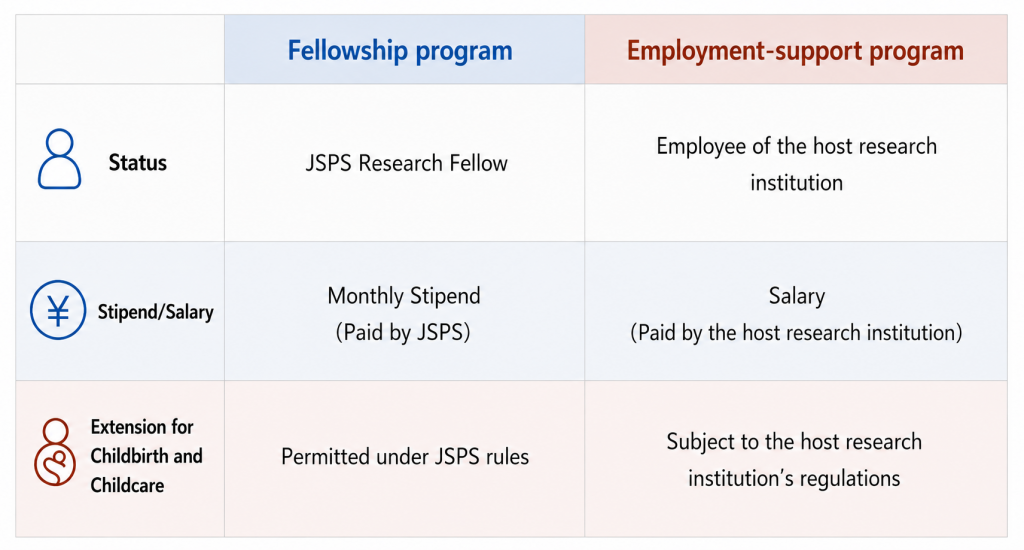
Tsuboi: The system was going through a major change around then. In 2023, a new “employment-support program” was introduced alongside the existing “fellowship program,” letting host institutions employ their fellows directly. Nagoya University joined this program in 2024, and Ukai was our very first fellow under it.
Tsuboi: The confusion came down to a difference in “who sets the rules.” At the time, Nagoya University’s regulations had no provision for extending the employment period, so an extension wasn’t possible.
⸻Did you have plans to take maternity or childcare leave at that point, Ukai?
Ukai: No, not at all. I wasn’t even married yet. I just didn’t have the headspace to think about life events. Since becoming a researcher, my contracts had always been one-year renewals, so I was constantly thinking about my next position. But the Gakushin PD appointment is three years. I remember thinking, “If nothing happens in these three years, maybe a life event will never come for me” — so I started reading the regulations closely.
Tsuboi: Around the same time, another Gakushin PD fellow came to me about taking maternity and childcare leave, and it hit me: “If we can’t extend her term, that’s a real problem!” So I worked backward from her due date and started looking into what it would take to change the rules in time.
⸻But changing an organization’s rules is no small task. Couldn’t you have just said it wasn’t possible?
Tsuboi: Yes, other URAs told me the same thing: “That’s going to be tough.” But other PD fellows wanted it changed too. And having had a child myself as a researcher, I knew how precious research time was. So even if the honest answer might end up being “we can’t,” I thought “Let’s do what we can.”
⸻What did you actually do?
Tsuboi: First, I gathered input from Gakushin PD fellows at Nagoya University, and started looking into how other universities handle this. I managed to get information from several schools, and found that some allowed extensions.
⸻That’s good to know. Did it lead directly to revising Nagoya University’s regulations?
Tsuboi: No. That alone wasn’t enough to make a solid case. But there’s a limit to what you can find out on your own. So I consulted with someone in the Research Funding Division, and they looked into the situation at other universities.
Ukai: I had no idea any of that was happening. I was just reading the materials and asking questions like, “What does this actually mean?”
Tsuboi: No, no, it was your sharp questions that got people moving. We found through inquiries to several national universities that most of them allowed term extensions for maternity or childcare leave.
⸻ That sounds like more than enough evidence.
Tsuboi: Still, in proposing the regulation change, we also had to check on funding. The numbers showed that some costs, including salary during maternity leave, wouldn’t be covered by JSPS funding, leaving the university to cover about 1.6 million yen per person.
⸻So it does create a burden for the university.
Tsuboi: Even so, the university moved forward with considering the extension, and the regulations were revised in December 2025. Now, Gakushin PD and RPD fellows employed by Nagoya University can extend their term by up to the length of maternity or childcare leave they took.
⸻That’s great to hear. Did it come in time for the fellow who needed it?
Tsuboi: Yes! I was so relieved.
⸻And for you, Ukai, having the rule settled must be reassuring for the future.
Ukai: It really is. Beyond just the system itself, hearing about Tsuboi’s own experiences was also a huge help. She talked about how childbirth doesn’t always go as planned, or how hard it can be to return to work without childcare.
⸻Do you plan to continue building your career as a researcher going forward?
Ukai: I haven’t decided yet. If there’s a position, I’d like to keep working as a researcher, but working at a company is also a real option for me. Universities have their strengths, and companies have theirs. I’d like to make the choice that feels right for me at each stage.
⸻It sounds like having a “choice” matters a lot to you.
Ukai: It does. In academia today, staying in research can require a lot of commitment. I hope more people who want to continue their research will be able to do so.
⸻That seems connected to the kind of support you’re aiming for, Tsuboi-san.
Tsuboi: Yes. I can’t change everything right away, but I want to keep listening to what Gakushin PD and RPD fellows have to say and doing what I can. In fact, based on feedback from them, we’re already working toward further changes to the regulations.