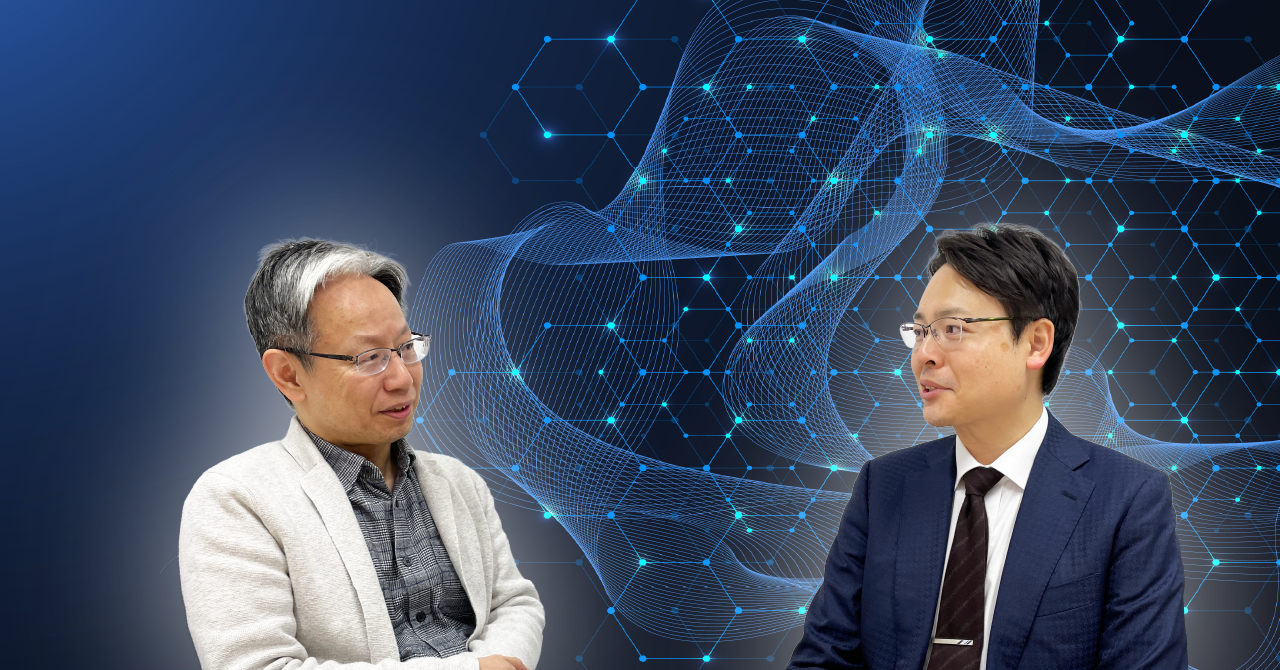
Interview and text: Megumi Maruyama (URA, Planning and Project Development Division, Academic Research & Industry-Academia-Government Collaboration)
Nagoya University launched the Business Development Office within Academic Research & Industry-Academia-Government Collaboration in May 2025.
Describing its role as a “cross-cutting” perspective focused on value creation, Masaya Nakamura, Chief Research Administrator, brings an external viewpoint shaped by years of experience in corporate business development, taking a broad view of the structures and environments surrounding research.
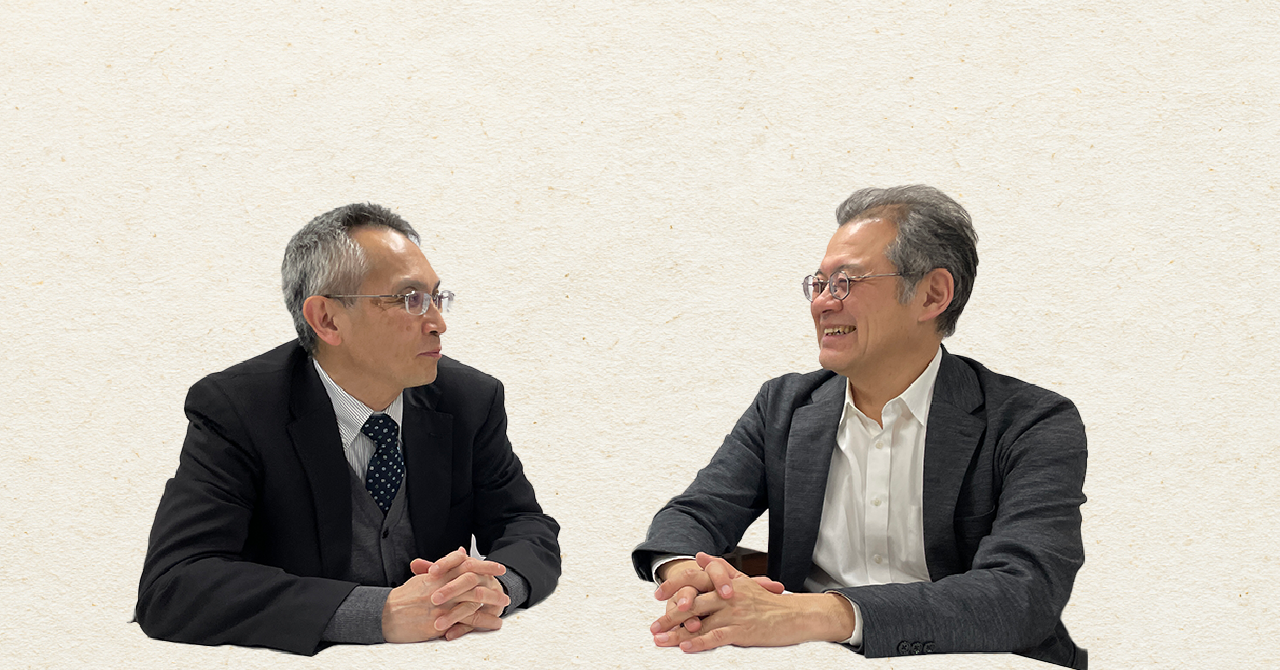
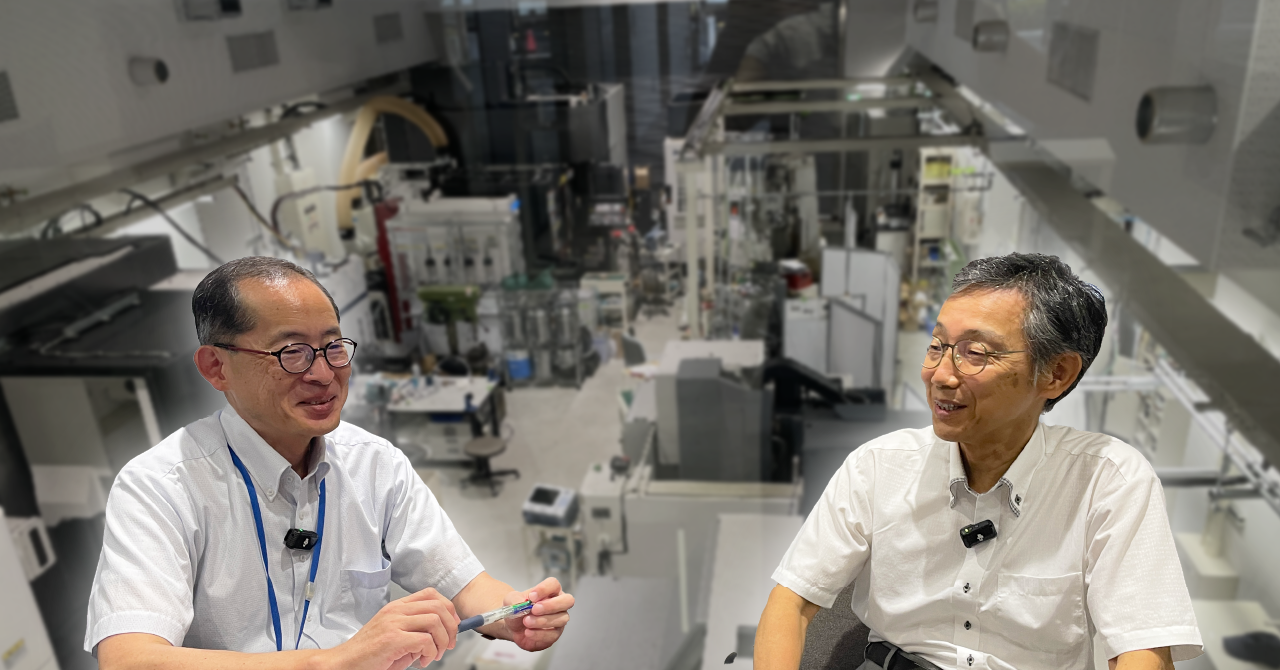
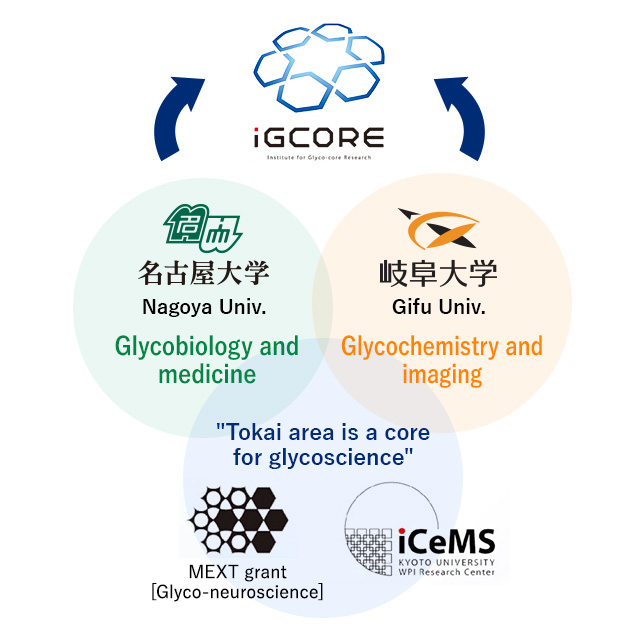
In this column, we feature a paired interview with Nakamura and Jun Hirabayashi, designated professor at the Institute for Glyco-core Research (iGCORE), where he is responsible for research strategy. Through their dialogue, we explore how a business development perspective can unlock new value when it intersects with academic research — particularly through conversations with Hirabayashi, who has experienced both the researcher’s viewpoint and a management role.
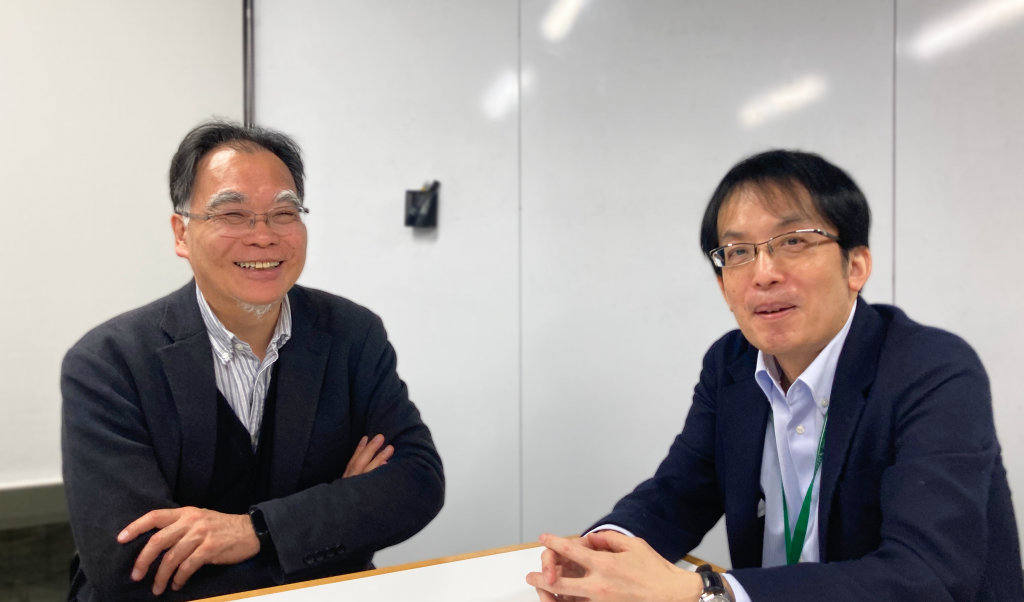
Designated Professor/Director,
Research Promotion Office, Institute for Glyco-core Research (iGCORE)
After a long career in glycoscience research at the National Institute of Advanced Industrial Science and Technology (AIST), joining Nagoya University in 2021 marked a shift into a research management role. The term “Expanded Central Dogma” was coined to describe a view of life that goes beyond DNA → RNA → proteins to include glycans as an integral part of biological systems.
Masaya Nakamura (Right)
Chief Research Administrator, Business Development Office, Academic Research & Industry-Academia-Government Collaboration
After a career in business development and product strategy at a pharmaceutical company, joining Nagoya University in 2025 brought an external, industry-informed viewpoint into the university. Experience gained in complex business settings — including three corporate mergers — has shaped a capacity for connection across organizations, alongside a flexible and unconstrained way of thinking rooted in formative boarding school years spent among peers from diverse backgrounds.
── When did the two of you first meet?
Nakamura: It hasn’t even been a year yet. I came to Nagoya University in March 2025, and we met soon after.
Hirabayashi: I remember that, even though it was our first meeting, I found myself talking nonstop (laughs).
Nakamura: We really got into it. It was when we visited iGCORE together with Masahiro Kito, Head of the Intellectual Property & Technology Transfer Division, to discuss launching a new industry collaboration initiative.
── At your first meeting, did you feel any kind of “wall,” if any, between your positions or perspectives?
Hirabayashi: Quite the opposite — it was eye-opening. Researchers tend to think bottom-up, starting from their own technologies: “This could be used for this, or applied there.” Trial and error is part of the process, and setbacks are something you learn to live with. But in business and other real-world contexts, thinking often starts from the goal and works backward. That approach was genuinely stimulating for us.
Nakamura: Companies and universities set goals differently. Companies decide on a goal first and move forward without deviating from it. That gives a sense of security, but it narrows the range of what you can try. Universities are the opposite — because the range of possible goals is broader, there’s room for unexpected breakthroughs. Ideally, we can preserve the strengths of universities while being a bit more conscious of goals from a business perspective.
── Universities certainly do seem to offer a unique kind of freedom. From your position overseeing research strategy at iGCORE, how do you think about “strategy”?
Hirabayashi: I wouldn’t say it’s fully defined yet, and I find myself a bit cautious about the word “strategy” itself. I sometimes wonder whether Japan has historically been good at creating strategies in the first place.
Nakamura: That’s true. Japan is strong at the tactical level, but often slower when it comes to building overall strategies or shared frameworks.
Hirabayashi: We’ve had incredible technological strengths, but we’ve been weaker at thinking about how to leverage them as a whole.
Nakamura: In other words, we’re not very good at standardization.
── As an institute leading glycoscience globally, how can iGCORE confront this Japan-specific challenge?
Nakamura: There are strengths too. In Japan, there’s a lot of shared, unspoken understanding — you don’t always have to verbalize everything, and achieving alignment can be quite smooth. Building on that, one possible direction is to create a Japan-originated global framework that defines how glycans should be analyzed and evaluated.
Hirabayashi: Glycoscience has long been an area in which Japan has built deep expertise. It has its own worldview, and trying to capture it within conventional scientific frameworks hasn’t been easy. Our predecessors overcame those challenges one by one at the tactical level. If a Japan-originated framework could be established, knowledge would accumulate through it, creating momentum for the next generation of strategies and research.
Nakamura: What’s crucial is how that framework connects to standards. If research results simply accumulate independently, they remain isolated achievements. But if there’s a shared way of organizing and evaluating outcomes, that can eventually become a standard that everyone uses.
Hirabayashi: That’s a key point. Glycoscience has broad applications — from pharmaceuticals to biotechnology — and the market is already substantial. Where standards emerge will significantly shape the future trajectory of the field.
── Hearing how the discussion of “strategy” leads naturally to frameworks and standardization really highlights the weight of the word.
Hirabayashi: Exactly. Strategy isn’t something you can easily set up or define. Sometimes, the word is used because a strategy can’t yet be fully articulated. At iGCORE, strategy may not be set in advance — it may emerge as we think about how research connects to society and its applications.
Nakamura: There are many ways to think about strategy, but in a diverse environment like iGCORE, what I envision is an emergent strategy — one that doesn’t start with a rigid plan, but instead takes shape through action. I believe that’s precisely the kind of approach iGCORE is aiming for.
The Business Development Office is a place where research seeds are positioned within society and the market, and where future possibilities are considered from inside the university. This column has explored that way of thinking through the dialogue between these two perspectives. Going forward, this “cross-cutting” approach—designed to create and maximize value by connecting diverse research seeds with societal and market needs—is likely to play an increasingly important role in linking people, ideas, and opportunities both inside and outside the university.