Four-ring helicene units were too unstable to control, so chemists had written them off for chiral materials. Scientists found a way to lock them into place and then switch their twist with a natural solvent.
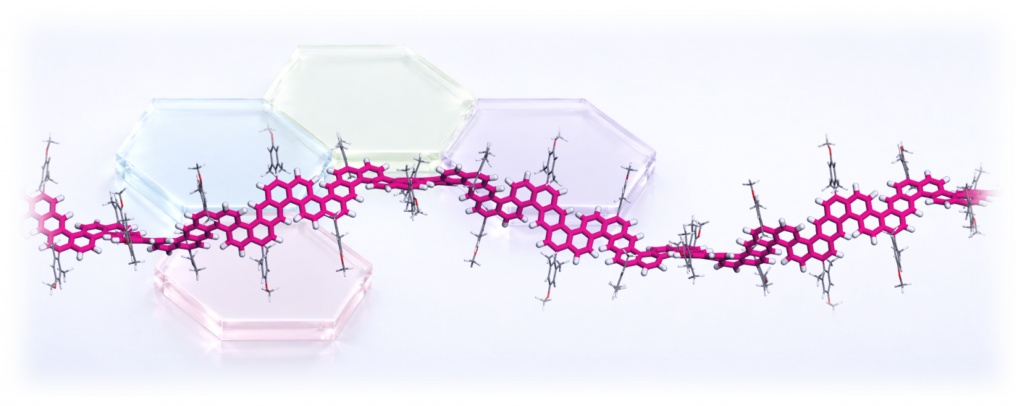
Researchers at Nagoya University have built a graphene nanoribbon that can switch which way it twists using a natural solvent. Graphene nanoribbons are thin ribbon-shaped structures made of fused carbon rings. Twisted or helical versions of these ribbons show promise for advanced light and electronic devices. However, no graphene nanoribbon could switch that twist on demand, until now. Scientists have worked out how to switch between a right-handed and left-handed twist (chirality) by changing the solvent around it.
The discovery, published in Nature Communications, opens opportunities for new optical switches, chemical sensors, and spintronic components that adapt to changing environments.
Tomoyuki Ikai, lead author and professor at Nagoya University’s Graduate School of Engineering, is a polymer chemist inspired by natural helical structures such as DNA and proteins. Polymers are large molecules built from many small, repeating units linked together in a chain. Ikai had been working on ladder polymers, where each repeating unit is locked into place and cannot freely rotate around the bond connecting to its neighbor (unlike a typical flexible linear polymer).
In 2019, Ikai and his collaborators built the first rigid, helix-shaped polymer. In 2021, they perfected a chemical method to fuse these building blocks together without flaws. This method is what let them build the new graphene nanoribbon.
“We used the same fusion approach already used to make predictable helical ladder polymers. But instead of a stable building block, such as [6]helicene, we used [4]helicene, a 4-ring unit written off as too unstable to be useful,” Ikai said.
Soak, twist, repeat
These units are difficult to control on their own because they switch their chirality too fast to hold one handedness. The team’s method fuses these small, restless units into one long chain. Once joined, they found that a neighbor effect took hold: each unit’s twist began to match its neighbors, and long stretches of the ribbon settled into a single, shared spiral.
To lock it in one overall direction, the researchers dissolved the ribbon in a natural chiral liquid, a liquid made of molecules that come in two mirror-image versions. They tested six candidates before they found the right one: beta-pinene, a compound found in pine trees and citrus peel.
Because beta-pinene molecules can be arranged in left- and right-hand mirror-images, these two versions each push the ribbon toward the opposite spiral. This also changed the twist direction of light the ribbon gave off, a property called circularly polarized luminescence, and is the first graphene nanoribbon shown to switch its light this way.
The switching induced a remarkably high degree of helical bias, with almost all of the helicene units aligning in the same direction. The switching effect is strongest at –90°C and grows weaker as the temperature rises toward room temperature.
“For a long time, people saw [4]helicene as unsuitable for chiral materials, because it could not be controlled,” Ikai said. “In this paper, we show that once you link enough of these units together, the instability itself becomes the useful part.”
A chiral solvent’s nudge toward one handedness is usually very weak on its own. Here, the ribbon’s own structure, with each unit mechanically linked to its neighbors, amplifies that weak nudge into a strong, nearly one-handed result.
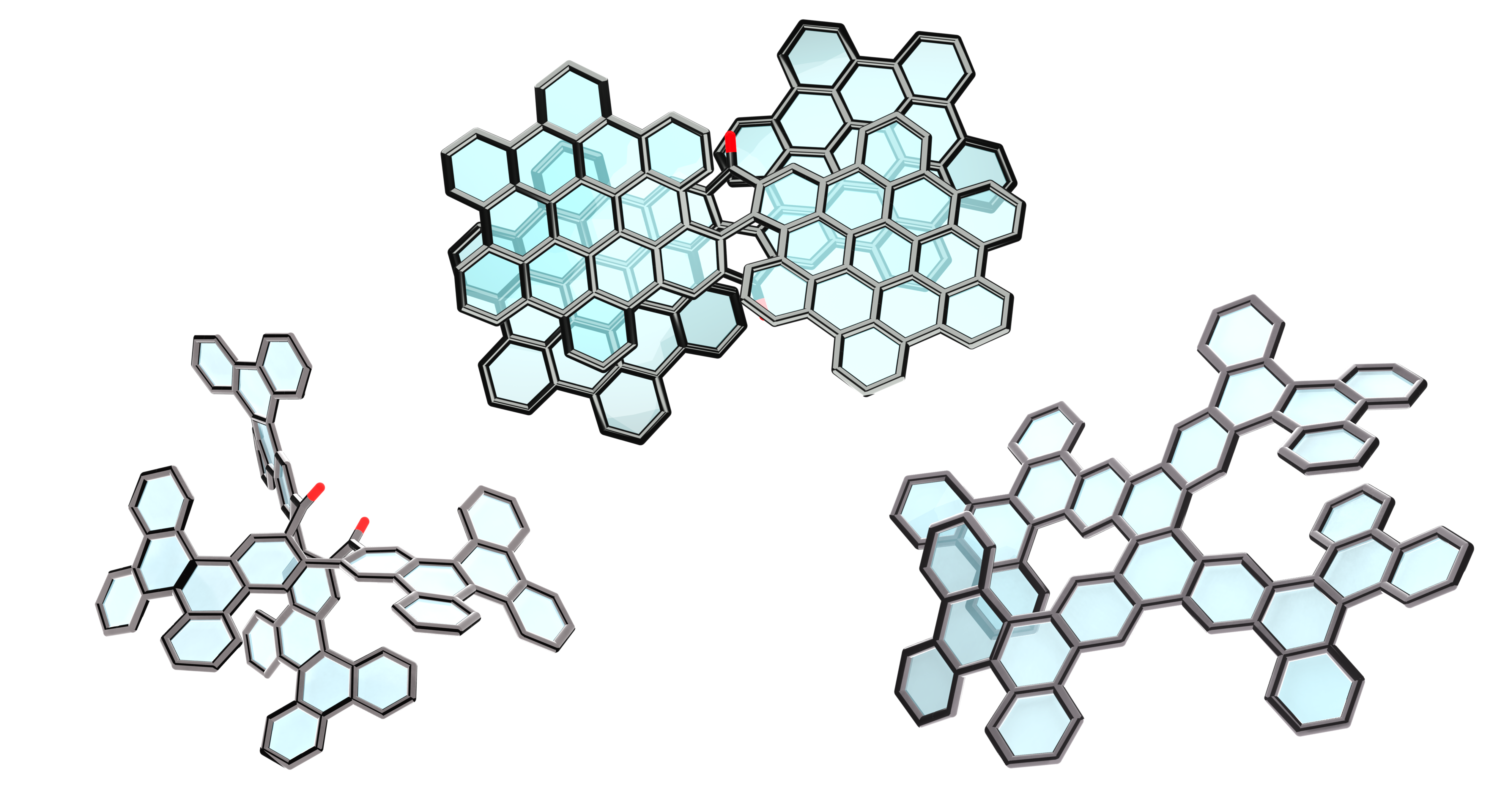
A side-by-side animation of the two possible spiral forms of the nanoribbon, one left-handed and one right-handed, mirror images of each other. Credit: Tomoyuki Ikai, Nagoya University
An adaptive material
The researchers point to several possible future uses: The switchable light could serve optical devices. The ribbon’s chemical sensitivity to beta-pinene suggests it may work as a chiral sensor, and a similar design could one day help detect hazardous or unstable chemicals. Because graphene conducts electricity well, the ribbon may also suit electronic sensors.
The molecule’s twisted shape connects to spintronics, a field that uses the spin of electrons rather than just their charge. Ikai noted that a right-handed or left-handed structure can, in principle, let electrons of one spin pass through more easily than the other, a property helical structures are known for in physics literature.
The current design only holds its twist while it stays in the chiral liquid. If the solvent is removed, the ribbon drifts back to a mixed, unstable state. Ikai’s next goal is a form of “chiral memory,” a way for the ribbon to lock in its twist even after the solvent is gone. This next step builds on memory techniques the researchers have explored in other helical systems and is now applied to graphene for the first time.
Publication information:
Tomoyuki Ikai, Hayato Inagaki, Kosuke Oki, Masaya Yoshida, Jenny Pirillo, Yuh Hijikata, and Eiji Yashima, 2026. Dynamic helical poly[4]helicene nanoribbon, Nature Communications. DOI: https://doi.org/10.1038/s41467-026-76724-9
Funding information:
This research was supported in part by JSPS KAKENHI Grant-in-Aid for Specially Promoted Research (18H05209), Grant-in-Aid for Transformative Research Areas (B) (25H01407), Grant-in-Aid for Scientific Research (B) (24K01537), Grant-in-Aid for Challenging Research (Exploratory) (23K17939), JST PRESTO (JPMJPR21A1), the Yushan Fellowship awarded by the Ministry of Education in Taiwan, the Yushan Fellow Distinguished Professorship at the National Tsing Hua University in Taiwan, Mitsubishi Foundation, and Toshiaki Ogasawara Memorial Foundation.
Expert contact:
Tomoyuki Ikai
Graduate School of Engineering
Nagoya University
E-mail: ikai@chembio.nagoya-u.ac.jp
Media contact:
Merle Naidoo
International Communications Office
Nagoya University
Email: icomm_research@t.mail.nagoya-u.ac.jp
Top image:
A 3D illustration of the [4]helicene nanoribbon shows the long chain of fused rings that gives the molecule its twisted structure. Credit: Tomoyuki Ikai, Nagoya University
Researchers
-
 IKAI TomoyukiGraduate School of Engineering, Molecular and Macromolecular Chemistry, 2
 -
YOSHIDA MasayaGraduate School of Engineering, Molecular and Macromolecular Chemistry, 2
-
PIRILLO JennyGraduate School of Engineering, Materials Chemistry, 2
-
HIJIKATA YuhInstitutes of Innovation for Future Society, Research Center for Net Zero Carbon Society