Scientists discover the brain circuit that keeps mice awake in unfamiliar environments, shedding light on why we often sleep badly on the first night in a new place.
You check into a hotel and toss and turn all night, but your sleep improves the following night. Scientists at Nagoya University wanted to understand why this happens. Working with mice, they have identified a group of neurons that become active when an animal enters a new environment. These neurons release a molecule called neurotensin that maintains wakefulness. The effect protects them from potential dangers in unknown surroundings. The study was published in Proceedings of National Academy of Sciences.
This discovery may explain the “first night effect” seen in humans. On the first night in a new place, the brain remains more vigilant, almost as if acting as a night guard. It keeps one eye open until it confirms the environment is safe. This response evolved to enhance survival. Although this sleep disturbance has been recognized for decades, the brain mechanism behind it had remained unclear.
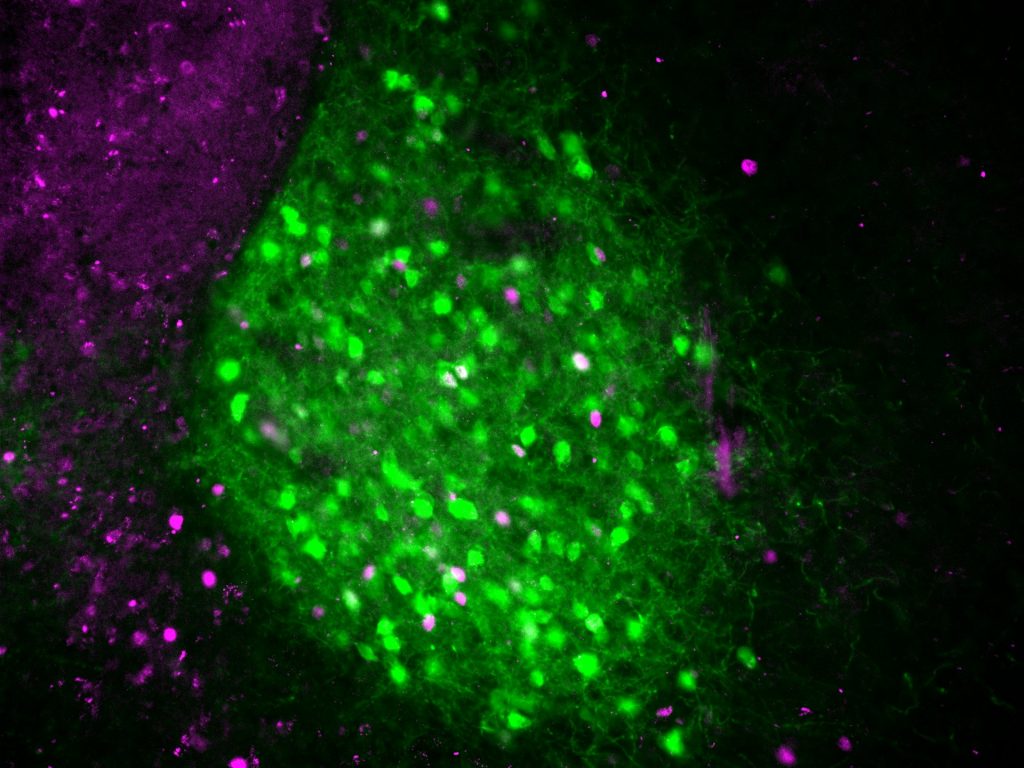
“The extended amygdala is a brain region that processes emotions and stress in mammals. Within this region, specific neurons called IPACL CRF neurons produce neurotensin and activate when sensing a new environment,” said Daisuke Ono, senior author and lecturer at Nagoya University’s Research Institute of Environmental Medicine. “Neurotensin then affects the substantia nigra, a brain area that controls movement and alertness.”
The researchers studied mice in new cages and recorded their brain activity. IPACL CRF neurons became highly active in their new environments.
When these neurons were artificially suppressed, the mice fell asleep quickly, even in new environments. When they were activated, the mice stayed awake longer. The team showed that IPACL CRF neurons use neurotensin to communicate with the substantia nigra.
Because the extended amygdala and substantia nigra exist in all mammals, researchers believe similar circuits likely operate in humans. The findings could lead to new treatments for insomnia and anxiety disorders. Many people with PTSD or chronic stress experience excessive nighttime alertness. Drugs that target this neurotensin pathway could help them sleep.
Paper Information:
Chi Jung Hung, Shuhei Ueda, Sheikh Mizanur Rahaman, Mikiyasu Yamamoto, Jiahui Li, Noriaki Fukatsu, Haruhiko Bito, Hiroshi Yamaguchi, Akihiro Yamanaka, Sayaka Takemoto-Kimura, and Daisuke Ono (2026). Neurotensin in the extended amygdala maintains wakefulness in novel environments, Proceedings of the National Academy of Sciences (PNAS). https://doi.org/10.1073/pnas.2521268123
Funding information:
This work was supported by the Uehara Memorial Foundation, Kowa Life Science Foundation, Takeda Science Foundation, Kato Memorial Bioscience Foundation, DAIKO FOUNDATION, SECOM Science and Technology Foundation, The Inamori Foundation, HIROSE Foundation, LOTTE Foundation, JST FOREST Program (Grant Number JPMJFR211A, Japan), and JSPS KAKENHI (Grant Numbers JP22KF0166, JP22K06483, 23H04939, 24H02006, JP22H04922 (AdAMS), 25H00437, JP24K02060, and 25H02445).
Expert Contact:
Daisuke Ono
Research Institute of Environmental Medicine
Nagoya University
Email: dai-ono@riem.nagoya-u.ac.jp
Media contact:
Merle Naidoo
International Communications Office
Nagoya University
Email: icomm_research@t.mail.nagoya-u.ac.jp
Top image:
IPACL CRF neurons (green) activate when mice encounter new environments and release neurotensin to maintain alertness. This brain circuit may explain the “first night effect” in humans. Credit: Hung et al., 2026