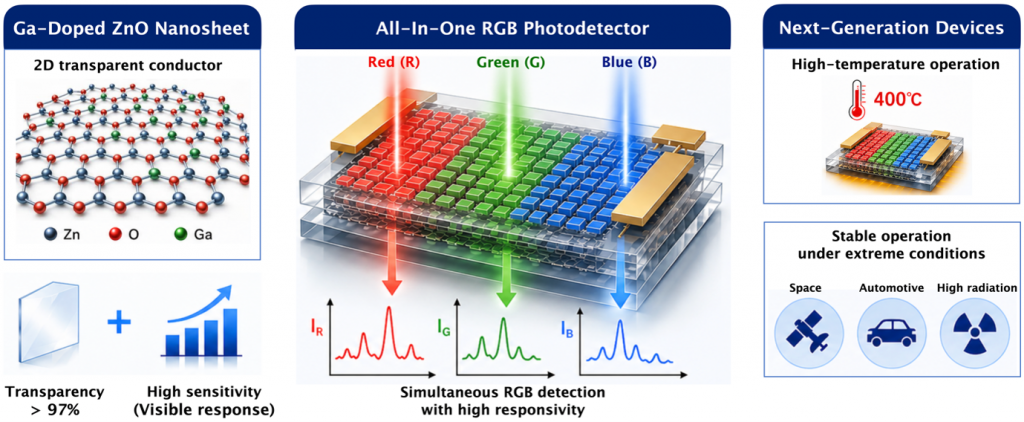
Gallium-doped zinc oxide nanosheets enable a single pixel to detect red, green and blue light.
Researchers at Nagoya University in Japan have developed gallium-doped zinc oxide (GZO) nanosheets that may enhance camera resolution in compact devices, including smartphones and medical endoscopes.
These nanosheets enable a single pixel to detect the intensity of red, green, and blue (RGB) light while remaining nearly transparent, unlike conventional sensors. They are ultrathin, lightweight, and can withstand temperatures up to 400 degrees Celsius, making them suitable for extreme environments such as space hardware and automotive systems. The findings were published in the journal ACS Nano.
Why a single pixel matters
Most commercial cameras use a Bayer array, arranging RGB color filters in a checkerboard pattern across millions of pixels. Since each pixel senses only one color, full-color images are reconstructed from neighboring pixels. If a single pixel could detect all three colors, the total pixel count could be cut by up to 75%, thereby shrinking the sensor while maintaining image resolution.
Transparent nanosheets are ideal for this approach because they allow light to pass through, enabling multiple layers to be stacked vertically, with each layer detecting a different color. Nanosheet sensors also eliminate the complex semiconductor processes required by conventional RGB sensors, simplifying production and reducing costs.
Improving the nanosheets’ weak point
A research team led by Professor Minoru Osada, along with researchers Ruben Canton-Vitoria, and Vivid Meelab at Nagoya University’s Institute of Materials and Systems for Sustainability focused on zinc oxide nanosheets, which are highly transparent and chemically stable. However, their initial experiments revealed that these nanosheets responded weakly to visible light, limiting their suitability for camera sensors.
To address this limitation, the team customized the electronic structure of zinc oxide by adding gallium, creating trap states that capture electrons and convert light into electrical signals. This modification enabled the nanosheets to respond strongly to visible light while maintaining their transparency.
Outperforming commercial sensors
Analysis showed that gallium-doped zinc oxide nanosheets convert only 0.005% of absorbed light energy into photocurrent, while each layer transmits 99.995% of visible light.
Despite minimal energy use, the modified nanosheets achieved a sensitivity of 800 amperes per watt (A/W), far exceeding the typical 10 A/W of commercial sensors. The trap states enable a strong response to small amounts of absorbed light, while most light passes through to subsequent layers.
This property enables color-selective stacking. The team developed an ultrathin sensor where the first GZO layer uses photoactive trap states to detect the full visible spectrum. After filtering out red light, a second GZO layer detects the green and blue components. A final green-cut filter isolates the last layer for blue detection. Experiments confirmed that the device successfully reproduces full-color images with half the error of conventional cameras.
“This optical sensor closely resembles how the human retina discriminates RGB colors,” said lead author Osada. “The brain reconstructs color by combining the responses of three types of visual cells, each sensitive to different wavelengths.”
Future perspectives
In addition to strong optical performance, the device maintained a stable light response up to 400 degrees Celsius in air and consistent performance in both vacuum and humid conditions. These thermal and chemical properties make it suitable for demanding environments, including space hardware and automotive systems.
The sensor can also be manufactured using a room-temperature solution process, eliminating the need for high-temperature processing and complex microfabrication required by conventional sensors.
By integrating multiple light-detection functions into a single device, the team has demonstrated a path toward smaller, more integrated, and higher-performing optoelectronic devices at lower cost than current cameras.
Paper information:
Vivid Meelab, Ruben Canton-Vitoria, Mohammad Furqan, Yoshinori Morita, Shu Morita, Eisuke Yamamoto, Makoto Kobayashi, Raul Arenal, and Minoru Osada (2026). Highly Transparent Gallium-Doped Zinc Oxide Nanosheets Enabling Stable All-in-One Red-Green-Blue Photodetectors with High Responsivity, ACS Nano, DOI: 10.1021/acsnano.6c04352.
Expert contact:
Ruben Canton-Vitoria
Institute of Materials and Systems for Sustainability, Nagoya University
Email: rcanton@imass.nagoya-u.ac.jp
Minoru Osada
Institute of Materials and Systems for Sustainability, Nagoya University
Email: mosada@imass.nagoya-u.ac.jp
Media contact:
Naomi Inoue
International Communications Office, Nagoya University
Email: icomm_research@t.mail.nagoya-u.ac.jp
Top image:
Gallium-doped ZnO (GZO) nanosheets combine >97% optical transparency with strong visible-light photoresponse, enabling an all-in-one RGB photodetector that simultaneously resolves red, green, and blue signals within a single pixel. The stacked devices retain stable operation up to 400 °C, making them promising for next-generation image sensors used in space, automotive, and high-radiation environments.
(Credit: Minoru Osada & Ruben Canton-Vitoria)