Nagoya University researchers have identified ways in which low-frequency noise in our environment coming from sources such as ACs and water pumps can trigger blood vessel damage to kidneys in mice.
Close your eyes and just listen for a few seconds. No matter where you are, countless low and deep rumblings are feeding into your ear, coming from AC units, elevator motors, distant traffic, and ventilation ducts.
These rumbles form low-frequency noise below 100 hertz, about the same pitch as a kick drum. Almost all its sources are human made. So they’re a relatively new environmental effect; Living things weren’t meant to be immersed in this kind of noise.
Previous studies have hinted that people who are surrounded with more environmental noise tend to have worse kidney function. But these studies could not point out which part of the noise was to blame, or the specific ways in which it might affect kidneys.
Now, a team led by Takumi Kagawa and Masashi Kato at the Department of Occupational and Environmental Health, Nagoya University Graduate School of Medicine have provided the first direct experimental evidence that the low-frequency component of environmental noise is the culprit for adverse kidney health in mice. Their findings were published in the journal Environmental Science & Technology.
Pitch matters more than volume
Kagawa and Kato first started by recording real noise from two ordinary household machines: the outdoor unit of an air conditioner and a heat pump water heater. Using audio software, they then split each recording in two: a low-frequency version containing only sounds at or below 100 hertz, and a high-frequency version containing everything above it.
Mice were played these sounds for 12 hours a day over five days, during nighttime when they are naturally active. The researchers then measured two standard markers of kidney health in the animals’ blood, creatinine and urea nitrogen, which build up when the kidneys stop filtering waste efficiently.
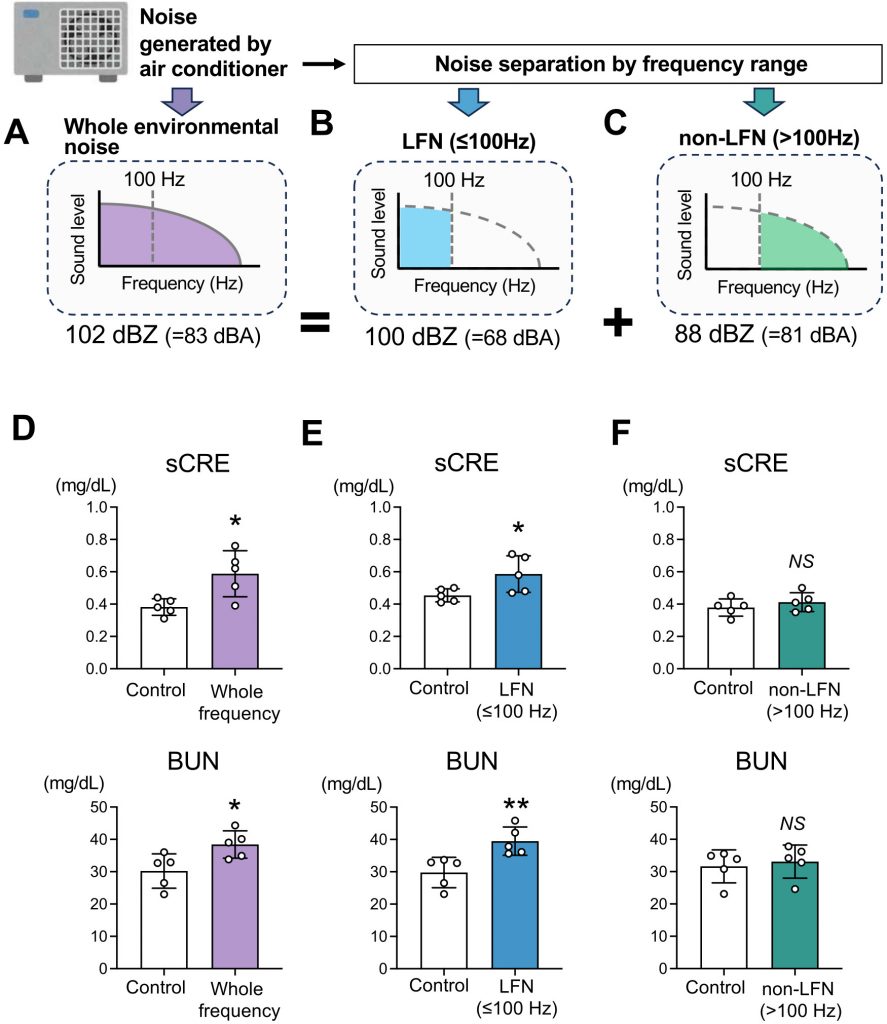
Playing the unedited environmental noise symphony containing all frequencies pushed both markers up, signifying kidney damage. But when only the high-frequency noise was played, nothing happened. This meant the lower frequencies were responsible for pushing up the creatinine and urea nitrogen levels, as the researchers soon verified.
“The biggest surprise to me was that the low-frequency component caused kidney dysfunction even though it was below the hearing range of mice,” Kagawa said. “In contrast, the higher-frequency component did not cause kidney dysfunction, even when both had the same physical sound pressure level,” he added, implying that the frequency of noise mattered more than its loudness.
Squeezed blood vessels
To find out the modus operandi, the researchers looked inside the kidneys. Kidneys clean the blood using a vast network of glomeruli—tiny knots of blood vessels that act as the organ’s filters. In the exposed mice, these filters were swollen and their delicate filtering membranes had thickened.
Additionally, the damaged kidneys were producing more endothelin-1, a molecule that can bind to receptors to clamp down blood vessels. Under normal conditions, endothelin-1 helps regulate blood flow. But researchers suspected that low-frequency noise can push it into overdrive, causing constricted renal blood vessels
To test this idea, the researchers gave a second group of mice ambrisentan, a drug already prescribed to human patients to treat hypertension, which blocks endothelin’s effects. The treated animals kept their kidney markers closer to normal and showed much less damage to their glomeruli, confirming endothelin signaling as a key pathway.
Because this study was conducted in mice, its relevance to humans remains unknown. However, “our findings highlight the importance of considering low-frequency noise, which has often been overlooked, in future human studies on environmental noise,” Kato said.
A double-edged sword
The result is also intriguing because the same researchers have also found some beneficial effects of low-frequency sound, such as reducing motion sickness and blood flow in skin blood vessels.
This suggests that “the biological effects of low-frequency sound depend on its frequency, sound level, and duration of exposure,” Kato said. “Moving forward, we hope to investigate both the beneficial and adverse effects of low-frequency sound and scientifically clarify which exposure conditions are harmful and which promote health.”
Publication Information:
Takumi Kagawa, Dijie Chen, Nobutaka Ohgami, Keming Tong, Yanjun Gao, Naruhito Iwasaki, Akihito Harusato, Toyonori Tsuzuki, Takumi Hayashi, Yuuki Shimizu, Toyoaki Murohara, and Masashi Kato, 2026. Glomerular Injury Induced by Daily Exposure to the Low-Frequency Component of Environmental Noise via Endothelin Signaling in Mice, Environmental Science & Technology. DOI: https://doi.org/10.1021/acs.est.5c12555
Funding Information:
This work was supported partly by Grants-in-Aids for Scientific Research (B) (22K11731, 23H03147, 25K02875, and 23K27837), Challenging Research (Exploratory) (25K22731, 25K22732, 25K22741), Young Research (24K19748, 26K20515), and Fund for the Promotion of Joint International Research (22KK0145) from the Ministry of Education, Culture, Sports, Science and Technology (MEXT), Grant-in Aid for JSPS Research Fellow (22J22680 and 22KJ1602) from Japan Society for the Promotion of Science, Frontier Next-Generation Researcher Program of the Tokai Higher Education and Research System (JPMJSP2125) from JST SPRING and JKA and its promotion funds from KEIRIN RACE (2023M-407). The funders had no role in the study design, data collection and analysis, decision to publish, or manuscript preparation.
Expert contact:
Masashi Kato
Department of Occupational and Environmental Health,
Nagoya University
Email: kato.masashi.r6@f.mail.nagoya-u.ac.jp
Media contact:
Sumeet Kulkarni
International Communications Office
Nagoya University
Email: icomm_research@t.mail.nagoya-u.ac.jp
Top Image:
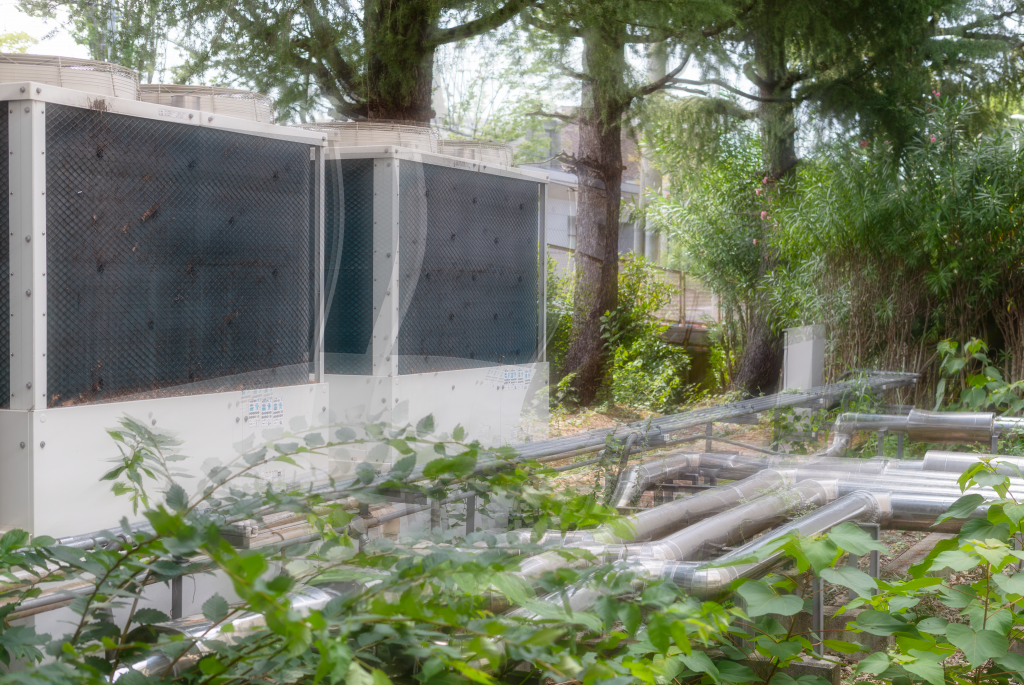
Visual representation of low-frequency environmental noise coming from climate control systems. Credit: Sumeet Kulkarni, Nagoya University.
Researchers
Related organizations
Related tags
- Department of Occupational and Environmental Health
- Environmental health
- Kidney Health
- Medicine, Dentistry, and Pharmacy
- Sound pollution