A new international study, led by Lund University in Sweden and Nagoya University in Japan, shows that changes associated with Alzheimer’s disease may affect how rapidly ALS progresses. In time, the findings may contribute to more reliable individual prognoses and better-designed clinical trials.
This press release was prepared by Lund University and published here with their kind permission.
Amyotrophic lateral sclerosis (ALS) is a serious neurodegenerative disease in which the nerve cells that control the body’s muscles break down. The course of the disease varies greatly. While some patients deteriorate rapidly, others live considerably longer with the disease. This makes it difficult to assess at an early stage how the disease will progress. Coexisting pathological changes in the brain are known to occur in ALS, but their association with disease progression has remained unclear. In this collaboration between Sweden, Japan and Italy, the researchers investigated how Alzheimer-related changes affect prognosis in ALS.
“Lund University conducts leading research into Alzheimer’s disease, while Nagoya University has a strong ALS research programme. As I am a doctoral student at both universities, the idea arose to bring the two fields of research together in this study,” says Kazuki Obara, who is also a neurologist in Japan.
To investigate whether and how coexisting Alzheimer-related changes in the brain affect the course of ALS, the researchers analysed levels of amyloid beta in cerebrospinal fluid in Japanese patient cohorts. Amyloid beta is used as a biomarker of changes associated with Alzheimer’s disease. A total of 264 patients with ALS were included, 60% of whom were men and 40% women, with a mean age of 67 years. The control group consisted of 164 patients with other neurological diseases.
“We found that around 14% of the patients with ALS showed signs of changes that also occur in Alzheimer’s disease,” Kazuki Obara continues.
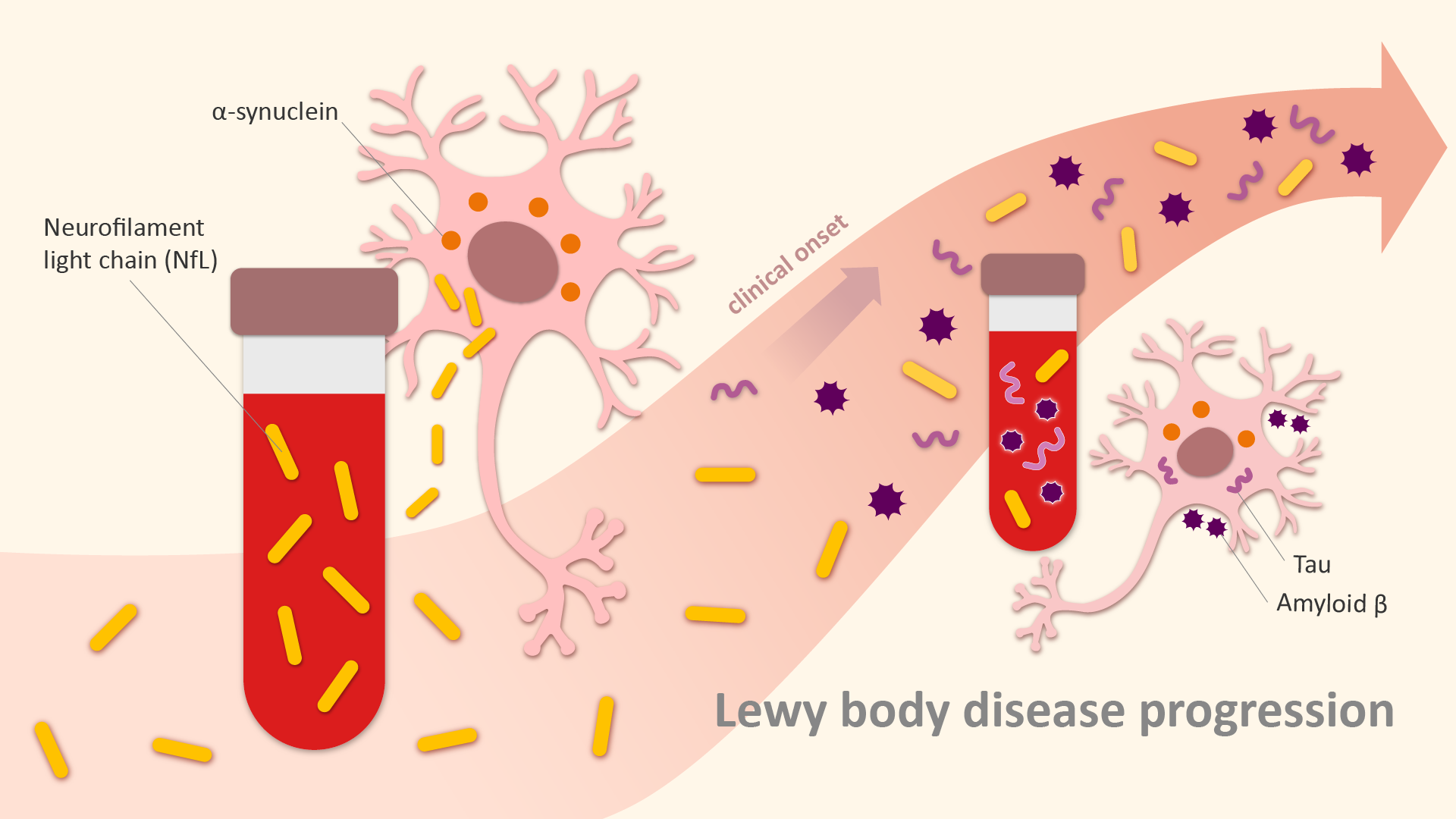
The researchers also studied NfL (neurofilament light chain), a biomarker with applications that include measuring nerve cell damage in ALS. The findings showed that the presence of amyloid beta-related changes modified the association between NfL and disease progression. In the amyloid beta-positive group, the association between high NfL levels and shorter survival was stronger than in the amyloid beta-negative group. The findings were supported by additional data from 153 patients with ALS in Bologna, Italy. The researchers also observed an interaction between amyloid beta and NfL with regard to decline in everyday physical function over time.
“The findings suggest that the same NfL level may have different prognostic significance depending on what other changes are present in the brain. One possible explanation is that several disease processes together make the nervous system more vulnerable, but the underlying mechanisms have not yet been established,” says Niklas Mattsson-Carlgren, a researcher at Lund University and consultant neurologist at Skåne University Hospital.
Improved identification of ALS
The researchers also tested machine-learning models that combined NfL with other biomarkers, including amyloid beta. The models improved the identification of ALS, including in people whose NfL values fell within a grey area. In time, NfL could be used in an initial assessment. If the result is unclear, the analysis could be supplemented with additional biomarkers and a more detailed clinical examination.
The aim is to provide doctors with a better basis both for diagnosing ALS and for assessing the course of the disease, so that they can discuss what to expect with patients and their families.
“A more detailed prognosis may also be valuable in clinical trials. If participants with very different expected disease courses are included in the same study, it becomes more difficult to determine whether a treatment has an effect. Biomarkers may therefore contribute to better patient stratification and more efficient studies of new treatments,” says Niklas Mattsson-Carlgren.
The study is based on observational data, and the findings cannot yet be used as a basis for clinical decisions. The methods also need to be confirmed in further independent patient groups. The researchers are now proceeding to investigate whether biomarkers linked to other neurodegenerative diseases, such as Parkinson’s disease, may also affect prognosis in ALS.
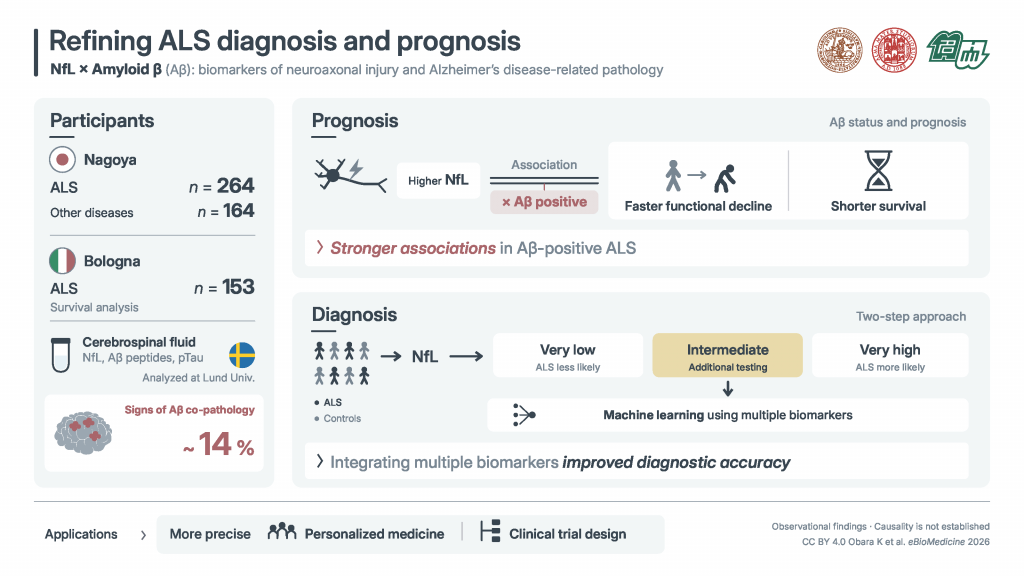
CSF biomarkers were analysed in 264 patients with ALS and 164 disease controls (Nagoya, Japan), with an independent ALS cohort from Bologna, Italy (n = 153). 14% of ALS patients were amyloid-β positive by CSF Aβ42/40, a rate similar to disease controls. In Aβ-positive ALS, high NfL was more strongly associated with faster functional decline and shorter survival. Machine learning models combining NfL with Aβ peptides, pTau and markers of muscle damage outperformed NfL alone and supported classification of patients with intermediate NfL values. In a two-step approach, NfL is used first, and multi-biomarker assessment is applied only to patients with intermediate NfL values. Aβ, amyloid-β; ALS, amyotrophic lateral sclerosis; CSF, cerebrospinal fluid; NfL, neurofilament light chain; pTau, phosphorylated tau. (CC BY, Obara K. 2026).
The study was conducted as part of the joint PhD program between Lund University and Nagoya University in Japan, which enables doctoral students to carry out research at both universities.
Publication
Kazuki Obara, Shorena Janelidze, Daisuke Ito, Linda Karlsson, Munetaka Yamamoto, Andrea Mastrangelo, Sinh Tran, Koyo Tsujikawa, Yosuke Nishio, Tomoo Ogi, Veria Vacchiano, Rocco Liguori, Ryoichi Nakamura, Naoki Atsuta, Gen Sobue, Christer Nilsson, Piero Parchi, Masahisa Katsuno, Niklas Mattsson-Carlgren, 2026. Cerebrospinal fluid amyloid and neurodegeneration biomarkers in the diagnosis and prognosis of amyotrophic lateral sclerosis: a multicohort observational study. eBioMedicine. DOI: https://doi.org/10.1016/j.ebiom.2026.106511
Expert contact
Kazuki Obara
Graduate School of Medicine
Nagoya University
Clinical Memory Research Unit, Department of Clinical Sciences Malmö
Lund University
kazuki.obara@med.lu.se
Masahisa Katsuno
Graduate School of Medicine
Nagoya University
katsuno.masahisa.i1@f.mail.nagoya-u.ac.jp
Top image
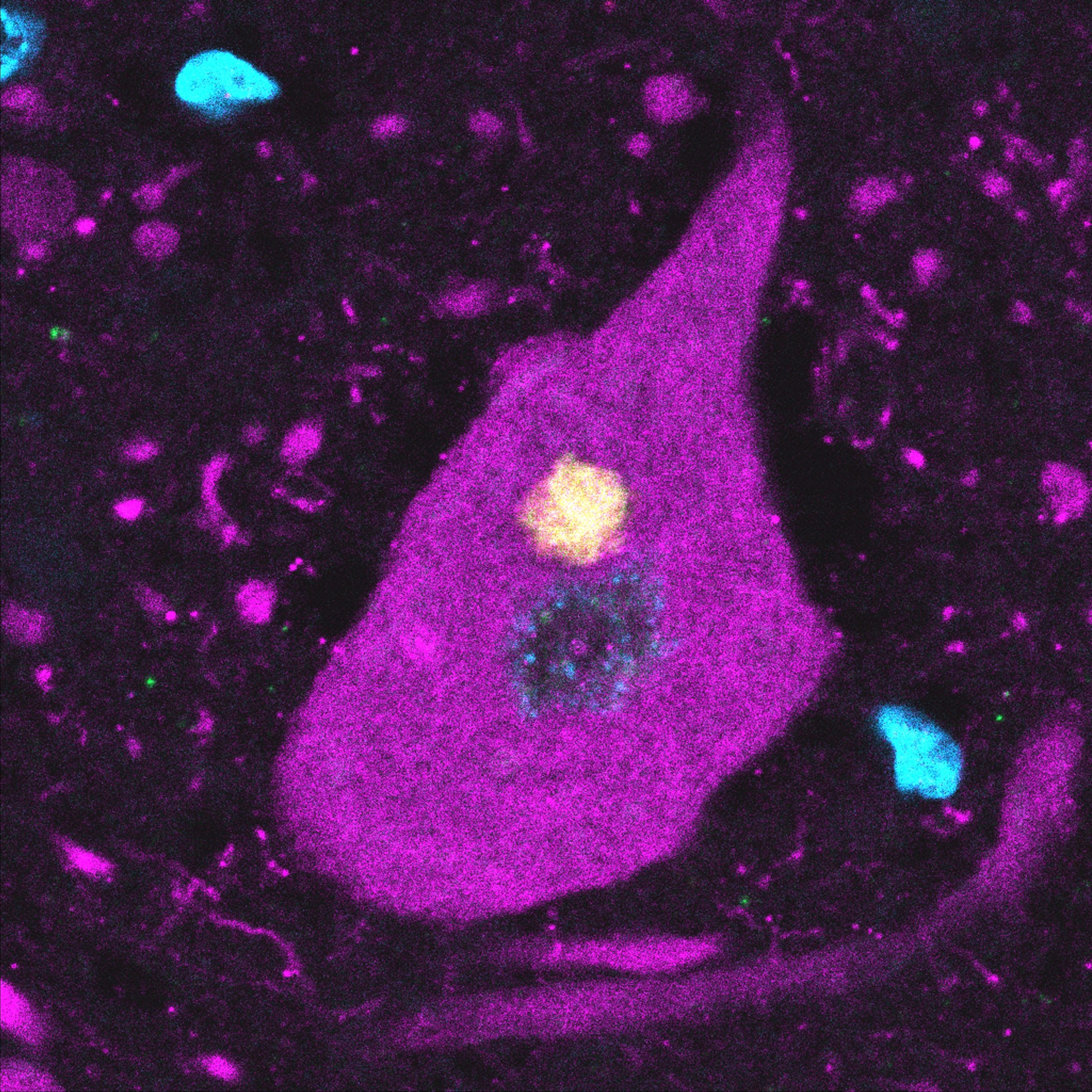
In ALS, the nerve cells that control the body’s muscles degenerate. Image by Getty Images on Unsplash
Researchers
Related organizations
Related tags
- ALS
- Alzheimer's disease
- Amyloid beta
- Amyotrophic lateral sclerosis
- Medicine, Dentistry, and Pharmacy
- Neurology