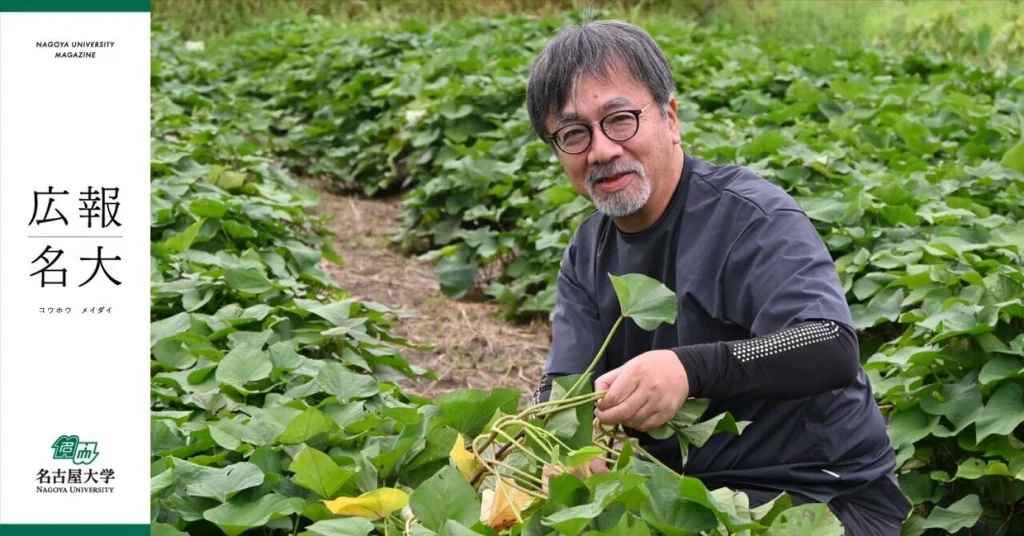
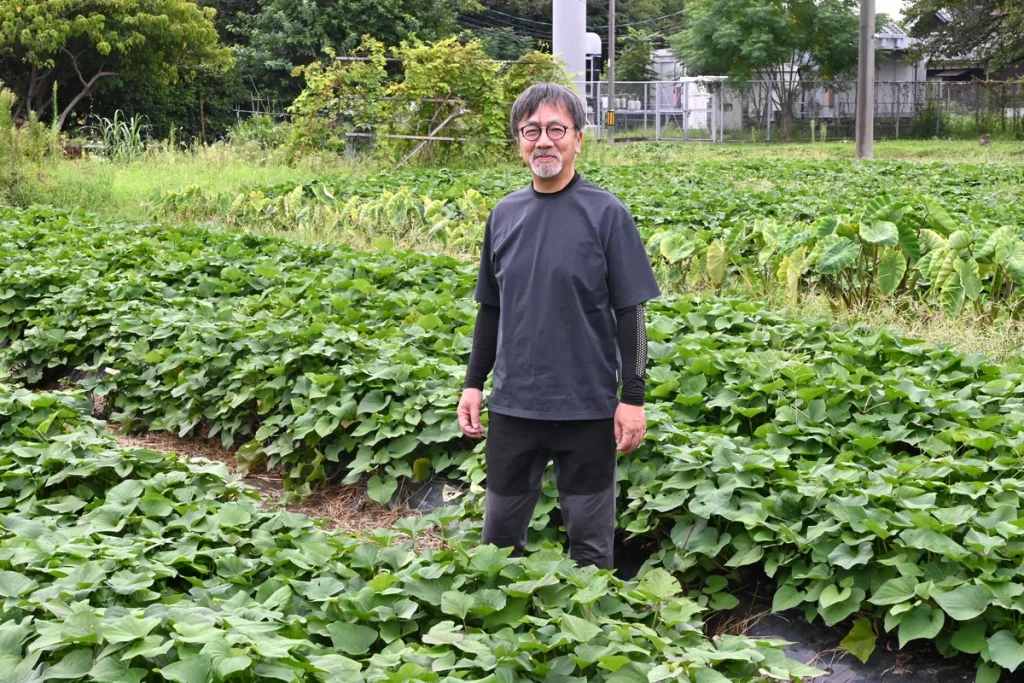
Akinori Nakamura walks through his field of sweet potatoes, surrounded by a profusion of bright green leaves. The potatoes are ready for harvest. Nakamura says, “I knew that if I wanted to work in agriculture, I would have to start while I still have the strength for it.”
Nakamura has a colorful employment history. After graduating from the School of Law at Nagoya University, he found work in recruitment support at a large HR tech company. He then held a variety of jobs at universities, in both administrative and teaching roles. Now he earns his living through farming. How does a law graduate end up as a farmer? In this article, we trace the thread running through Nakamura’s seemingly nonlinear career.
Proactive undergraduate days at Nagoya University
After graduating from a high school in Aichi Prefecture, Nakamura entered the School of Law at Nagoya University where he led a highly proactive undergraduate life. Notably, he spent his first two years on the committee for the annual Nagoya University Festival, dedicating much of his time to the role. Through the committee, he became friends with people in different departments and years of study. These friends had a big impact on his life. Nakamura tells us that he is still in contact with many of them today.
Nakamura also kept busy as a tour leader for ski trips and worked on publishing his own zine. His zine garnered attention from the media, and as a result, he landed a part-time job at a company that makes television and radio programs. In his job as an assistant director, he became fascinated with the issue of how to convey the specific charm of people and organizations, and how to make a topic interesting to as many people as possible. This job may have sowed the seeds for his subsequent career path.
When Nakamura started applying for jobs, his goal was to work at a major advertising agency, but an acquaintance encouraged him to visit Recruit Co., Ltd. and, drawn to its unique corporate culture, Nakamura joined the company as a new graduate hire.
From recruitment to the world of education
At Recruit, Nakamura supported corporate recruitment and served as the editor-in-chief of the regional edition of the job information magazine “Toraba-yu.” He spent 15 years in a fulfilling role at the forefront of recruitment support and information dissemination but began to question if the intensity of the work was suited to his lifestyle. Shifting circumstances at home also made him wonder if he should look for another job.
Around that time, Nakamura learned from an acquaintance that Japanese universities were struggling to recruit students due to the shrinking domestic population. Seeing an opportunity to utilize the skills he had acquired at Recruit, he took an admin job at a private university in Aichi Prefecture. However, soon after starting his new position, he realized that he wanted to do more to support each student and decided to become a faculty member. He joined academic societies, wrote papers, and started work on books. He was then hired at another university in a dual position, teaching at the Faculty of Business Administration while serving as the director of its career center. This marked the beginning of his career as an educator.
Giving back to his alma mater, Nagoya University, with experience accumulated at companies and educational institutions
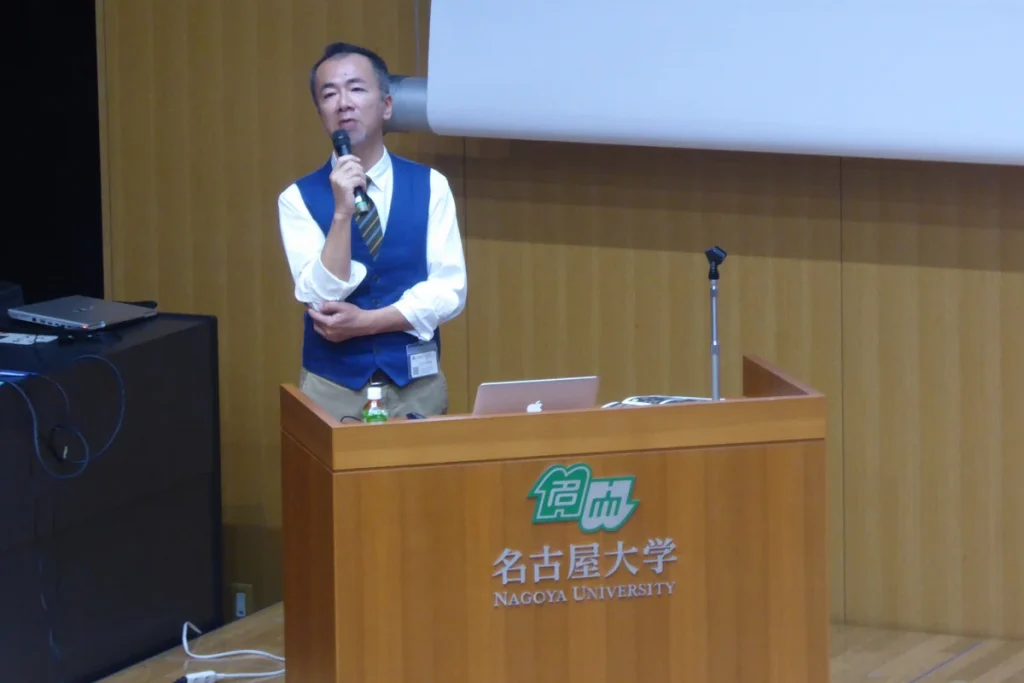
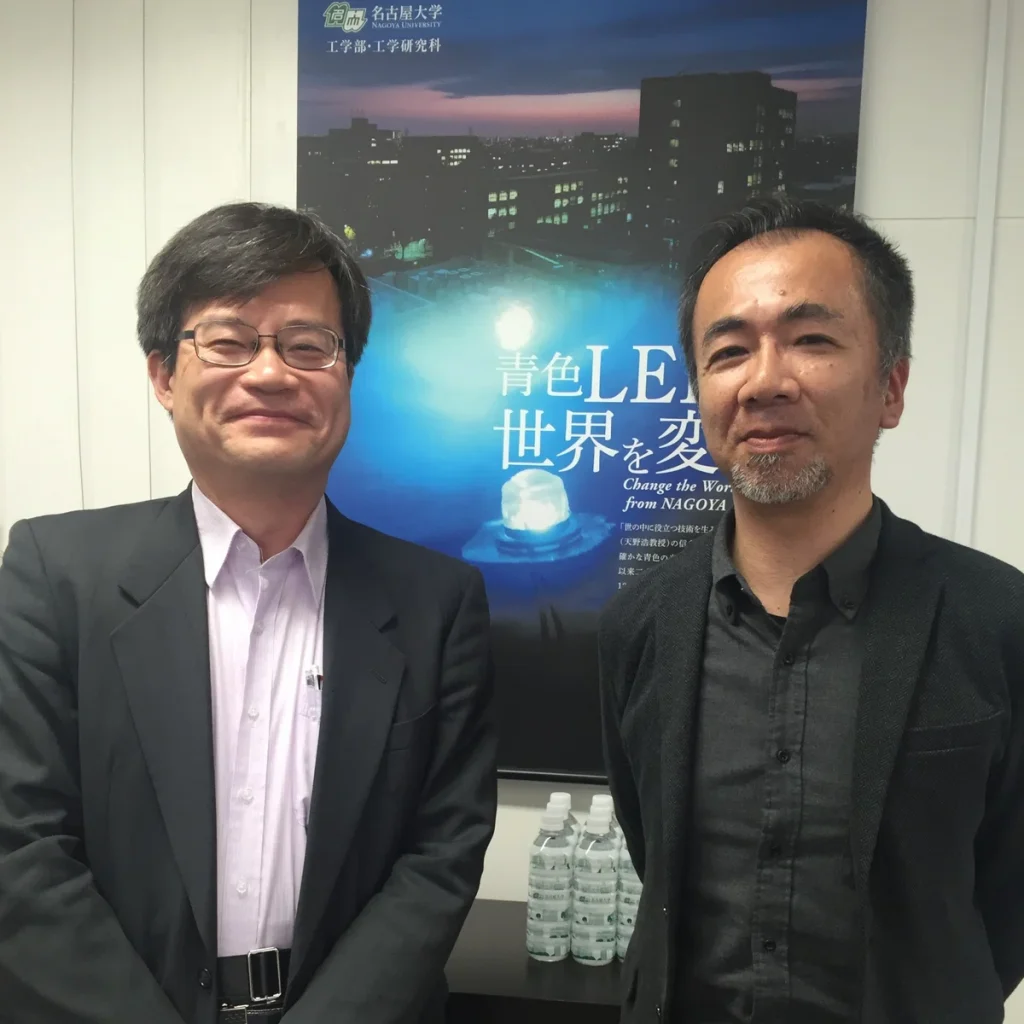
By this time, Nakamura had accumulated a range of experiences across corporate work, university admin, and teaching, and he found an opportunity to put this wealth of experience to use when the Graduate School of Engineering at his alma matter – Nagoya University – scouted him for a new position. They were after someone who could develop “methods and practices to invigorate communication between the university and society.” It was a niche job within the Graduate School of Engineering that required translating and disseminating research results to businesses and prospective students. After taking up his joint position as Associate Professor and Head of the Communication Design Office, Nakamura first set about revising the university’s strategies for prospective student outreach.
His arrival on the job coincided with a shift in the information world: prospective students were moving away from paper-based sources of information and depending increasingly on the internet to learn about universities. Nakamura took to revamping and expanding the Graduate School website, and set up an institutional LINE account; this was, at the time, a novel move for a graduate school at a national university. “In that position, everything I had learned in my corporate career and my work in university admin seemed to come together.” Nakamura recalls the joy of being able to give back to his alma mater while striving to create new points of contact between Nagoya University and society, and with prospective students.
A life-changing encounter with abandoned farmland
Just when Nakamura’s projects at Nagoya University were starting to take off, his previous university offered him a job as vice president, which he chose to take up. In his new post, he oversaw various projects such as the reform of entrance examinations, career support, and regional cooperation initiatives. Through the latter, he learned about the major issue of abandoned farmland. It is said that approximately 10% of all farmland across Japan has been abandoned. In Nakamura’s hometown of Konan the situation is even more dire, with that figure exceeding 30%. Feeling a sense of urgency that so much farmland was going unused, Nakamura thought about what could be done to tackle the issue. While looking into the problem, he came across the concept of “sixth industrialization,” which describes a means of food production whereby the same party handles all stages of production, processing, and sales of food.
It was around this time that Nakamura made the major decision to start working in agriculture. He told himself, “It will be too late after I retire. If I’m going to do it, it has to be now.” With his heart set on his new goal, he took early retirement from the university.
Growing and selling sweet potatoes through the sixth industrialization concept
After retiring from his university post, Nakamura launched a business called “NEXT food LABO.” His goal was to create a business model that could generate 1 million yen in annual revenue per every 1,000m² of land. The idea was to create a mode of work that other people might be able to implement, creating a new kind of side business for the senior generation. He rented 1,000m² of abandoned farmland in Konan, and started out by preparing the soil. Then, with cooperation from local farmers, he began growing sweet potatoes, which are said to be an easy crop for beginners. However, Nakamura’s work did not end there. Aiming to implement the concept of sixth industrialization, he collaborated with a local pastry chef to develop an original sweet potato snack, “premium amaimo.” The sweet potatoes were grown without pesticides or chemical fertilizers, and the final product is gluten-free and contains no additives. The product’s selling point is that it capitalizes on the natural flavor and sweetness of the potatoes.
In 2025, he won the grand prize at the nationwide food competition “FOOD SHIFT Selection 2025,” hosted by the Ministry of Agriculture, Forestry and Fisheries. As he was the only person to become a grand prize winner in the three Tokai prefectures, his efforts drew widespread attention, giving him the opportunity to make a courtesy visit to Aichi Governor Hideaki Omura.

Nakamura’s next goal lies in encouraging others to implement his business model
Nakamura has his sights set on a bigger goal than the success of his own farm: his aim is to create a business model that combines the concept of sixth industrialization with the recultivation of abandoned farmland. Having already hit his profit target for this year, Nakamura’s next task is to spread awareness regarding his business model.
When asked for a final message to students, Nakamura gave an unexpected response. “I think every student should think about studying abroad. I spent time abroad after I started working, and it made me realize the importance of seeing Japan from a different perspective.” Nakamura explains that there is much to be learned from living abroad that cannot be gained by simply visiting a foreign country, and that living elsewhere can force you to reevaluate your most basic assumptions. These words hold a special significance considering Nakamura’s ever-zealous pursuit of new opportunities, as illustrated by his eclectic career history. His drive to take on new challenges continues to propel him in his new line of work out in the fields.
Originally published in Japanese on September 25, 2026.