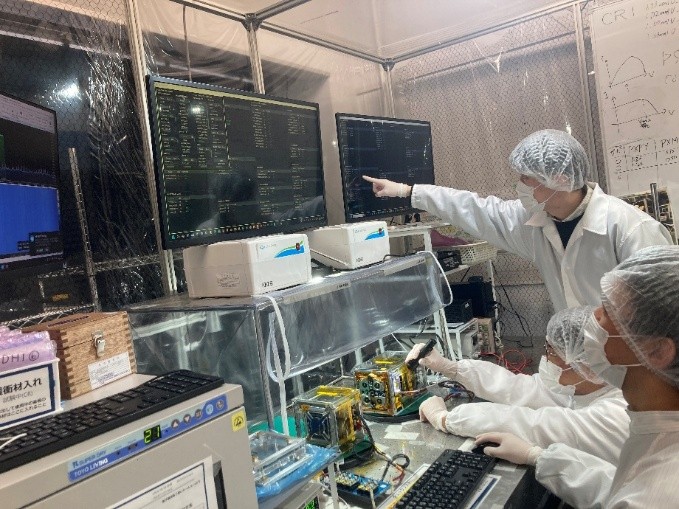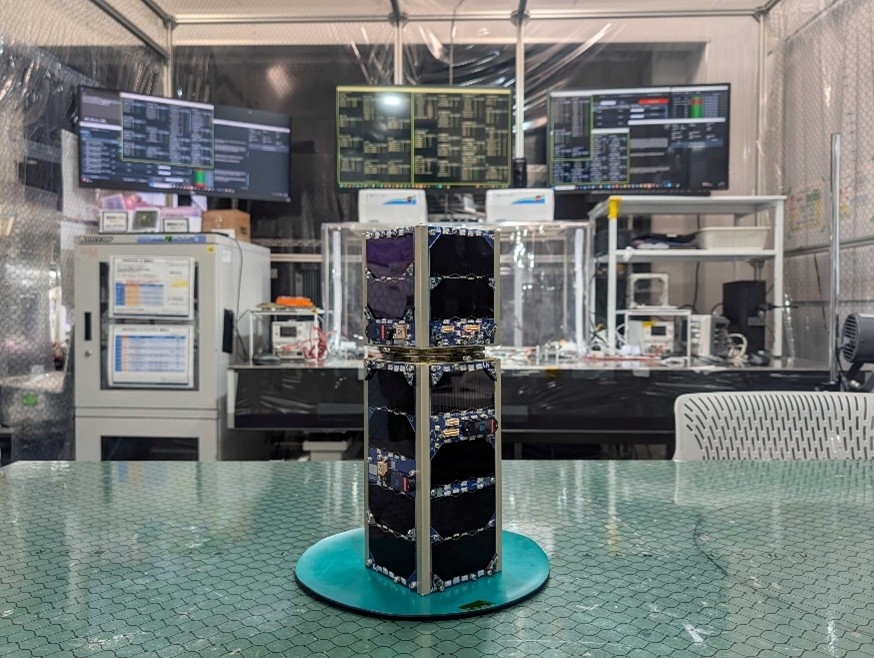
At 12:09pm on April 23 (JST), MAGNARO-II — a satellite developed at Nagoya University — was launched into space from New Zealand aboard the Electron Rocket. MAGNARO-II was developed by Associate Professor Takaya Inamori and a team of students at the Graduate School of Engineering.
The satellite was designed to divide into two parts after reaching orbit. Inamori’s team are testing whether the divided satellite can orbit in formation without the use of fuel or an orbit control system; instead, MAGNARO-II will leverage the forces that act upon it, such as Earth’s magnetic field. Omitting an orbit control system freed up space for the team to install other components on the satellite, such as communication devices and a telescope. As the satellite is not dependent on an exhaustible reserve of fuel, the two parts are expected to maintain formation in orbit for longer compared to previous models.
The satellite only passes over Japan around four times a day, and so opportunities for communication are limited. To make the most of these opportunities, the satellite has been programmed to send out messages in Morse code which are easier to detect when the satellite is close to the horizon.
Ahead of the launch, the students said that they were excited to hear the satellite’s first beep. Associate Professor Inamori commented, “I worked hard with the students on this project, so I hope it’s a success.”
The project is supported by a JAXA Space Strategy Fund. Insights garnered through this research are expected to contribute to the advancement of space communication systems.