Two years ago, a new material was reported to have an unusually large lithium-ion conductivity. Now, Nagoya University researchers have uncovered why it works so well and attained its record-high room temperature conductivity among oxide-related solid electrolytes.
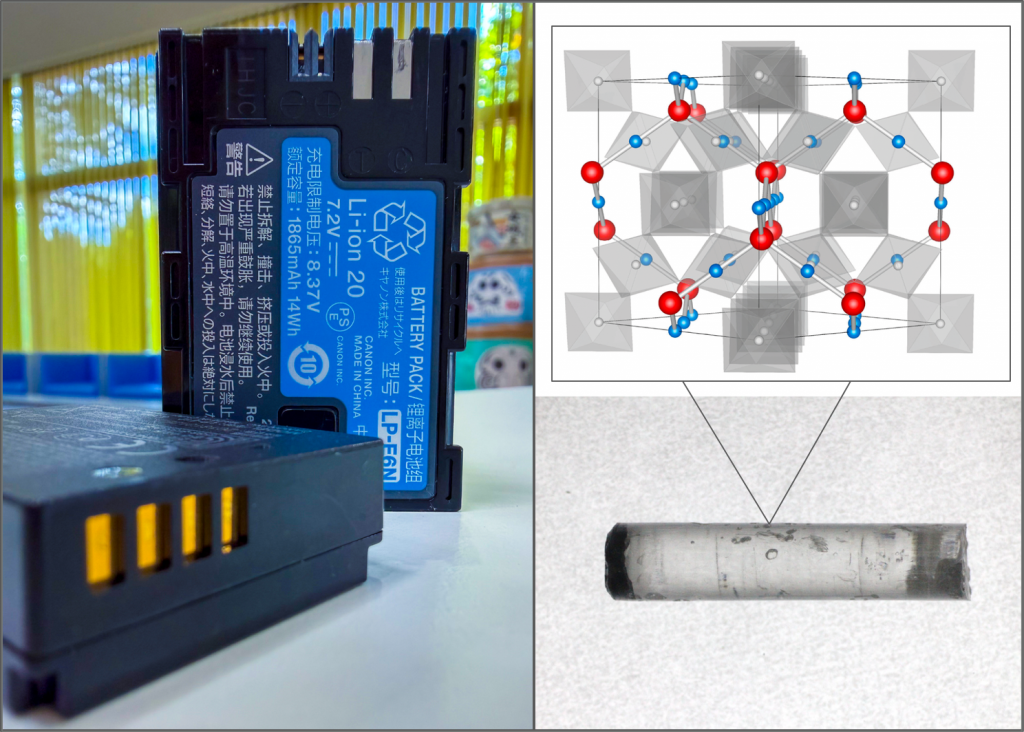
There is a good reason why every time you check in for a flight, you are asked to confirm that there are no portable chargers or power banks in your checked luggage. A highly flammable liquid electrolyte shuttles lithium (Li) ions between the electrodes of the Li-ion batteries that power these devices. As a result, if a Li-ion battery is damaged, its liquid electrolyte can cause a catastrophic fire.
Solid electrolytes, which can help reduce this risk, are an active area of research. One of the most important challenges in making solid-state batteries is increasing their ionic conductivity, or how easily positively charged Li ions can move through the solid electrolyte.
There are some solid electrolytes containing sulfide- and chloride-based materials that show high conductivity. This conductivity arises because electron clouds around negatively charged sulfide or chloride ions can easily deform as lithium ions pass through the material. But these electrolytes have their own safety issues: exposure to humidity can release toxic gases such as hydrogen sulfide and hydrogen chloride into the air.
In comparison, oxides and oxyfluorides are much more robust. When used as solid electrolytes, they are also more electrochemically stable, which is important because battery materials experience repeated voltage changes during charging and discharging. But on the flip side, they have generally exhibited low conductivity.
“At this stage, safety and ionic conductivity are a trade-off,” said Takeshi Yajima, an associate professor at the Department of Materials Design Innovation Engineering at Nagoya University. “Oxyfluorides are safer but have low conductivity, while sulfides have high conductivity but can be dangerous.”
A surprisingly good conductor…
In 2024, a new oxyfluoride crystal with a chemical formula Li2–xLa(1+x)/3Nb2O6F, shortened as “LLNOF”, was discovered to have an unusually large conductivity of seven millisiemens per centimeter (mS/cm), which is comparable to liquid electrolytes. But why it showed this conductivity remained a mystery: the electron cloud around the central fluoride ion does not deform as easily as in sulfides or chlorides to explain LLNOF’s behavior through the previously known mechanism.
Soon after this discovery, Yajima and his lab decided to grow their own, high-quality LLNOF single crystals to pin down the mechanism. This, Yajima says, was the hardest part, taking over a year to achieve. “We had to make sure that the crystals were of sufficiently high quality for structural analysis,” he said.
But the researchers’ efforts bore fruit as they were able to grow millimeter-sized LLNOF single crystals using the Bridgman method. Using single crystal diffraction, they were able to peek into the local arrangement and rearrangement of atoms within each crystal unit.
…reveals its secret
What they found was a dynamic interplay among four atomic sites that form a tetrahedron around LLNOF’s fluoride ion. Each of these sites can either contain a lithium ion, a lanthanum atom, or remain vacant. The researchers found that every time a Li ion makes a jump onto the next vacant spot, the central fluoride ion migrates slightly towards the lithium’s original site. Fluoride ions effectively “get out of the way,” lowering the energy barrier for Li ions to hop around.
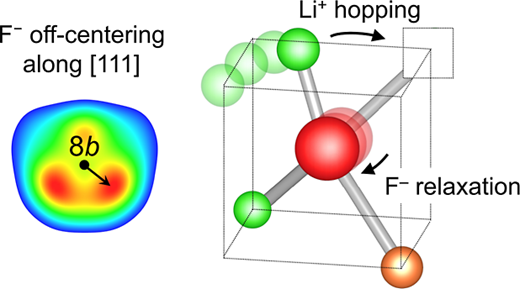
That is why, compared to other oxyfluorides where the atoms stay rigid, LLNOF shows higher Li ion conductivity.
The researchers then tweaked the composition of this crystal by changing the relative amounts of lithium, lanthanum, and vacant sites in LLNOF (the “x” in its chemical formula). They found that conductivity improved by lowering x, reaching a maximum value of 16.3 mS/cm. This result, representing the highest reported bulk Li-ion conductivity among oxide-related solid electrolytes, has been published in the Journal of the American Chemical Society.
Yajima believes this mechanism, which does not rely on highly polarizable ions, can be used to develop even more efficient solid oxide-based solid electrolytes. “The general understanding has been that sulfide-based materials are better conductors because of their anion character, but this mechanism challenges that understanding,” he adds. This research marks an important step towards realizing practical solid-state Li ion batteries.
Publication information:
Takeshi Yajima, Chika Takazawa, Taisuke Sato, Yasutoshi Iriyama, 2026. Migration-Coupled Local Fluoride Relaxation in Li2–xLa(1+x)/3Nb2O6F Single Crystals. Journal of the American Chemical Society. https://doi.org/10.1021/jacs.6c08912
Funding information:
This work was supported by Grants-in-Aid for Scientific Research (KAKENHI) Grant Numbers JP24H02204 and JP21K04636, JST GteX (JPMJGX23S2), and JST ASPIRE (Grant Number JPMJAP2419).
Expert contact:
Takeshi Yajima
Department of Materials Design Innovation Engineering,
Nagoya University
Email: yajima.takeshi@material.nagoya-u.ac.jp
Media contact:
Sumeet Kulkarni
International Communications Office
Nagoya University
Email: icomm_research@t.mail.nagoya-u.ac.jp