A Tokyo study finds teenagers felt less depressed during lockdown, with brain scans showing distinct patterns
Lockdowns isolated teenagers from friends, disrupted their routines, and kept them at home with daily reports of bad news. So most people assume teenagers felt worse during COVID-19 lockdowns, but a Tokyo study shows the opposite. Scientists at Nagoya University and their collaborators tracked Tokyo teens through the pandemic and found they experienced depression less often during lockdowns than during normal school life.
Published in PLOS Medicine, the study found two groups that experienced depression differently. Both felt better during lockdown, but brain scans showed biological differences between them.
Less depression, different paths to feeling better
Unlike most COVID studies that only assessed mental health during or after the pandemic, this study tracked students before it started, making it possible to know what actually changed.
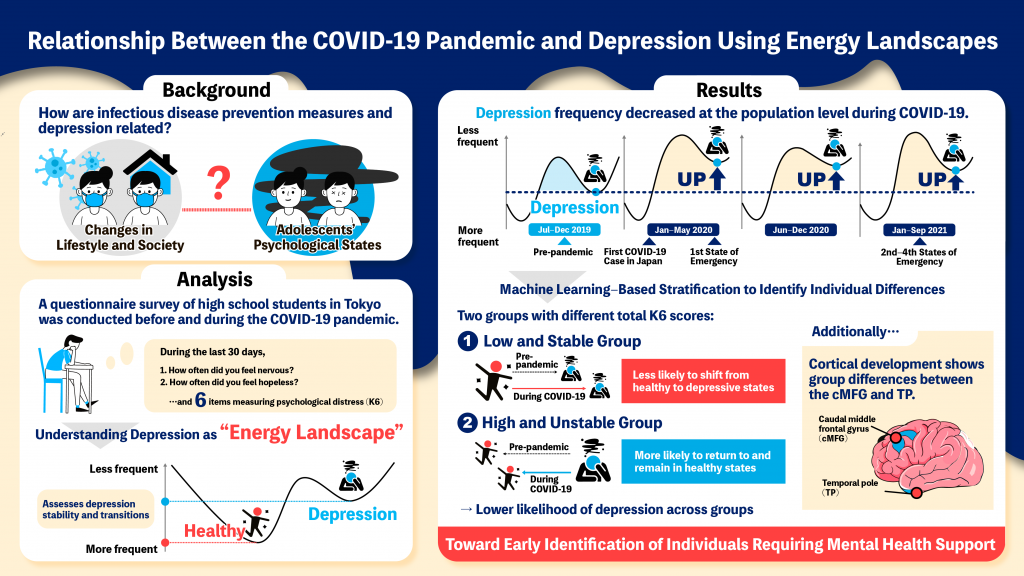
Each month high school students between the ages of 16-18 years rated how often they felt nervous, hopeless, sad, and experienced other negative feelings.
Using energy landscape analysis, a model that calculates the probability of different mental states, the researchers found that before the pandemic students were about 11 times more likely to be in healthy states than depressive ones. During the pandemic, this increased to 15-18 times.
Most students showed positive mental health outcomes, and two patterns were found. The majority (73%) rarely felt depressed, while the others experienced depression that came and went. MRI scans also showed differences between the two groups, with the fluctuating group having faster changes in brain regions linked to higher-order cognitive functions.
Turning emotional states into visual patterns
The researchers used a method that creates visual maps of psychological states. They created images showing which states were easy to fall into and which were easy to escape.
“The maps showed that during lockdown students who rarely felt depressed became even more protected, while students who struggled with depression found it easier to bounce back to feeling healthy,” Shingo Iwami, senior author and professor at Nagoya University’s Graduate School of Science, elaborated.
Instead of just measuring how depressed someone is, this method shows how their psychological health changes over time and which states they stay in longer. Traditional methods cannot detect these patterns and identifying them could help us better support young people during future crises.
Why some teens feel better during lockdown
The findings support some studies showing that while many teenagers struggled during lockdown, others felt relief from routine psychological stress experienced during school and social activities.
However, the researchers point out that the study sample was small and included only Tokyo students, so results might differ in other settings.
“Not everyone responds in the same way to a crisis. Results might be very different for teenagers who were already struggling, faced challenges at home, or lacked resources during lockdowns,” Professor Iwami said.
Paper Information:
Daiki Tatematsu, Naotoshi Nakamura, Masato S Abe, Tetsuo Ishikawa, Takahiro Ezaki, Lin Cai, Eiryo Kawakami, Kazuyuki Aihara, Atsushi Nishida, Naohiro Okada, Naoki Masuda, Kiyoto Kasai, Shinsuke Koike, and Shingo Iwami (2026). Psychological distress among Japanese high school students during the COVID-19 pandemic: An energy landscape analysis, PLOS Medicine. https://doi.org/10.1371/journal.pmed.1004884
Expert Contact:
Shingo Iwami
Graduate School of Sciences
Nagoya University
Email: iwami.shingo.p9@f.mail.nagoya-u.ac.jp
Media contact:
Merle Naidoo
International Communications Office
Nagoya University
Email: icomm_research@t.mail.nagoya-u.ac.jp
Top image:
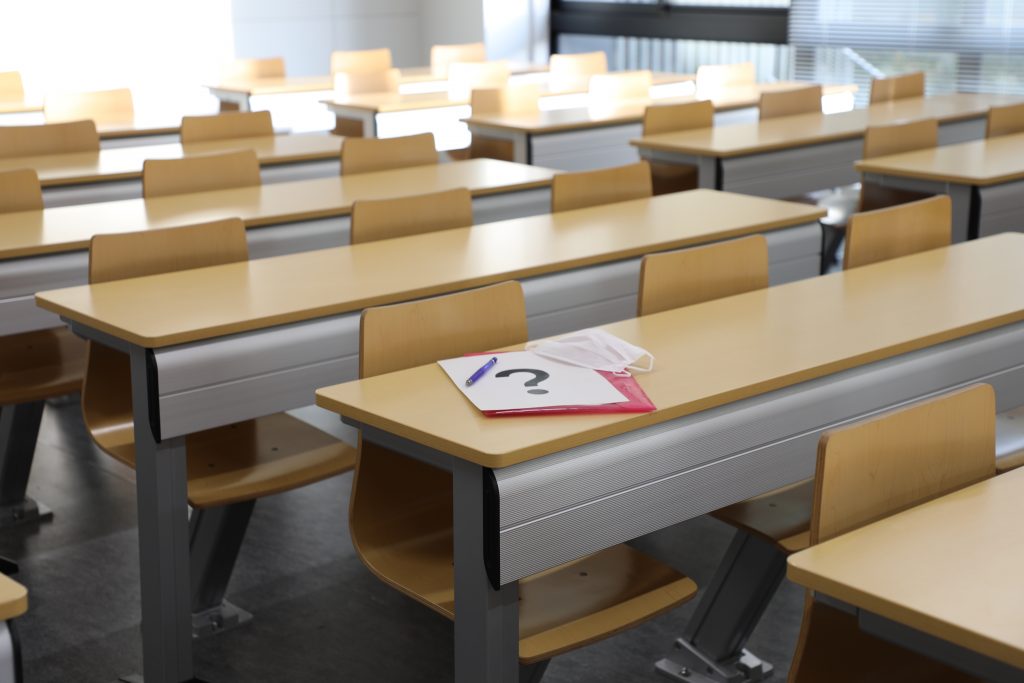
A study has found that Tokyo high school students experienced depression less often during COVID-19 lockdowns. Credit: Merle Naidoo, Nagoya University