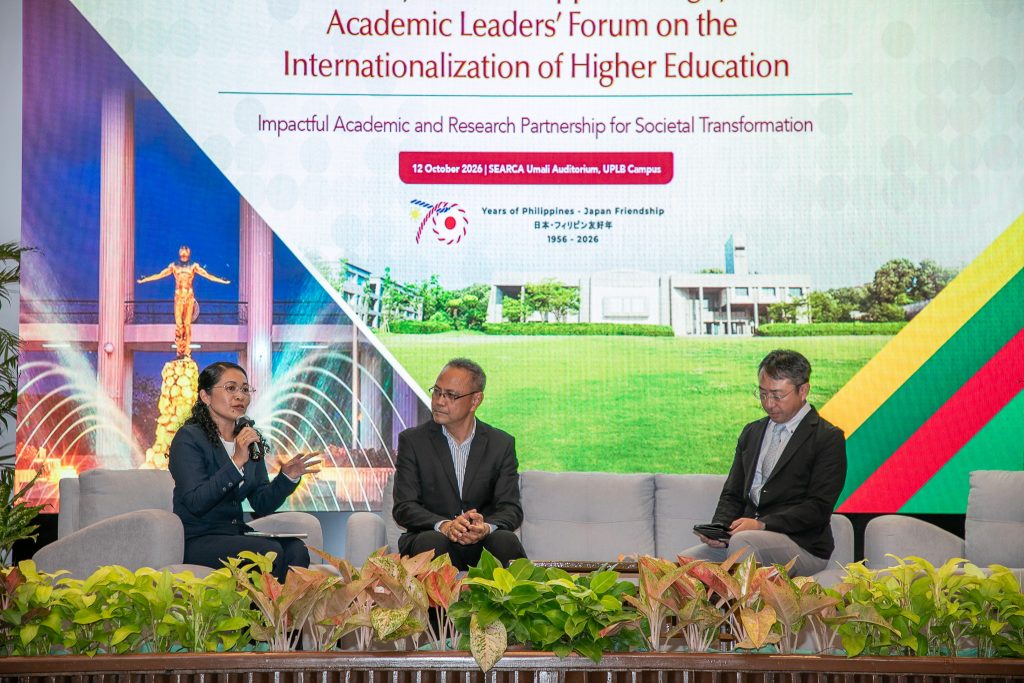
At a forum in Los Baños, Philippines, on Oct. 12, leaders of Nagoya University in Japan and the University of the Philippines took stock of more than a decade of cooperation in doctoral education and set a course toward further collaboration. The importance of international collaboration in higher education emerged as the most enduring thread in Japan-Philippines ties.
Nagoya University and the University of the Philippines held their second Academic Leaders’ Forum on the Internationalization of Higher Education on Oct. 12 at the Southeast Asian Regional Center for Graduate Study and Research in Agriculture (SEARCA) Umali Auditorium, on the University of the Philippines Los Baños (UPLB) campus. Los Baños lies about 60 kilometers southeast of Manila, at the foot of Mount Makiling and the shores of Laguna de Bay. Under the theme “Impactful academic and research partnership for societal transformation,” participants from both countries discussed how to turn the partnership’s agreements into results. The forum also marked 70 years since Japan and the Philippines normalized diplomatic relations.
“The most pressing challenges of our time do not respect national borders,” SEARCA Center Director Mercedita Sombilla said in her welcome remarks. “Collaboration is no longer an option; it is essential.”
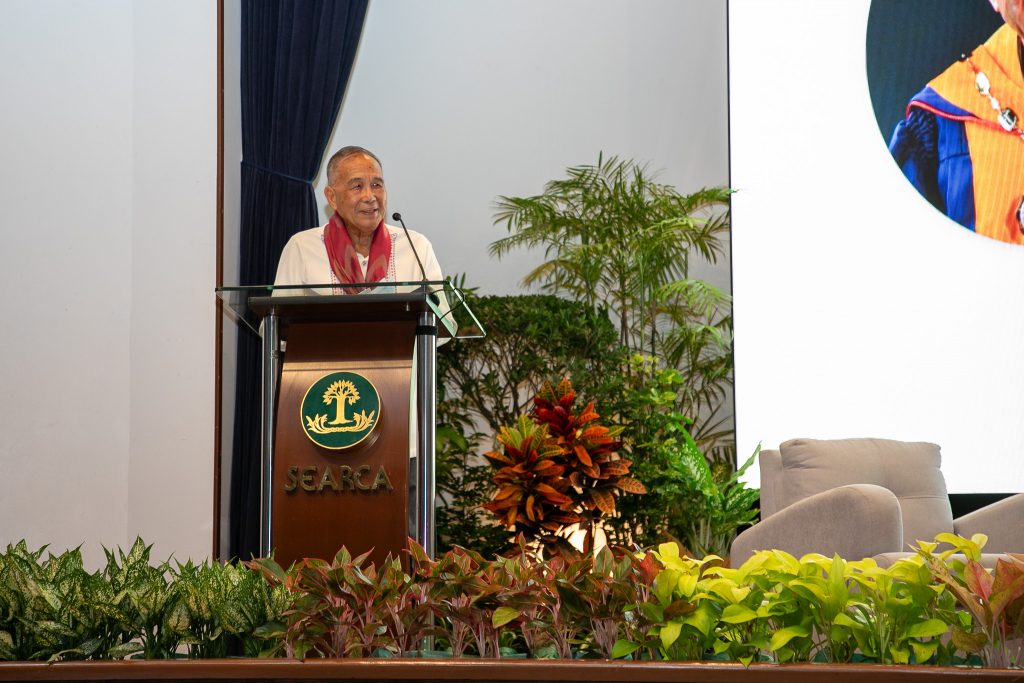
In his keynote, National Scientist and former University of the Philippines President Emil Javier drew on the motto Japan and the Philippines adopted when they elevated their ties to a Comprehensive Strategic Partnership in May: “Weaving the future together.”
“Each single thread alone is weak, but many threads, laced and intertwined together, make for a durable, usable and exquisite fabric,” he said. Of these threads, Javier argued, higher education and research has been the most enduring, “because higher education not only spans generations, but it also multiplies and compounds.”
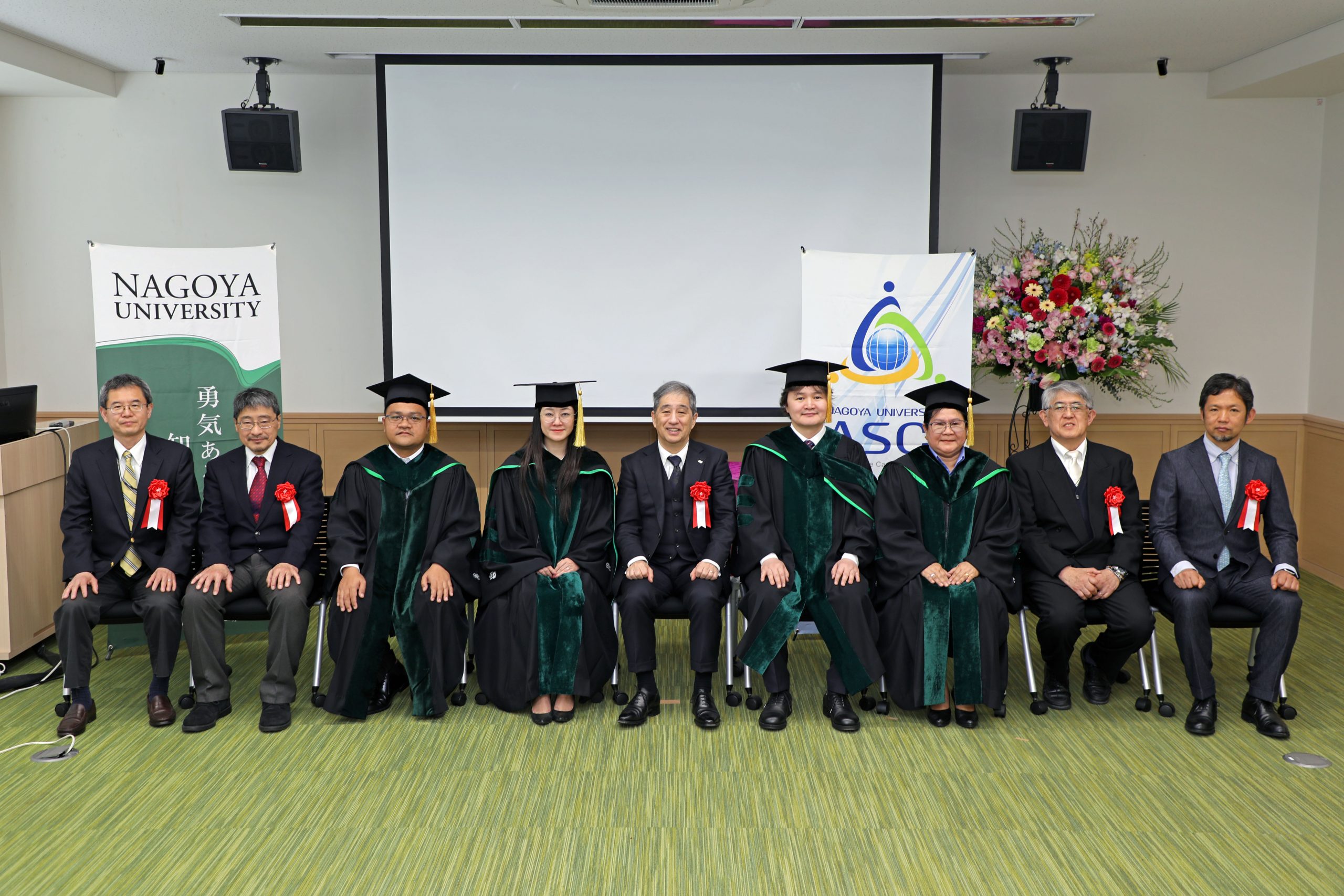
Anchoring the partnership is doctoral education. In 2015, Nagoya University and UPLB established the Nagoya University Asian Satellite Campuses Institute-Philippines Satellite Campus at UPLB. Its transnational programs allow professionals to earn a Nagoya University doctorate without leaving their careers. As of October, the program had produced 13 graduates from the Philippines, with 17 students working toward their degrees and nine newly admitted.
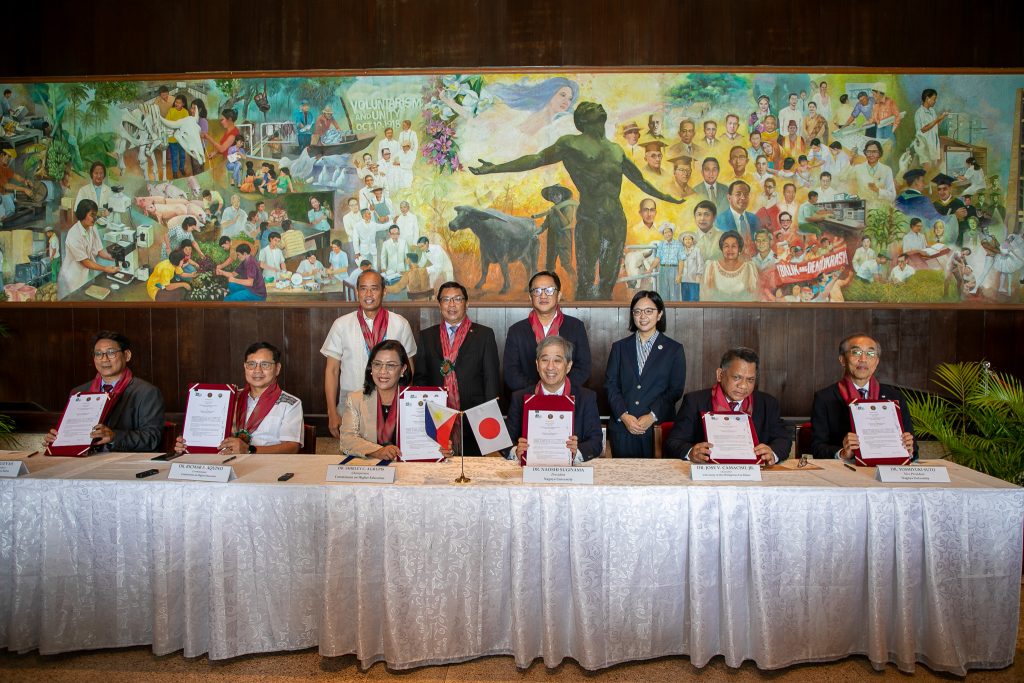
At the first forum, held in Nagoya in May 2025, the two universities adopted a roadmap for international partnership for 2025 to 2030. On the morning of the forum in Los Baños, Nagoya University, UPLB and the Philippine Commission on Higher Education (CHED) signed a letter of intent to cooperate on the development of a doctoral dual degree program. Nagoya University President Naoshi Sugiyama said joint supervision by faculty from different institutions is “particularly important for developing doctoral graduates” who can work on the global stage.
University of the Philippines President Angelo Jimenez, who named research as the core of his vision, said his university’s journey “will go on a higher plane with Nagoya University.”
The afternoon sessions examined what collaboration delivers in practice:
- Sustainable campuses: Hiroki Tanikawa, dean of Nagoya University’s Graduate School of Environmental Studies, and UPLB Vice Chancellor (Research and Extension) Nathaniel Bantayan presented their institutions’ sustainability strategies. “Gone are the days of working in silos,” Bantayan said. “This is the age of collaboration.”
- Collaborative degree programs: Ednalyn Grace A. Viste, Co-Lead for Transnational Higher Education at the International Affairs Service of the Commission on Higher Education (CHED) of the Philippines, stated that internationalization and strengthening of transnational higher education are among the core priorities in Philippine higher education policy. She also highlighted that the doctoral dual degree program being developed by Nagoya University and UPLB has significant potential to generate meaningful impact. UPLB Vice Chancellor (Academic Affairs) Agham Cuevas described a dual program as a two-way exchange, with UPLB gaining access to advanced facilities and Nagoya University gaining field sites, regional knowledge and Southeast Asian networks. Katsuyoshi Michibayashi, vice dean of the Graduate School of Environmental Studies, provided the example of a jointly supervised doctoral program with France’s University of Montpellier as what successful international collaboration looks like: “The degree program should be built upon shared research interests, rather than simply an administrative agreement.”
- Strategic partnership: In a roundtable, faculty, alums and partner organizations explored new areas of cooperation, with several describing themselves as bridges between the universities.
In her synthesis, Maria Kristina Alinsunurin, school secretary of the UPLB Graduate School and a Nagoya University alum, said, “A larger network is valuable only if it makes possible work that neither university could do alone.” She asked participants what results beyond the two universities the partnership should be able to show by 2030.
Nagoya University Vice President (International Affairs, Planning & Evaluation, Institutional Research, and Humanities & Social Sciences Reform) Yoshiyuki Suto called the letter of intent an important milestone, but only a beginning. “The real significance of today’s agreement will ultimately be measured by what we accomplish together in the years ahead,” he said.
Click through more pictures of the event below:
Researchers
-
 SUGIYAMA NaoshiTokai National Higher Education and Research System
-
 SUTO YoshiyukiGraduate School of Humanities, Research Center for Cultural Heritage and Texts
-
IDO AyakoGlobal Multi-Campus Institute
-
 TANIKAWA HirokiGraduate School of Environmental Studies, Department of Environmental Engineering and Architecture, Material-Systems Science in Environment
-
 MICHIBAYASHI KatsuyoshiGraduate School of Environmental Studies, Department of Earth and Environmental Sciences, Geology and Geobiology
-
 NAKAMURA HikaruGraduate School of Engineering, Civil and Environmental Engineering, 1
-
 OHKURA SatoshiGraduate School of Bioagricultural Sciences, Field Science Center, Division
-
SHIMIZUTANI SatoshiGraduate School of International Development, Department of International Development and Cooperation
-
LINLEY MatthewGlobal Multi-Campus Institute
-
TAKAI JiroGraduate School of Education and Human Development, Department of Psychology and Human Developmental Sciences, Psychological Sciences