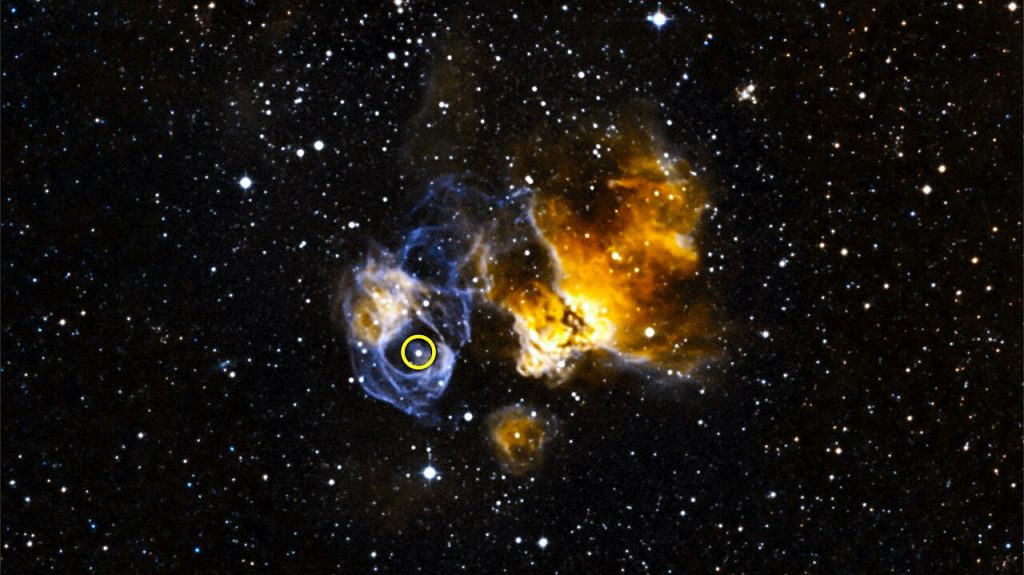
In 2016, a binary star system emitting unusually strong gamma-rays was discovered in our galactic neighborhood. Now, astronomers have found the smoking gun, or rather, a smoking trail of cool molecular gas that suggests the source responsible are jets emanating from a microquasar — one of the few known outside the Milky Way.
Unlike the Milky Way which shrouds objects behind dust when looking towards the galactic core, the Large Magellanic Cloud (LMC), a dwarf satellite galaxy to our own, offers unhindered views to interesting and relatively nearby astrophysical phenomenon.
LMC P3 is one such stellar puzzle. It is the most luminous gamma-ray binary star system, composed of a compact object — either a black hole or a neutron star — alongside a massive star that is more than 30 times heavier than the Sun. The two stars take roughly 10 days to orbit each other.
It lies within the ashes left behind by the supernova that created its compact object. This optically attractive cloud of molecular gas, also known as a supernova remnant, is called DEM L241.
A smoking radio trail
Ever since its discovery, unusually strong gamma ray emission from LMC P3 has puzzled astronomers. Gamma rays lie at the highest energy limit of the electromagnetic spectrum. But an important clue to LMC P3’s mystery was hidden in the other end of the spectrum: radio waves.
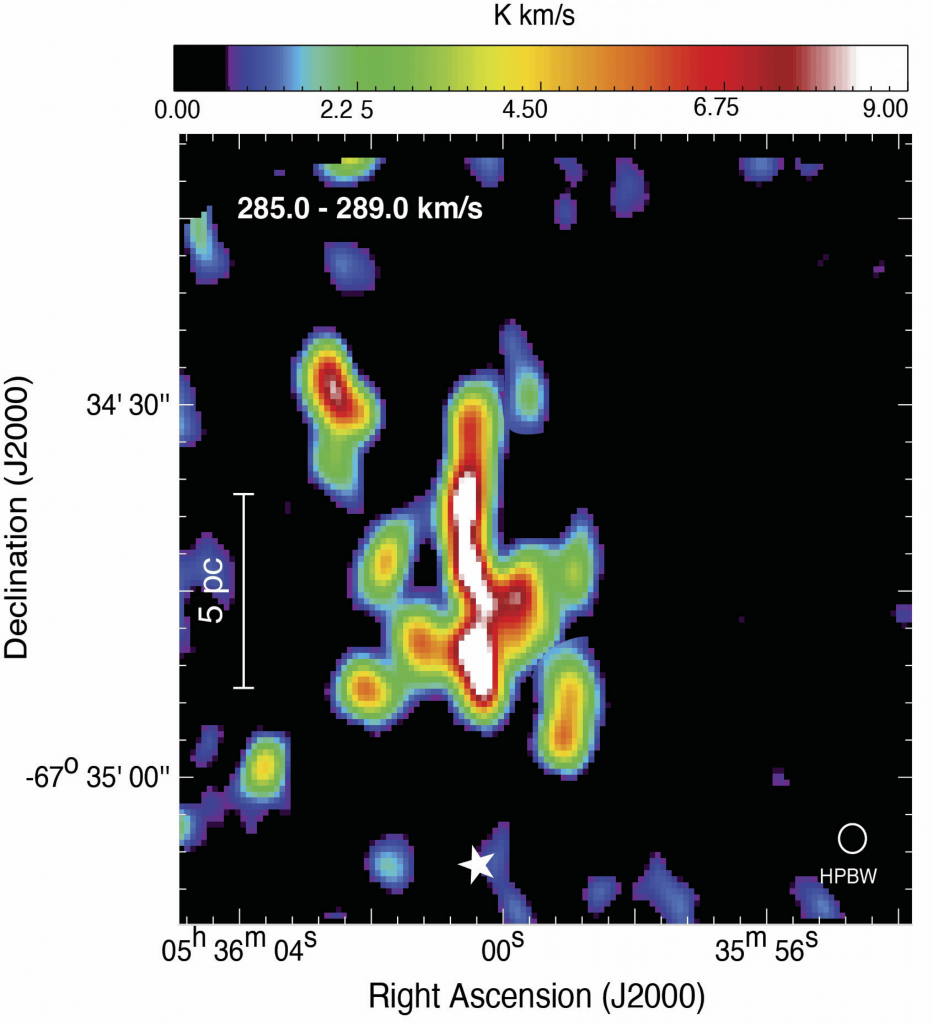
Starting in 2022, a team led by astronomers from Nagoya University and Gifu University in Japan recorded observations of DEM L241/LMC P3 using the ALMA observatory in Chile, one of the largest radio telescopes in the world.
Specifically, they used ALMA bands 6 and 7 to measure carbon monoxide (CO) emission from the surrounding cold molecular gas, at wavelengths around 1.3 mm and 0.87 mm. This helped researchers measure the gas’s structure and motion and estimate its temperature.
What they saw was revealing. “We discovered a gigantic molecular jet,” said Yasuo Fukui, professor emeritus at Nagoya University and lead author of this new discovery, which has been published in The Astrophysical Journal Letters.
The newly discovered jet signature is a strikingly straight and narrow trail of “heated” molecular gas about 26 light-years long and three light-years wide. Even though very cold compared to room temperature, this gas trail stands out because it is considerably hotter, at a temperature of 35 to 60 Kelvin, compared to 15 Kelvin for the surrounding gas.
Fukui said the relatively high temperature observed over a large fraction of the molecular cloud makes it “a very strong case” that the gas is interacting with a high energy jet coming from the compact object — precisely the kind of jet that can also power LMC P3’s gamma rays.
Microquasar mechanism
The new study, which was co-led by Bhuvana Gadikere Rajendra, a researcher, and Kisetsu Tsuge, a designated assistant professor, both at the Institute for Advanced Study at Gifu University, together with Hidetoshi Sano, an associate professor at the Graduate School of Natural Science and Technology at Gifu University, strengthens support for one of two competing theories of gamma-ray binary emission for LMC P3: Microquasar jets.
Previously, pulsar winds were thought to be a possible mechanism. This scenario requires the LMC P3’s compact object to be a pulsar or a rapidly spinning neutron star that sends out a wind of energetic particles that in turn collides with its companion star’s own stellar wind. This creates a shock wave that accelerate particles to produce gamma rays.
But the newly found jet signature indicates quasar-like mechanism is the driving process. Quasars are some of the universe’s most luminous objects found in distant galaxies, powered by supermassive black holes at galactic cores accreting material and unleashing powerful jets of matter.
In LMC P3’s case, the compact object could be a stellar mass black hole or neutron star that draws in material from its companion to form an accretion disk. This is a small-scale version of a quasar, hence termed microquasar, that can power jets of high-speed particles that can similarly produce gamma rays.
Since black holes drive more powerful jets than neutron stars, the fact that LMC P3’s gamma ray emission is particularly high “provides a very strong support for the possibility that its central object is a black hole” instead of a neutron star, Fukui said.
Nagoya University & Gifu University Authors
Yasuo Fukui, Bhuvana Gadikere Rajendra, Hidetoshi Sano, Kisetsu Tsuge, Rami Z. E. Alsaberi, Rin Yamada, Yuya Asano, Kengo Tachihara. Yumiko Yamane
Publication information:
Yasuo Fukui, Bhuvana G. R, Hidetoshi Sano, Kisetsu Tsuge, Rami Z.E. Alsaberi, Rin Yamada, Yuya Asano, Aya Bamba, Miroslav Filipovic, Charles Law, Norikazu Mizuno, Toshikazu Onishi, Paul Plucinsky, Gavin Rowell, Manami Sasaki, Piyush Sharda, Hiromasa Suzuki, Kengo Tachihara, Kazuki Tokuda, Yumiko Yamane, 2026. ALMA Observations of DEM L241/LMC P3 in the Large Magellanic Cloud: Evidence for the Formation of Cool Molecular Jets Driven by a Microquasar. Astrophysical Journal Letters. DOI:10.3847/2041-8213/aea0cb
Funding information:
This paper makes use of the following ALMA data: ADS/JAO.ALMA #2021.2.00008.S. ALMA is a partnership of ESO (representing its member states), NSF (USA) and NINS (Japan), together with NRC (Canada), NSTC and ASIAA (Taiwan), and KASI (Republic of Korea), in cooperation with the Republic of Chile. The Joint ALMA Observatory is operated by ESO, AUI/NRAO and NAOJ. This work was also supported by JSPS KAKENHI grant Nos. 25K17435 (K. Tsuge), 21H01136 (HS) and 24H00246 (HS). This work was supported by the Tokai Pathways to Global Excellence (T-GEx), part of the MEXT Strategic Professional Development Program for Young Researchers, and by the establishment of university fellowships toward the creation of science technology innovation (Grant Number: JPMJFS2138). Support for C.J.L. was provided by NASA through the NASA Hubble Fellowship grant No. HST-HF2-51535.001-A awarded by the Space Telescope Science Institute, which is operated by the Association of Universities for Research in Astronomy, Inc., for NASA, under contract NAS5-26555.
Expert contacts:
Yasuo Fukui
Department of Physics,
Nagoya University
Email: fukui@a.phys.nagoya-u.ac.jp
Kisetsu Tsuge
Institute for Advanced Study,
Gifu University
Email: tsuge.kisetsu.i2@f.gifu-u.ac.jp
Media contact:
Sumeet Kulkarni
International Communications Office
Nagoya University
Email: icomm_research@t.mail.nagoya-u.ac.jp