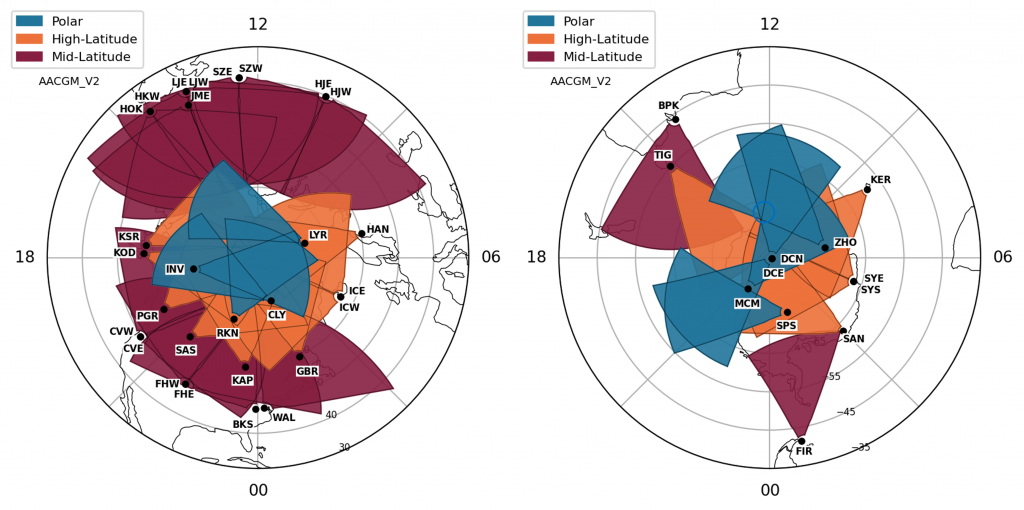
Super Dual Auroral Radar Network (SuperDARN) consists of high-frequency (10-18 MHz) over-the-horizon radars utilizing backscatter from decameter ionospheric irregularities for mapping ionospheric drifts generated by solar wind interactions with the Earth’s magnetosphere and ionosphere. During its 30-year history, SuperDARN has grown from just a few auroral radars to 40+ installations covering mid to polar cap latitudes. While the conventional network operations remain essentially unchanged, the accumulated knowledge about HF propagation at high latitudes and SuperDARN data analysis details, in combination with advancements in hardware design and computing/data storage capacity, provides a fertile background for exploring and implementing novel operational regimes and diagnostics.
In this talk, following a brief introduction to SuperDARN principles and operations, the speaker will describe different aspects of expanding the network’s diagnostic capabilities within the last two decades. The topics will cover improvements in data quality, geolocation accuracy, spatial coverage, and temporal resolution; extended ionospheric and ground surface diagnostics; advanced beamforming and multi-static operations; etc., followed by a brief discussion on future plans.
Date: April 23 (Thursday), 2026 16:30-17:30
Venue: Research Institutes Building II, 3rd floor, RB2-3F Hall
Speaker: Dr. Pavlo Ponomarenko, University of Saskatchewan, Canada
ISEE coordinator: Dr. Nozomu Nishitani (Center for International Collaborative Research)
Language: English
Target audience: scientists and researchers in related fields
For more detailed information, please follow this link: 98th ISEE/CICR colloquium