Skip to content

News & Events

Stay informed about research breakthroughs, university announcements, and opportunities to engage with Nagoya University's dynamic global community.

Admissions

Study in Japan's fourth largest city, and home to some of its most well-known companies—all without the Tokyo prices and Kyoto crowds.

Academics

Pursue your interests through one of our English or Japanese language programs, selecting from a wide variety of specialized fields.

Campus life

Find out about our facilities, comprehensive support, extracurricular activities, and the safe and welcoming community that fosters lifelong connections and growth.

About

Meet our leadership and discover the inclusive values and academic heritage that drive Nagoya University's contributions to knowledge and society.

Scientists control molecular alignment on a graphene surface ~ A fluke discovery could pave the way towards improved graphene-based electronics ~

Scientists at Nagoya University have developed a simple way to align molecules in one direction on a flat graphene surface. Efficiently controlling molecular alignment is expected to lead to significant progress in surface chemistry and molecular engineering, as well as materials science.

press released on March 22, 2018
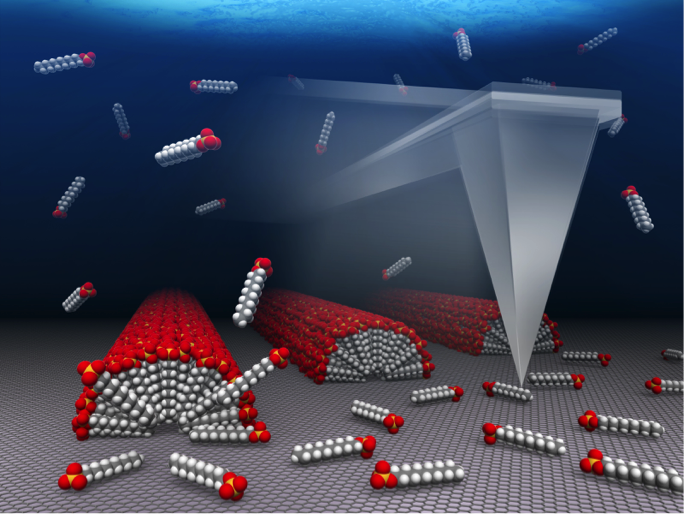
Molecular assemblies on graphene grow in perfect orientation by atomic force microscopy (AFM) tip scanning. The gray plane on the bottom represents the graphene surface. The stick-like particles consisting of red, white, yellow and gray colored balls represent surfactant (sodium dodecyl sulfate (SDS)) molecules. The gray colored reverse pyramid-like structure represents the probe tip of AFM.

Nagoya, Japan – A group of scientists at Nagoya University have developed a simple and powerful method to construct perfectly unidirectional molecular assembly structures on graphenes, according to a study reported in the journal Scientific Reports. Discovered accidentally during other research, the method relies on a common laboratory tool, atomic force microscopy (AFM), to control molecular alignment……>>read more on the ITbM website

We use cookies
By clicking "Accept Cookies," you agree to the use of cookies to improve your user experience, optimize the site, produce statistics, and interact with social networks.
Our Site Policy