
A research group in Nagoya University developed a high-speed cell sorting method of large cells with high-viability using dual on-chip pumps.
press released on July 28, 2017
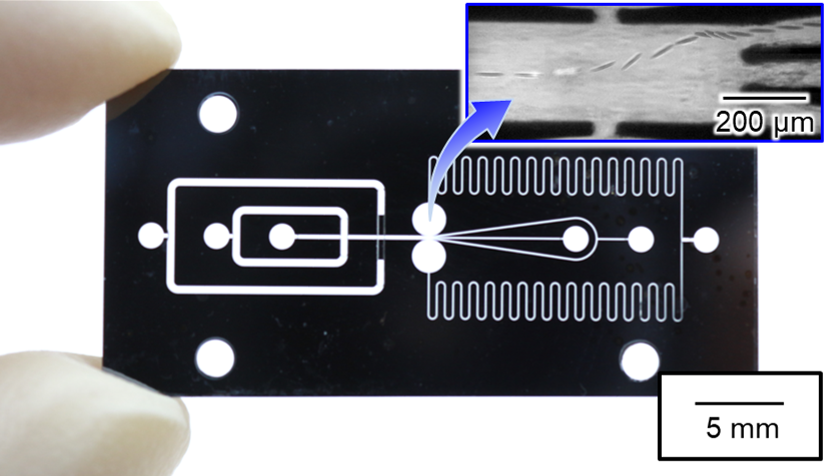
Nagoya, Japan – The sorting of individual cells is necessary for many biological applications, including the isolation of specific cell types from cell suspensions. A fluorescence-activated cell sorting (FACS) has been used for high-throughput cell sorting. In this method, lasers are used to excite auto-fluorescence or tagged-fluorescence of cell included in droplets, and then droplets are diverted into different containers depending on their characteristics. However, this technique is concerned about sample infections due to aerosols generation. Additionally, a FACS of larger cells requires the samples to be processed under low pressure through wider nozzles to prevent damage. Thus, sorting is limited to low-level throughput.
Research at Nagoya University on cell sorting used a microfluidic chip to prevent sample infection. This chip has microchannels into which cell suspensions are introduced for sorting. The research group integrated two externally-driven on-chip pumps into the microfluidic chip for high-speed flow control. Using a high-speed actuator as the driving source of pump, they succeeded in producing a flow with 16 microseconds for cell sorting.
Microfluidic chip contains a cross-shaped sorting area and three-branched microfluidic channel. "Target/non-target cells are three-dimensionally aligned in the main channel," corresponding author Shinya Sakuma says. "When target cells are detected, the on-chip pumps work rapidly to sort cells into one of two interest channels. Meanwhile, non-target cells are flushed into the waste channel without pump actuation."
The technique allows us to sort not only large but also small cells with high speed, high purity, and high viability. "We tested the method on microalgae as an example of large cells, around 100 micrometers in size, and achieved 95.8% purity, 90.8% viability, and a 92.8% success rate," corresponding co-author Yusuke Kasai says. "As a model small cell type, we used a cancer cell whose size is around 24 micrometers, and achieved 98.9% purity, 90.7% viability, and a 97.8% success rate."
The article "On-chip cell sorting by high-speed local-flow control using dual membrane pumps." was published in Lab on a Chip at DOI: 10.1039/c7lc00536a.
Authors
Assistant Prof. Shinya Sakuma, Yusuke Kasai, Takeshi Hayakawa and, Prof. Fumihito Arai, Nagoya University
Related Links
Lab on a Chip Video (youtube)
Arai Lab., Department of Micro-Nano Mechanical Science and Engineering, Nagoya University
Micro-nano Mechatronics & Biomedical Applications, Prof. Fumihito Arai, Unite: research seeds for needs, Nagoya University
[ImPACT Program] Planned Serendipity
Cell Search Engine -Turning Serendipity into Planned Happenstance-, ImPACT Program of Council for Science, Technology and Innovation (Cabinet Office, Government of Japan).
Media Coverage
Electronics 360, "New Cell Sorting Process Takes Only 16 Seconds to Sort", by Siobhan Treacy
Funding
This work was funded by ImPACT Program of Council for Science, Technology and Innovation (Cabinet Office, Government of Japan).