Cells share small molecules with their neighbors through tiny tunnels made of proteins arranged in a ring. Research at Nagoya University suggests that the tails of the proteins must link up to form an inner ring for the tunnel to become evenly round — a previously unknown step in how these cell-to-cell connections are built.
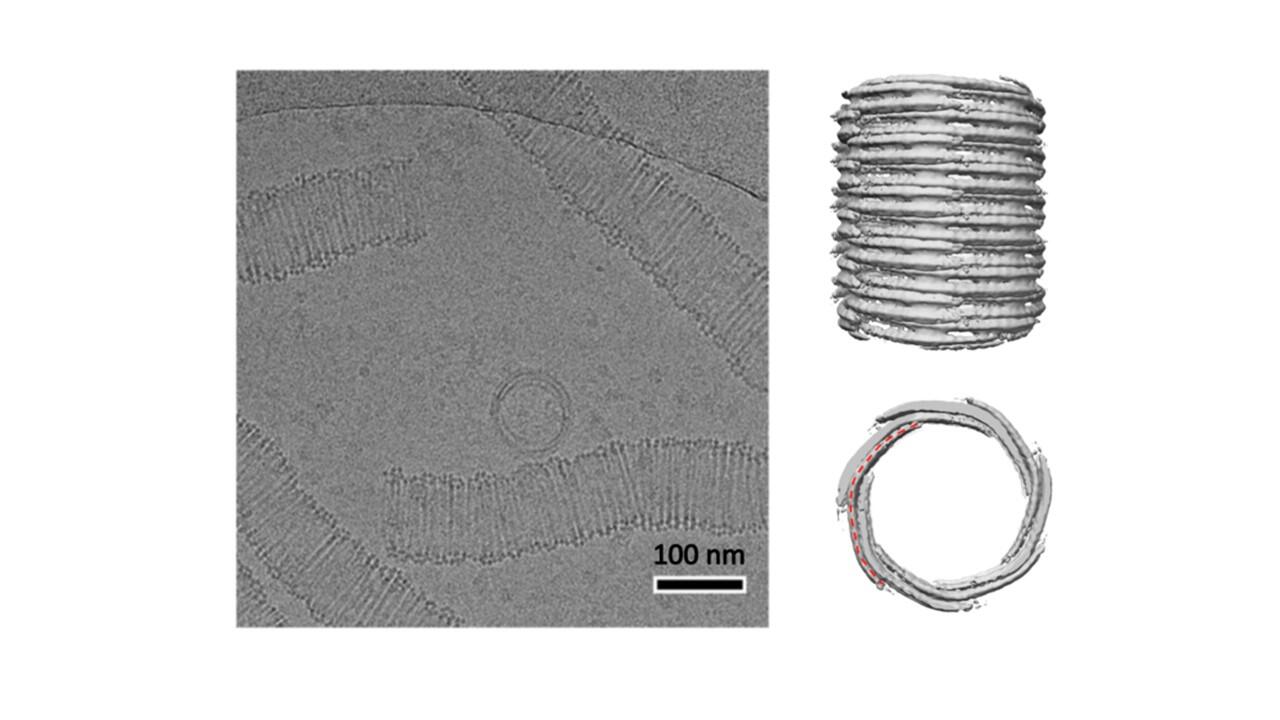
Tunnels connecting cells, called gap junction channels, help control processes such as development, nerve activity and immune responses. In most invertebrates, such as in insects, they are built from proteins called innexins, but little was known about how innexins assemble into working channels, and no detailed structure of an insect innexin channel had been determined. A team led by Atsunori Oshima, a professor at Nagoya University, used cryo-electron microscopy — a method that photographs flash-frozen molecules with an electron microscope to reveal their 3D shape in atomic detail — to study an innexin from the malaria mosquito Anopheles gambiae.
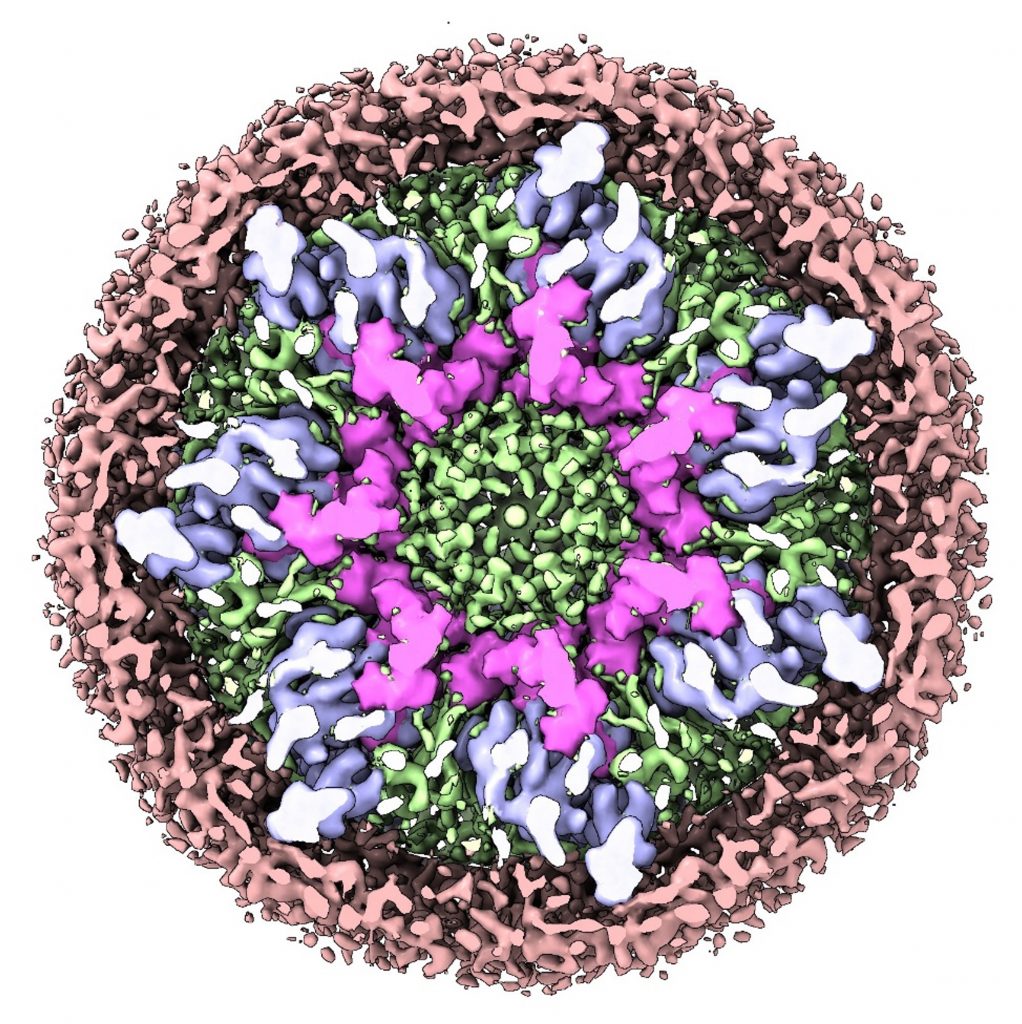
In a paper published in the Proceedings of the National Academy of Sciences, the team reports that seven identical protein units form a symmetrical ring, unlike the eight-unit ring that the researchers previously reported for an innexin from a roundworm. At the center, the starting end of each protein chain, called the N-terminus, attaches to the neighboring unit, forming an inner ring that helps the structure assume its circular shape.
To test the inner ring’s role, the researchers shortened the N-terminus one building block, or amino acid, at a time and checked whether the channels could still pass electric current between pairs of frog egg cells. Removing one amino acid (the second in the chain) left the channel working, but removing two cut its activity to almost nothing, and removing three or four shut it down completely. Replacing the third amino acid with either of two others reduced or did not affect activity, suggesting that the exact chemical makeup is not as essential as are the length and shape of the N-terminus. In the version missing two amino acids, the inner ring did not form, the channel was squashed out of round, and fatty molecules called lipids sat where the N-termini would normally be. The researchers propose that forming the inner ring is the final step that turns a lopsided assembly into a mature, symmetrical channel.
The research was conducted in collaboration with the Institute of Science Tokyo and the Tokyo University of Agriculture and Technology.
Publication
Shota Kawaguchi, Takahito Nakano, Hidemi Hirano, Masakatsu Watanabe, Shota Suzuki, Kouki Nishikawa, Yoshinori Fujiyoshi, Atsunori Oshima, 2026. N-terminal integrity governs heptamer assembly and maturation in a mosquito innexin hemichannel. Proceedings of the National Academy of Sciences. DOI: https://doi.rog/10.1073/pnas.2627957123
Funding
Japan Society for the Promotion of Science (JP23K27111, JP24K09472, JP24K18061, JP26KJ1021, 20H00451)
Japan Agency for Medical Research and Development
Astellas Foundation for Research on Metabolic Disorders
Naito Foundation
Uehara Memorial Foundation
Takeda Science Foundation
Hori Sciences and Arts Foundation
Nagoya University (Quantum-Based Frontier Research Hub for Industry Development, CIBoG WISE program)
Expert contact
Atsunori Oshima
Cellular and Structural Physiology Institute (CeSPI)
Nagoya University
oshima.atsunori.b9@f.mail.nagoya-u.ac.jp
Media contact
Daniel Schenz
International Communications Office
Nagoya University
Email: icomm_research@t.mail.nagoya-u.ac.jp