For almost sixty years, general relativity has predicted that black holes are defined by only mass and spin. A new study works out how to check whether some black holes are hiding something more.
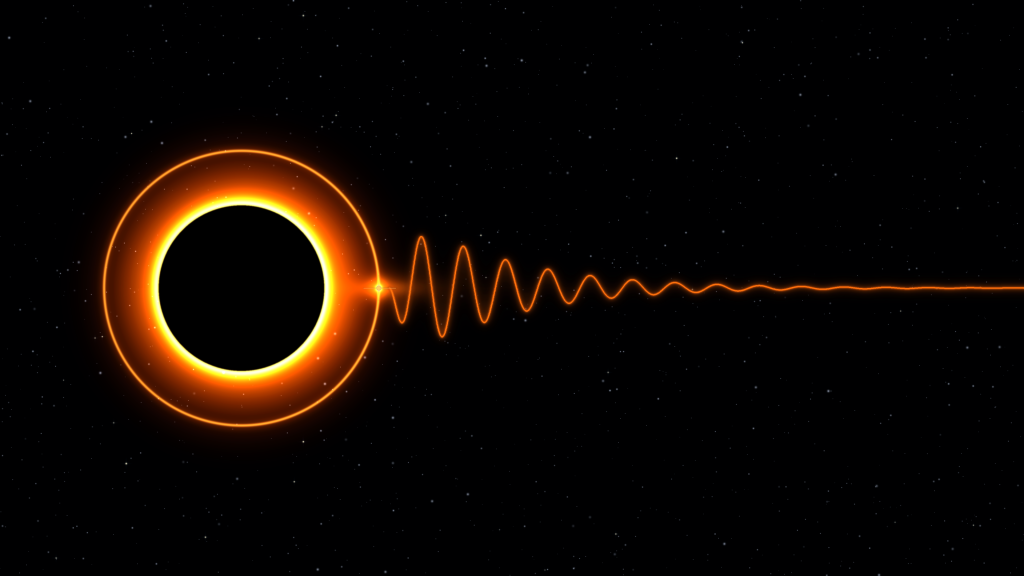
When two black holes crash together and merge, the newly formed black hole rings like a bell, sending out gravitational waves with specific frequencies that fade over time. This brief, fading pattern of waves is called ringdown, and it may hold secrets about what is hiding around black holes.
Under Einstein’s basic rules for the simplest kind of black hole, ringdown waves depend only on two things: a black hole’s mass and how fast it spins. But what if black holes have hidden matter around them? If this were true, this matter would also affect characteristics of the ringdown waves. As a result, ringdown may hold information about hidden matter surrounding the black hole. In theoretical physics, this extra structure is often called “black hole hair.”
A team led by researchers from Nagoya University in Japan has found a way to check for hair using changes in ringdown waves. They found that hidden matter does not affect these waves uniformly; the frequency and fade-out speed of the waves respond differently. This difference may show us if hidden matter is present, and how its pressure is arranged around a black hole.
For spinning black holes, hidden matter affects ringdown differently, depending on whether the waves move with or against the black hole’s spin. Published in the Journal of Cosmology and Astroparticle Physics, the study tells us what pattern in the gravitational wave signal would be a clue that hidden hair is present and may help future observations tell a hairy black hole apart from an ordinary one.
If hairy black holes exist
Scientists continue testing whether Einstein’s theory of general relativity perfectly describes black holes and what deviations may exist.
Finding signs of black hole hair is difficult because different kinds of extra matter or new physics can change the ringdown in different ways. This study gives researchers a clearer idea of what patterns to look for in future ringdown data.
“Black hole hair may represent matter surrounding the black hole, or deviations from the simplest kind of black hole predicted by general relativity. Because these may slightly change the ringdown signal, detecting or ruling out these changes could give us a new way to test gravity in this extreme region,” said first author Ariadna Uxue Palomino Ylla, a PhD student from Nagoya University’s Graduate School of Science.

A black hole distorts spacetime so severely that it bends the path of light and gravitational waves. If there is hidden matter or new physics affecting gravity, the effects would be most pronounced exactly where gravity is strongest. This makes black holes the best place to find out if hidden matter or unknown physics might be present.
To check for hair, the team relied on a known link. The way light would orbit near a black hole corresponds to the way its ringdown waves behave, so scientists can calculate one from the other. They added a small amount of hidden matter to standard black hole models and used Einstein’s equations to calculate how that matter changes the ringdown’s frequency and fade-out speed.
The researchers tested this approach on three well-known theoretical black holes. They also extended it to spinning black holes and studied light that orbits with the spin and light that orbits against it.
Hair affects frequency and fading speed differently
A key finding is that the frequency and fade-out speed of ringdown waves do not change in the same way. The difference between them depends on how much hidden matter is present and how its pressure is arranged around the black hole.
“The ringdown waves may not only show that something extra is affecting the black hole; the way the signal changes could also give us clues about what this hidden matter is actually like,” said Palomino Ylla.
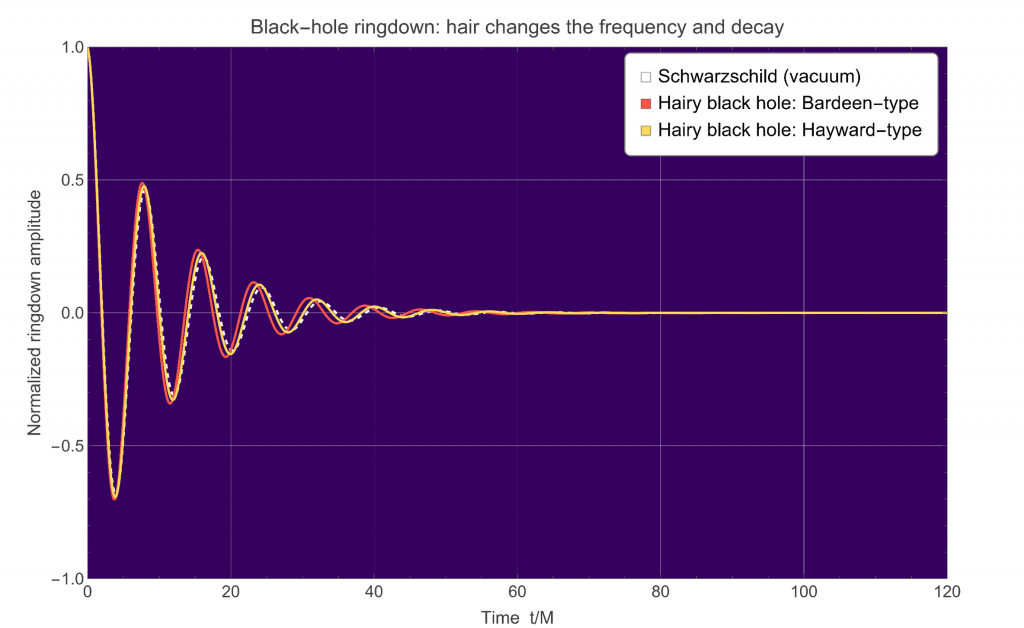
The researchers included spinning black holes in their analysis. Rotation makes calculations more complex because light circling with the black hole’s spin would behave differently from light circling against it. Hidden matter would also change the ringdown’s frequency and fade-out speed differently, depending on the spin direction. The exact pattern depends on the type of hidden matter involved.
Instead of studying each possible type of black hole hair from scratch, the new method gives researchers a common way to predict how extra matter or new physics could change a black hole’s ringdown. While the results are early estimates, this method helps scientists know what to look for if they ever spot something strange in a real black hole’s signal. In the future, this approach may help researchers use these waves to learn about a black hole’s size, spin, and any black hole hair nearby.
Publication information:
Ariadna Uxue Palomino Ylla, Kosuke Makino, Akane Tanaka, Akihiro Ishibashi, and Chul-Moon Yoo, 2026. Ringdown waves from hairy black holes, Journal of Cosmology and Astroparticle Physics. DOI: https://doi.org/10.1088/1475-7516/2026/09/046
Funding information:
This work was supported by JSPS KAKENHI (JP24K07027, JP25K07281, JP25K07306) and MEXT KAKENHI Grant-in-Aid for Transformative Research Areas A Extreme Universe (JP21H05182 and JP21H05186).
Expert contact:
Ariadna Uxue Palomino Ylla
Graduate School of Science
Nagoya University
E-mail: palomino.ylla.ariadna.uxue.e8@s.mail.nagoya-u.ac.jp
Media contact:
Merle Naidoo
International Communications Office
Nagoya University
Email: icomm_research@t.mail.nagoya-u.ac.jp
Top image:
After a black hole is disturbed, it emits gravitational waves that fade over time, a signal called ringdown. These waves may reveal hidden matter nearby. Researchers found that this hidden matter would alter the frequency and fade-out speed by different amounts. This would change the waves in a characteristic way and give scientists a new approach to test Einstein’s theory of general relativity. Credit: Ariadna Uxue Palomino Ylla, Nagoya University