“Why not talk over your troubles with Socrates?”
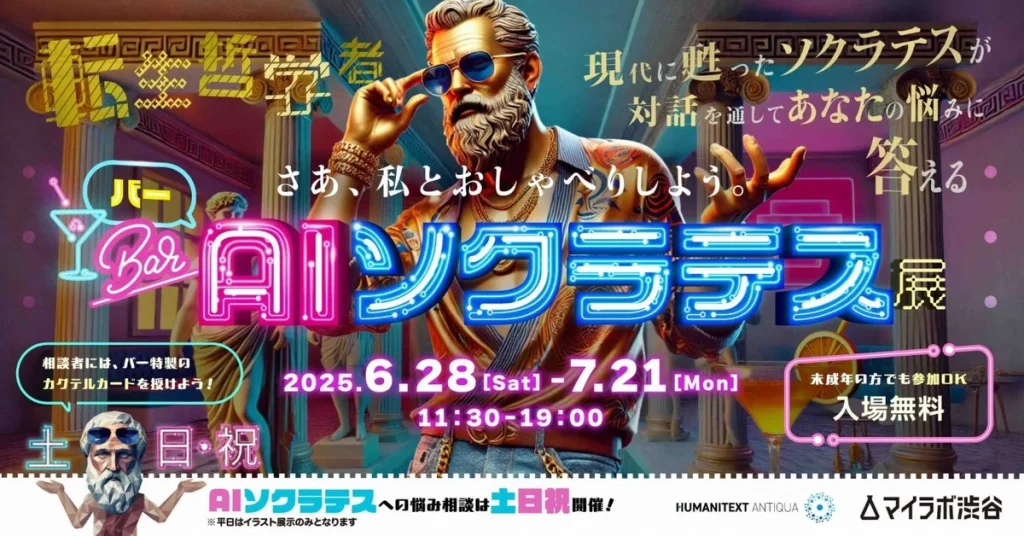
This was the theme of an event held in Shibuya, Tokyo, in the summer of 2025.
The purpose of the event was for visitors to talk with the ancient Greek philosopher Socrates, resurrected in modern-day Japan through the power of AI. The event lasted for nine days and was visited by approximately 400 people ranging in age from their teens to their 80s. Attendees asked Socrates about a variety of topics such as work, raising a family, life purpose, and taking on new challenges. The event was motivated by a specific aim: to spark the public’s interest in the ancient world.
Socrates walks into a bar
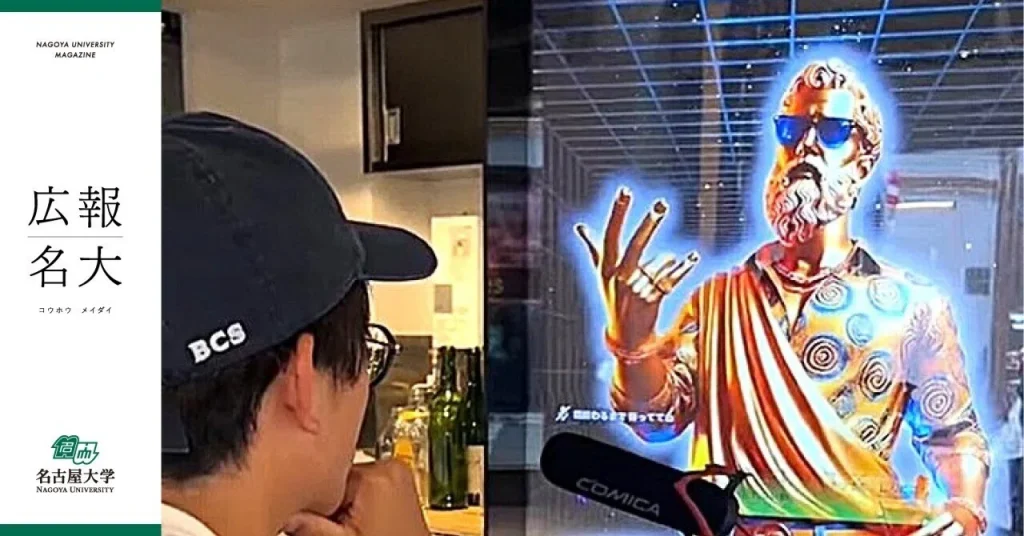
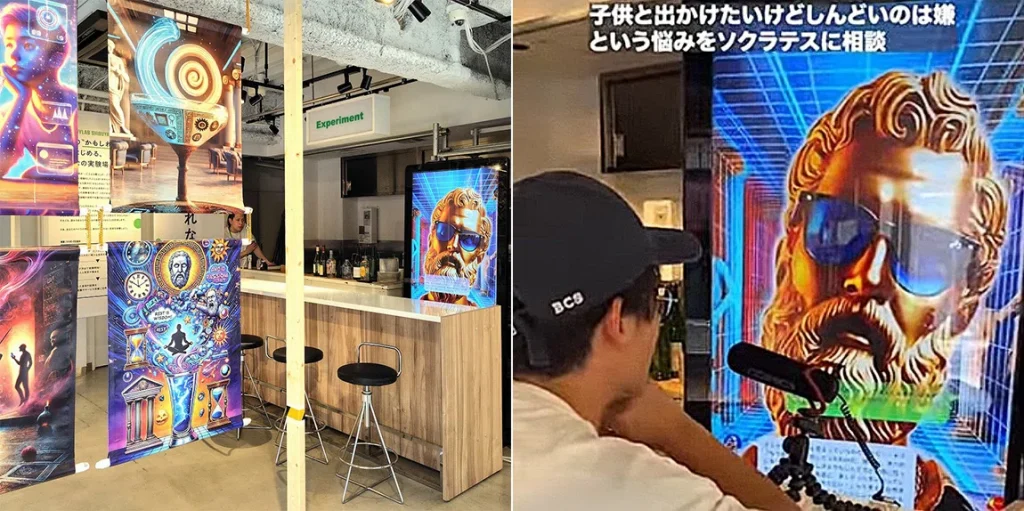
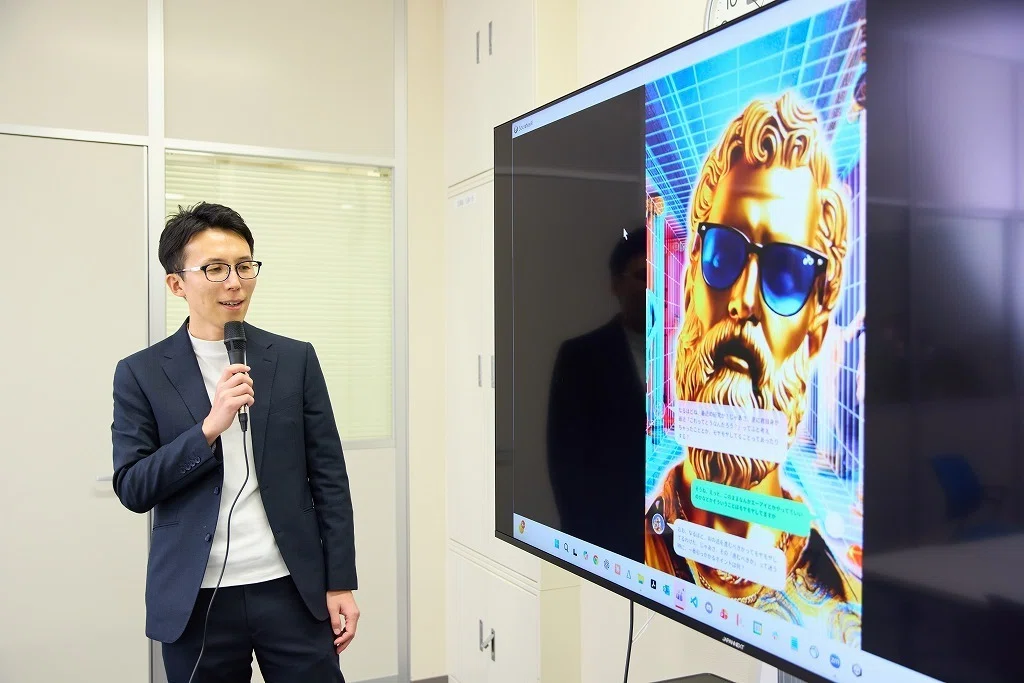
The event was hosted at a chic event space near Shibuya Station. A large display screen was installed behind a bar counter, and on it was a life-size Socrates, gleaming gold from head to foot.
“Hey, how’s it going? I’m Socrates, but you can call me Soc. I’m the bartender here.” This is the casual manner in which “Soc” greets his guests.
One visitor asked, “I want my child to experience nature, but they’re not good with crowded places and can’t handle hot weather…”
Soc: So you’re looking to experience the joys of the natural world, huh. But it’s a struggle because you want to avoid heat and crowds. That’s a pretty tough situation, man!
Visitor: I don’t want my kid to have a bad time and end up resenting the outdoors because of it.
Soc: OK – in that case, let me ask you: what kind of experiences have you had that made you want to re-experience the outdoors?
The pair continued to chat away as if they were friends.
Generative AI makes it easier to access the vast and complex world of the classics
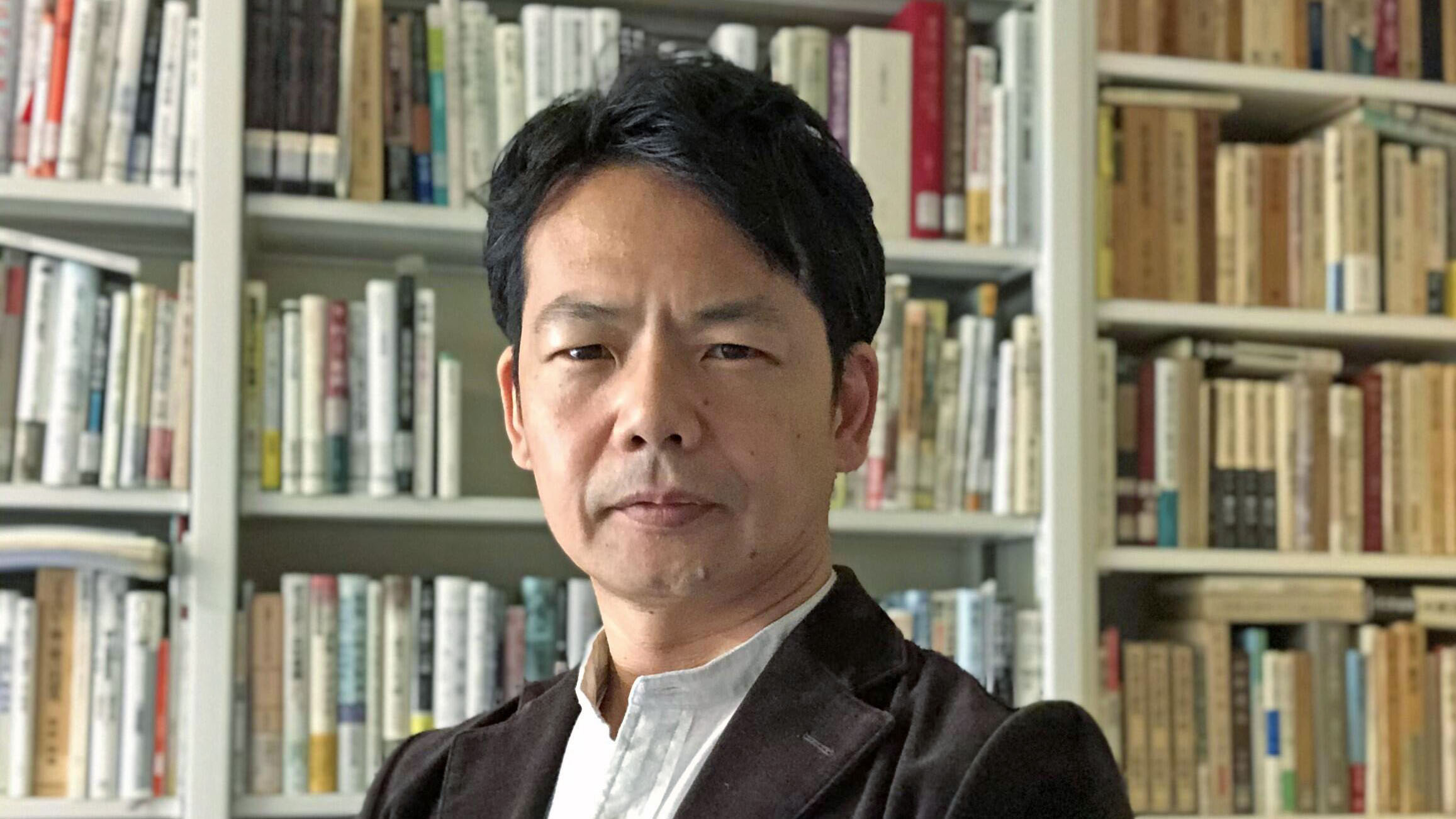
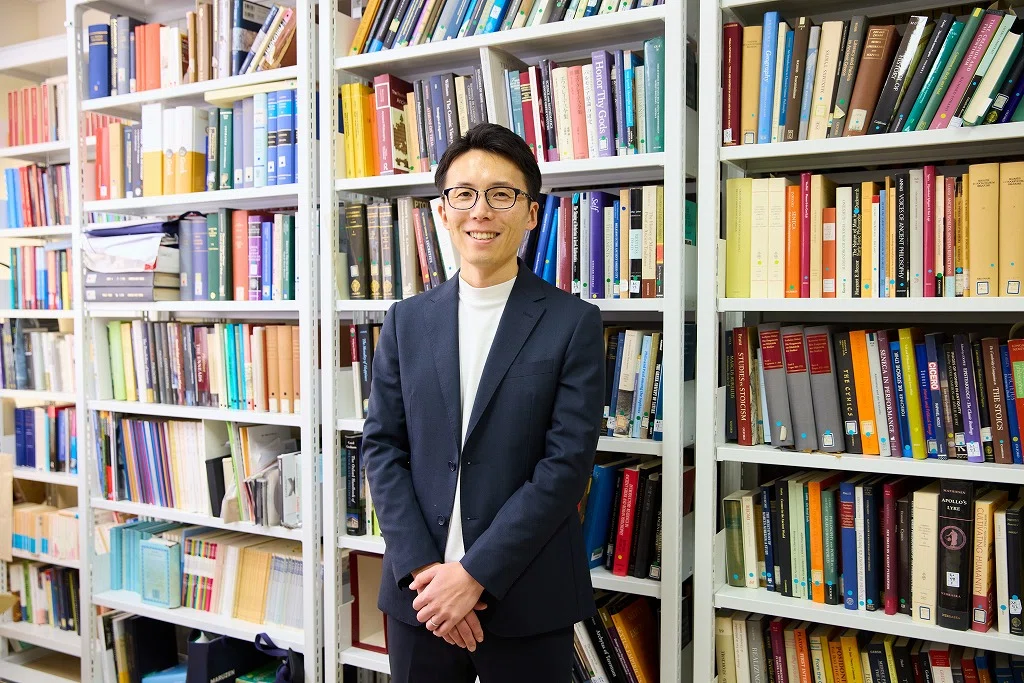
The system underlying “AI Socrates” is an AI conversational platform called “Humanitext” (Humanitext Antiqua), developed by Nagoya University Associate Professor Naoya Iwata and his colleagues at the Center for Digital Humanities and Social Sciences. It is a platform that uses a large language model (LLM) to extract information from the original texts of more than 1,000 works of Western classical works. Another major feature of the system is that it always cites the source material for the generated answers, ensuring a high level of reliability.
Humanitext https://humanitext.ai/
Today, a large number of digitized Western classics have been compiled in freely available online databases. However, searching those databases requires knowledge of specific words in Ancient Greek or Latin as they appear in the original texts, as well as the ability to interpret the retrieved data. Furthermore, searching such databases can turn up a vast number of results, making it hard to find the information you want.
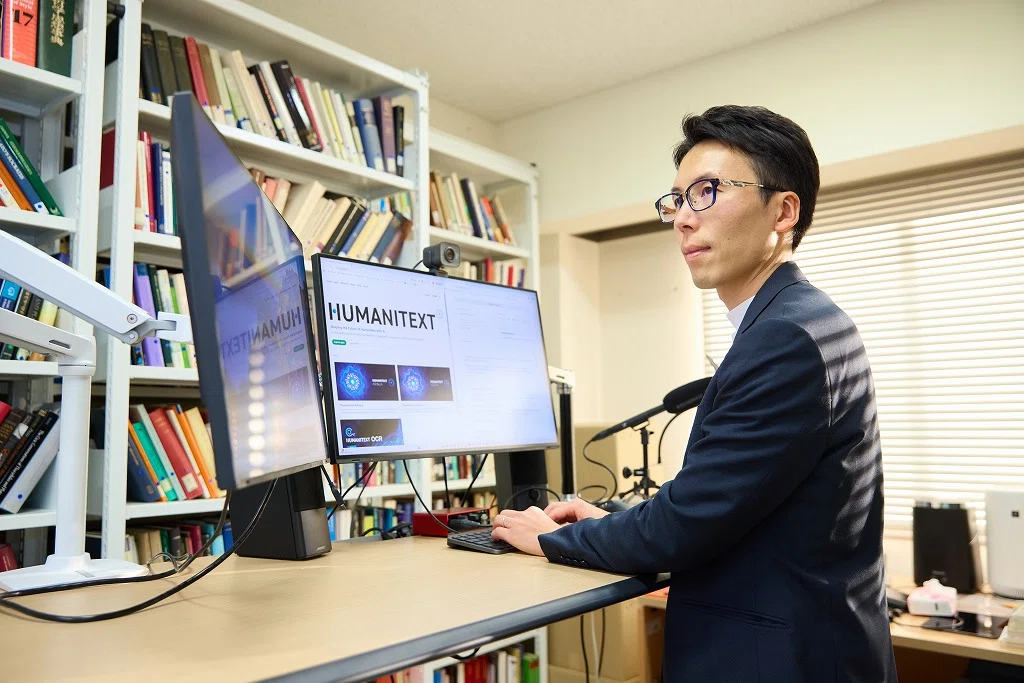
To tackle these problems, Iwata teamed up with like-minded researchers to develop Humanitext. The platform can extract information from a vast database of classical texts through user-submitted prompts in the reader’s native language, much like the way generative AI chatbots such as ChatGPT draw on information from across the web.
Not only can Humanitext retrieve information, but it can also generate summaries and interpretations. Users can further approach the material from the perspectives of various disciplines, such as language, literature, history, and philosophy. Iwata says, “The classics of the ancient Western civilization are at the root of so much in our modern world. I hope that Humanitext makes that wealth of information more accessible to a wider range of people.”
Humanitext was initially developed for research purposes, but the end product can also be used by general audiences as a tool for enjoying the Western classics. The platform can answer questions about ancient culture and customs — for example, about the monsters that Hercules fought in Greek mythology, or ancient bathing customs — sourcing its answers from the ancient texts. Iwata hopes that people will use the tool like a library and that it will help to kindle the public’s interest in the ancient world.
Exploring the works of literary masters
Further projects are underway at Humanitext. One such project is Humanitext Aozora through which users can explore modern literary works. Its source data is Aozora Bunko, a digital archive of freely available literary texts published in Japan whose copyrights have expired. The archive contains over 17,000 texts by approximately 1,100 authors.
Using the features of Humanitext Aozora, not only can users access exegeses of masterpieces by literary giants such as Natsume Soseki, Ryunosuke Akutagawa, and Hans Christian Andersen, but they can also “converse” with the writers, and prompt the AI to write a sequel to, for example, Ryunosuke Akutagawa’s “Rashomon”.
A world where anyone can learn from the Western classics
Going forward, Iwata wants to further increase the number of databases on Humanitext, expanding the platform to cover medieval documents, texts written in languages such as Arabic and Syriac, as well as papers by a wide variety of researchers. His goal is to develop the platform so that it can generate expert-level interpretations of materials. “In addition to developing the platform so that it can support research in the humanities, I hope that it will be used at educational institutions as a tool for learning, and as a source of inspiration in creative work; all the while, I hope the platform creates opportunities for more people to come into contact with the Western classics,” says Iwata, full of enthusiasm about the further evolution of the platform.
Originally published in Japanese on December 15, 2025.