Scientists applied advanced mirror-making technology, originally developed for synchrotron radiation research at a Japanese X-ray facility, to build high-resolution X-ray optics
Scientists in Japan have developed a high-resolution X-ray telescope sharp enough to distinguish an object just 3.5 mm wide from one kilometer away, by combining precision mirror-making technology with space astronomy. To test its performance, they built a first-of-its-kind evaluation system, capable of simulating starlight on the ground to measure the telescope’s sharpness before its launch on the US-Japan FOXSI sounding rocket mission. The findings, published in Publications of the Astronomical Society of the Pacific, represent a landmark achievement for Japanese X-ray astronomy and pave the way for high-resolution X-ray observations on future smaller satellites.
Why do we need X-ray telescopes in space?
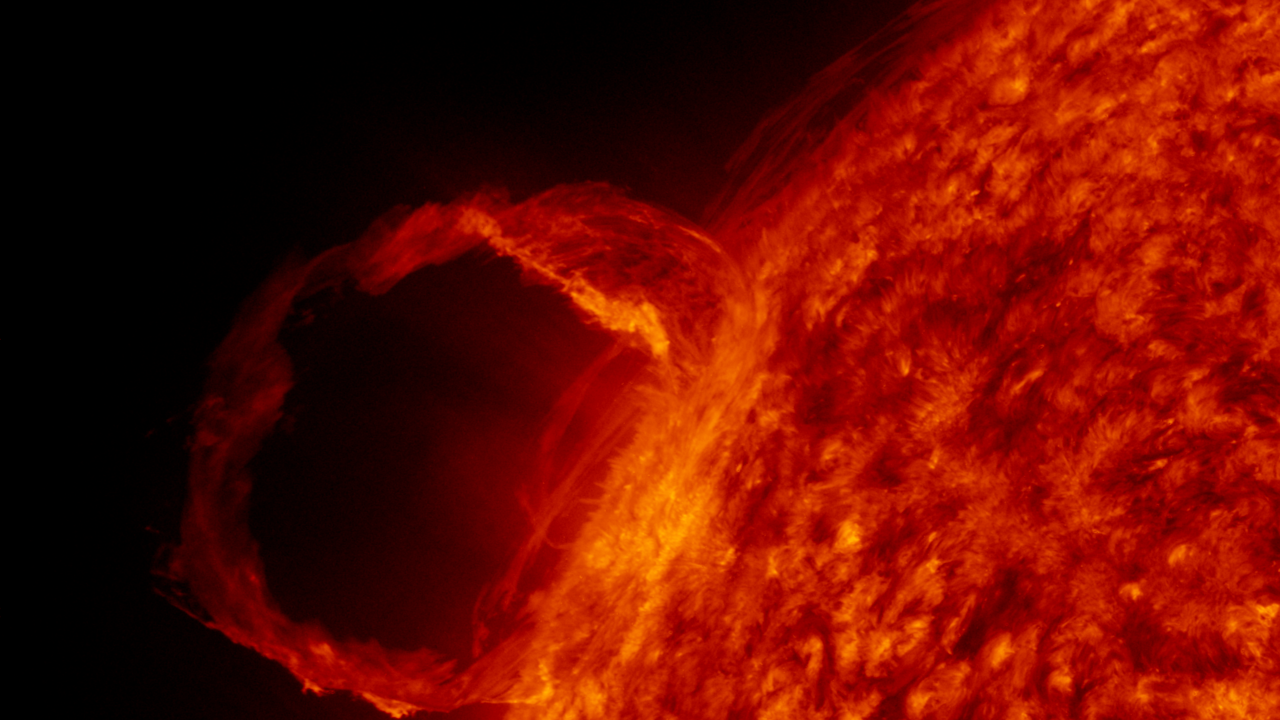
Enormous amounts of X-rays are released by solar flares, exploding stars, and matter around black holes. These X-rays hold clues about some of the highest-temperature and most violent processes in the universe, but Earth’s atmosphere absorbs them before they reach the ground. Because scientists cannot study them from the surface, instruments must travel into space on balloons, sounding rockets, or satellites.
X-ray astronomers do it with high precision mirrors
Achieving a high-resolution X-ray space telescope has been a challenge in Japanese X-ray astronomy. Two technical obstacles stood in the way: first was the telescope’s mirror. X-rays do not reflect off ordinary surfaces. They can only be reflected at extremely small angles, and the mirror surface must be shaped to nanometer-level precision. Second was integration. Even a perfectly fabricated mirror can lose its precision during the process of mounting it into a telescope assembly.
“The mirror is like a very precise funnel for X-rays. If any part of the funnel is even slightly out of place, the X-rays miss their target and the image blurs,” said Ikuyuki Mitsuishi, senior author and project leader from the Graduate School of Science at Nagoya University. “It must also survive the intense vibrations of a sounding rocket launch while retaining its optical precision.”
From a synchrotron radiation facility to a space telescope
SPring-8 is one of the world’s most powerful X-ray research facilities, located in Hyogo Prefecture, Japan. Its particle accelerator produces very bright X-ray beams, known as synchrotron radiation, for scientific research. Scientists there had developed extremely precise mirror-making techniques to focus those X-ray beams. Those same techniques were used by the research team to build a high-resolution space telescope mirror.
The researchers used a precision electroforming technique from SPring-8 to produce a nickel mirror, 60 mm in diameter and 200 mm tall. Unlike mirrors built from multiple pieces, this mirror was cast as a single seamless shell, so there were no joints or seams that could deflect the X-rays away from the focal point, and nothing could move out of place.
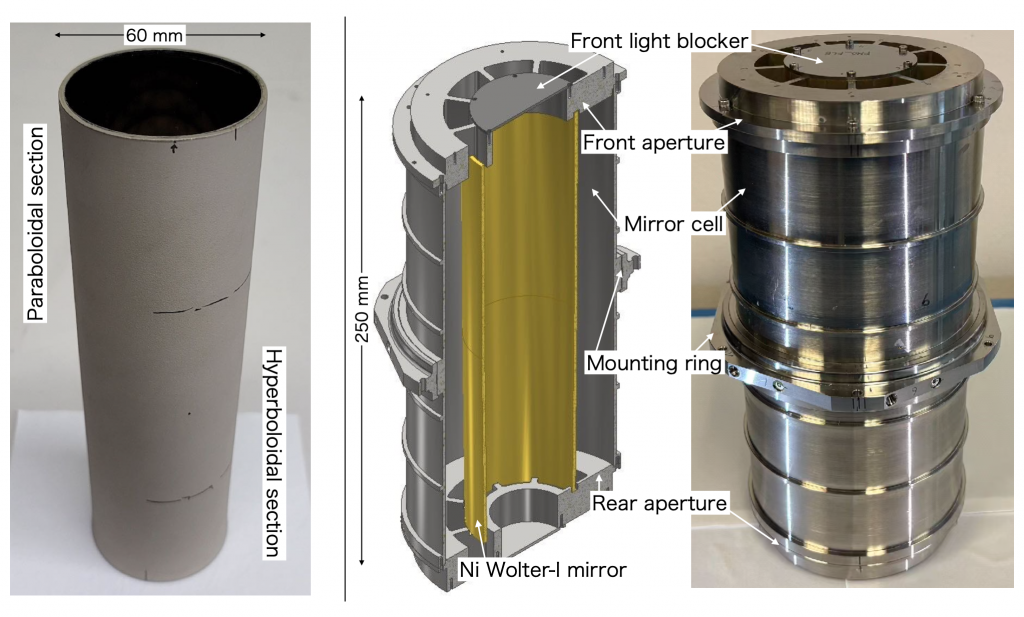
The project brought together two very different areas of expertise: the astronomy team, led by researchers from Nagoya University, worked on the optical design and the challenge of integrating the mirror into a space-ready telescope assembly. A team from the synchrotron radiation community, including members from SPring-8 as well as researchers from universities and industry, was responsible for precision mirror fabrication and building the ground-based testing system.
Before launch, the researchers had to prove that the telescope worked on the ground, but this created a problem: to test a space telescope properly, you need to simulate starlight, and starlight arrives from so far away that its rays are almost perfectly parallel by the time they reach Earth. Recreating that on the ground is extremely difficult.
The research team solved this by building a testing system at SPring-8. A very small X-ray source, just 10 micrometers across, was placed 900 meters away from the mirror. At that distance, the X-rays stayed parallel and closely mimicked the rays arriving from a real star.
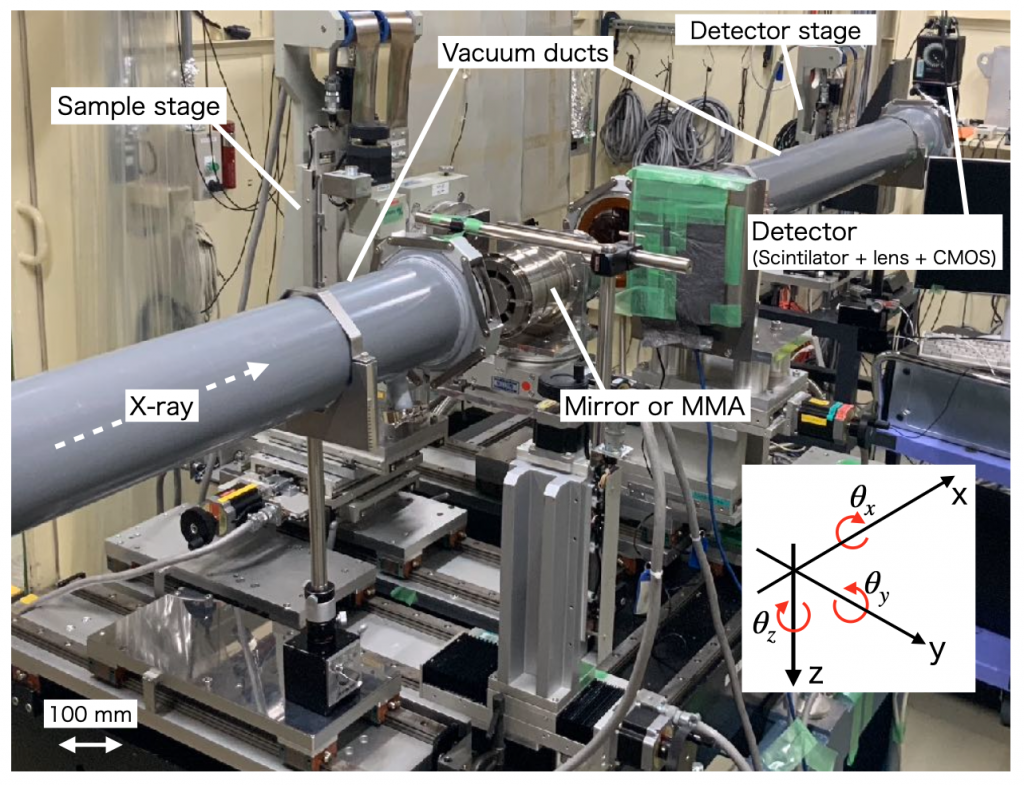
“It’s the first ground-based system capable of accurately evaluating the performance of high-resolution X-ray space telescopes at hard X-ray energies, and it is available to researchers worldwide who want to develop and test similar technology,” said Ryuto Fujii, first author and former master’s student.
Launched into space with FOXSI-4 (and soon FOXSI-5)
FOXSI is a collaborative sounding rocket experiment—a small sounding rocket that carries instruments briefly into space. It is designed to capture X-ray images of the Sun’s corona and flare. The program first launched in 2012 and its fifth flight is scheduled for 2026.
The telescope was one of seven X-ray telescopes aboard FOXSI-4, which launched from Alaska on April 17, 2024, and successfully observed a solar flare in progress. Dr. Mitsuishi and his students were present at the launch. For the research team, this was a historic moment, the first time a domestically developed Japanese high-resolution X-ray telescope had flown as part of an international sounding rocket mission.
The researchers also identified the main factor that limits further improvements in sharpness: tiny imperfections along the length of the mirror surface. This gives them a clear target for improvement in future mirrors.
A foundation for future space research
This research shows that combining space astronomy and synchrotron radiation science can produce results that neither field could achieve alone. An improved version of the telescope is set to fly on the FOXSI-5 mission.
The long-term goal is miniaturization. The research team aims to scale the mirror technology down to fit inside CubeSats, satellites about the size of a shoebox. High-resolution X-ray optics have not yet flown on CubeSats. If successful, this technology could make X-ray space observations much more accessible and open a new chapter in compact X-ray astronomy.
Paper information:
Ryuto Fujii, Koki Sakuta, Kazuki Ampuku, Yusuke Yoshida, Makoto Yoshihara, Ayumu Takigawa, Keitoku Yoshihira, Tetsuo Kano, Naoki Ishida, Noriyuki Narukage, Keisuke Tamura, Kikuko Miyata, Gota Yamaguchi, Hidekazu Takano, Yoshiki Kohmura, Shutaro Mohri, Takehiro Kume, Yusuke Matsuzawa, Yoichi Imamura, Takahiro Saito, Kentaro Hiraguri, Hirokazu Hashizume, Hidekazu Mimura, and Ikuyuki Mitsuishi (2026). Development of Electroformed X-ray Optics Bridging Synchrotron Technology and Space Astronomy, Publications of the Astronomical Society of the Pacific, 138(4). DOI: https://doi.org/10.1088/1538-3873/ae3b74
Funding information:
This work was supported by the Grants-in-Aid for Scientific Research (KAKENHI) from the Japan Society for the Promotion of Science (JSPS) under grant numbers JP22K18274, JP20K20920, JP23H00156, JP22H00134, and JP21KK0052, and JST SPRING (grant number JPMJSP2125). Additional support was received from the ISAS program for small-scale projects, Iwadare Scholarship Foundation, Yokoyama Scholarship Foundation, Hattori International Scholarship Foundation (HISF), and the THERS Make New Standards Program for the Next Generation Researchers.
Expert contact:
Ikuyuki Mitsuishi
Graduate School of Science
Nagoya University
E-mail: mitsuisi@u.phys.nagoya-u.ac.jp
Media contact:
Merle Naidoo
International Communications Office
Nagoya University
Email: icomm_research@t.mail.nagoya-u.ac.jp
Top image:
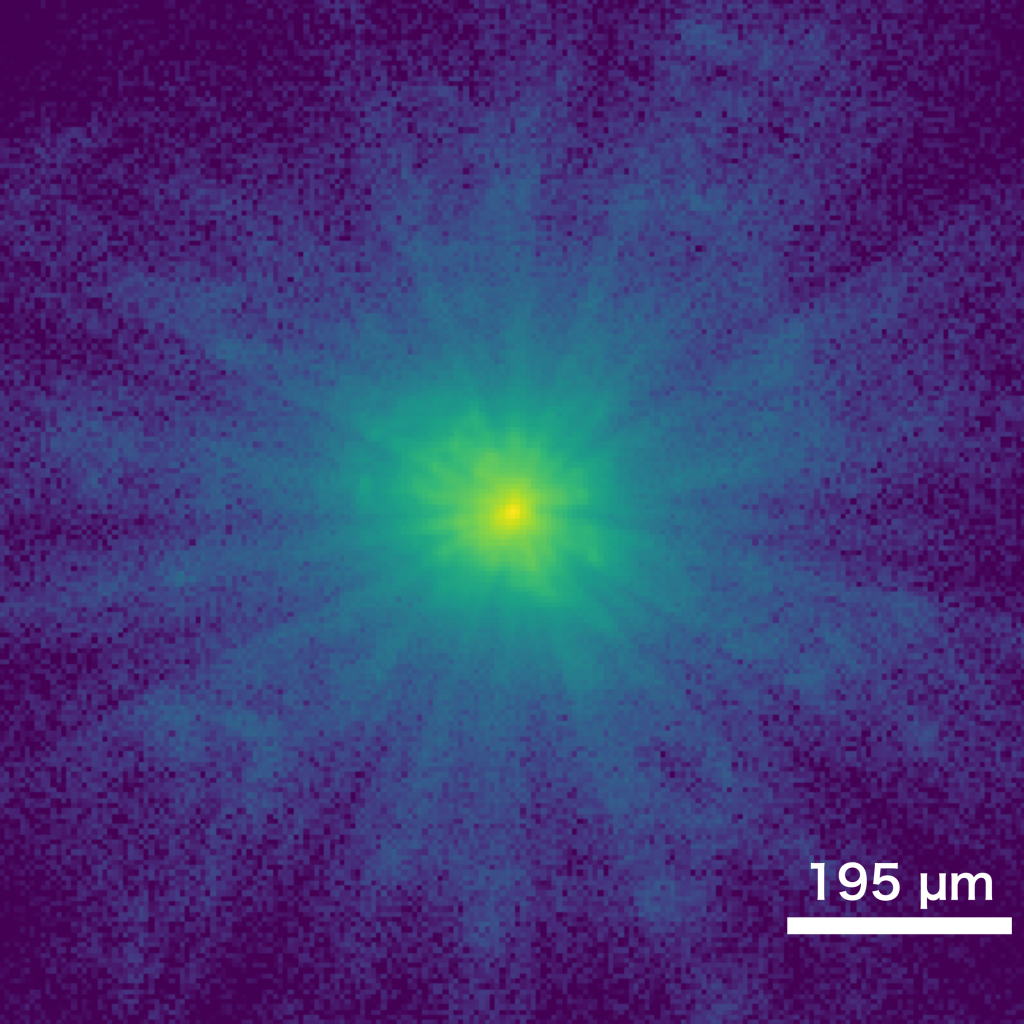
A color-coded X-ray image from ground-based testing at SPring-8 shows the X-ray optics successfully focusing X-rays onto a sharp central point. Yellow-green indicates the highest X-ray concentration, while blue represents lower intensity. Credit: Fujii et al., 2026