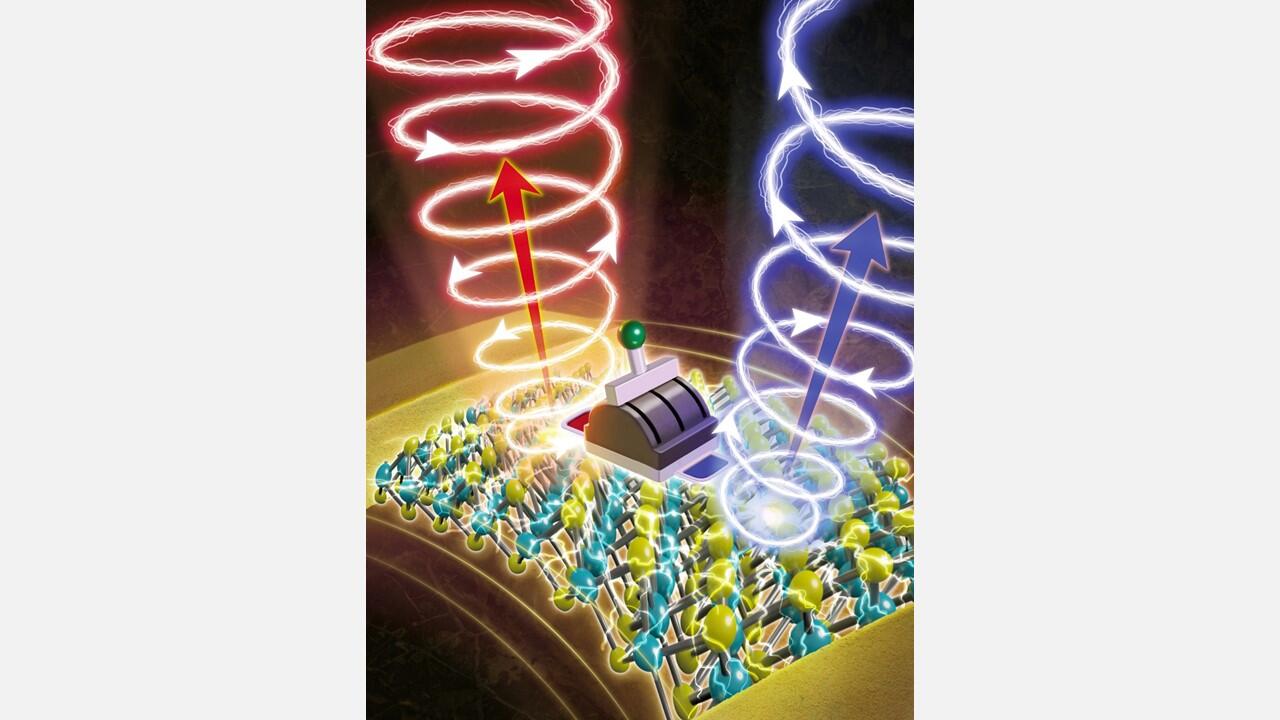
Nagoya University researchers break conventional rules to develop heat-resistant, recyclable metal alloys for automotive and aerospace use.
Aluminum is prized for being lightweight and strong, but at high temperatures it loses strength. This has limited its use in engines, turbines, and other applications where parts must stay strong under high temperature conditions. Researchers at Nagoya University have developed a method that uses metal 3D printing to create a new aluminum alloy series optimized for high strength and heat resistance. All new alloys use low-cost, abundant elements, and are recycling-friendly, with one variant staying both strong and flexible at 300°C. The study was published in Nature Communications.
Breaking with tradition to create the perfect aluminum alloy
“The design centers on iron, which metallurgists usually don’t add to aluminum because it makes the metal brittle and vulnerable to corrosion,” Naoki Takata, lead author and professor at Nagoya University Graduate School of Engineering, explained.
“The extreme cooling rates in laser powder bed fusion, which is a representative process of metal 3D printing technologies, cause molten metal to solidify in seconds. This changes fundamental rules—the rapid cooling traps iron and other elements in arrangements (formation of metastable phases) that can’t form under normal manufacturing conditions. By carefully selecting which elements to add, we created new alloys that are both heat-resistant and strong.”
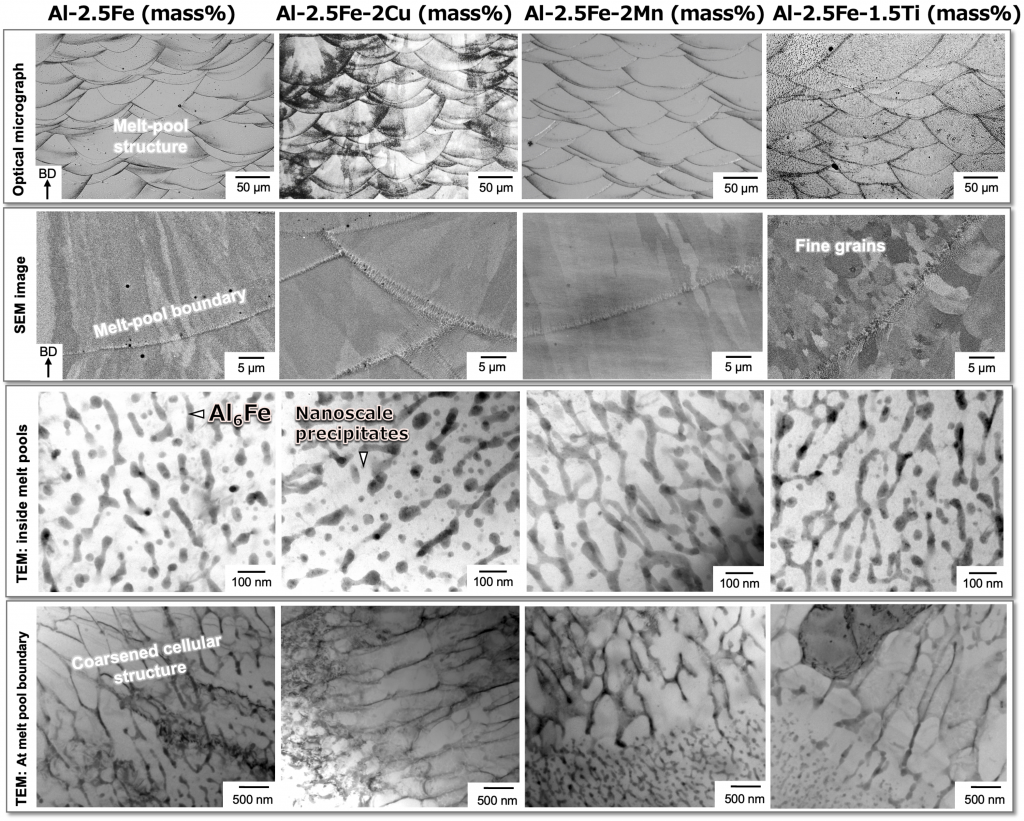


The researchers developed a systematic method to predict which elements will strengthen the aluminum matrix and which will form protective micro or nano structures. They tested these predictions by creating new alloys with copper, manganese, and titanium, and then confirmed the results through electron microscopy.
The best performing alloy contains aluminum, iron, manganese, and titanium (Al-Fe-Mn-Ti), and outperforms all other 3D-printed aluminum materials by combining strength at high temperatures with flexibility at room temperature.
“Our method relies on established scientific principles about how elements behave during rapid solidification in 3D printing and is applicable to other metals. The alloys also proved easier to 3D print than conventional high-strength aluminum, which frequently cracks or warps during fabrication,” Professor Takata noted.
Watch how advanced aluminum alloys are made using 3D printing. This video shows a laser melting metal powder layer by layer to create strong, lightweight aluminum parts. Copper, manganese, and titanium are added to improve strength, durability, and performance. Credit: Aichi Center for Industry and Science and Technology, Toyota
Lighter vehicles, fewer emissions
The new materials could enable lightweight aluminum components in parts that operate at elevated temperatures, such as compressor rotors and turbine components. Lighter vehicles consume less fuel and produce fewer emissions.
The aerospace industry may also benefit, as aircraft engines require materials that combine light weight with heat resistance. Beyond these applications, the research provides a framework for designing new classes of metals specifically for 3D printing, with potential to accelerate development across multiple industries.
Paper information:
Naoki Takata, Koki Minamihama, Takanobu Miyawaki, Yue Cheng, Yifan Xu, Wenyuan Wang, Dasom Kim, Asuka Suzuki, Makoto Kobashi, and Masaki Kato (2025). Design of high-performance sustainable aluminum alloy series for laser additive manufacturing. Nature Communications, 16, 11105. DOI: https://doi.org/ 10.1038/s41467-025-67281-8
Funding information:
This research was supported by JST PRESTO (Grant JP22688912) and JSPS KAKENHI (Grant 24H00378).
Research Contact:
Naoki Takata
Graduate School of Engineering
Nagoya University
Email: takata.naoki@material.nagoya-u.ac.jp
Media Contact:
Merle Naidoo
International Communications Office
Nagoya University
Email: icomm_research@t.mail.nagoya-u.ac.jp
Top image:
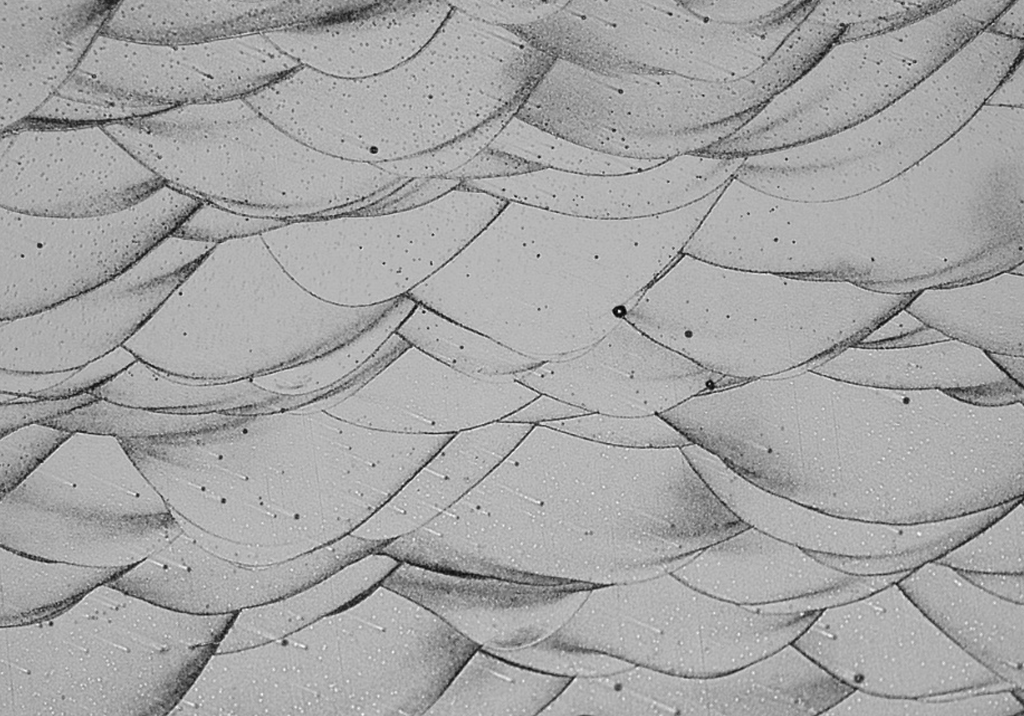
Microscope image showing the layered structure of a new 3D-printed aluminum alloy. The wave-like patterns are “melt pools,” traces left by the laser as it melted metal powder layer by layer. The small dark dots are nanoscale particles that give the alloy its exceptional strength and heat resistance. Credit: Takata et al., 2025
Researchers
-
 TAKATA NaokiGraduate School of Engineering, Materials Design Innovation Engineering, 3
 -
KIM DasomGraduate School of Engineering, Materials Design Innovation Engineering, 3
-
 SUZUKI AsukaGraduate School of Engineering, Materials Process Engineering, 1
 -
KOBASHI MakotoGraduate School of Engineering, Materials Process Engineering, 1