A new deep learning model classifies Japanese Sue ware from 3D scans with 93% accuracy while showing which parts of an object drove its decision
Classifying ancient pottery has always depended on the trained judgment of an archaeologist. Identifying the subtle differences between piece types takes years of experience, and two experts will not always agree. Now, a team including researchers at Nagoya University in Japan has developed a deep learning model that can classify pottery by shape with high accuracy, using three-dimensional scan data rather than photographs or drawings.
What sets the approach apart is not just its accuracy: by visualizing which parts of an object the model weighted most heavily, the researchers found that it tended to focus on regions that may correspond to those expert archaeologists consider when examining a piece by hand.
“Our model lets us see which points were most important to the classification decision,” said senior author Hayata Inoue of Nagoya University’s Graduate School of Humanities. “This transparency transforms the model from a black box into a tool that helps us understand how these decisions are made.” The results were published in the Journal of Archaeological Science.
A pottery type caught between categories
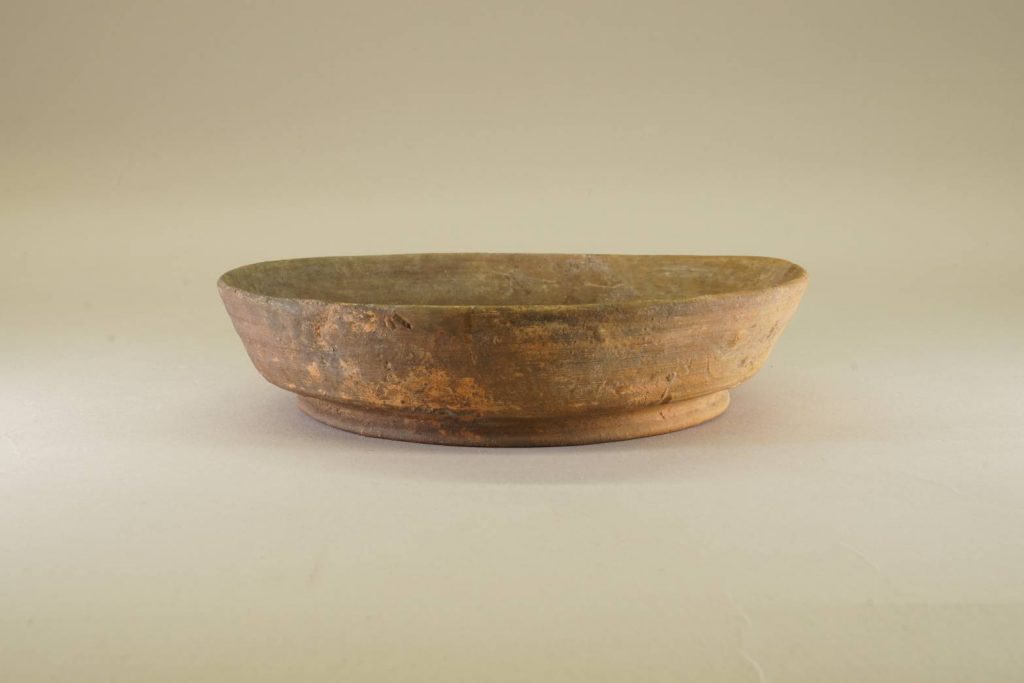
The study focuses on Sue ware, an unglazed stoneware used mainly between the fifth and tenth centuries in Japan. Gray to brown-gray in color, it was shaped on a potter’s wheel and fired at high temperatures in a tunnel kiln, resulting in pieces that are relatively consistent in shape and a natural candidate for classification by form.
The research examines pottery from the Sanage kiln in Aichi Prefecture, which was the dominant Sue ware production center in Japan from the eighth to the mid-ninth century. Among the types it produced, two everyday tableware categories have long posed a challenge: the Dish Body and the Bowl.
Dish-type pieces tend to have more vertical walls and flat bottoms, while bowl-type pieces have gently curving walls and bases. During the eighth to mid-ninth century, however, many examples across these two categories labeled by experts combine features of both. Researchers believe this blurring reflects a historical shift. Eating habits in Japan are thought to have changed during this period from reaching into dishes by hand to using chopsticks or spoons, and the evolving shapes of tableware may be a record of that transition.
Building a model that works in three dimensions
Earlier approaches to pottery classification using deep learning have mostly relied on 2D photographs or cross-sectional outline drawings. The limitation is straightforward: reducing a three-dimensional object to a single profile discards surface information, and two objects that look nearly identical in outline can be meaningfully different in 3D.
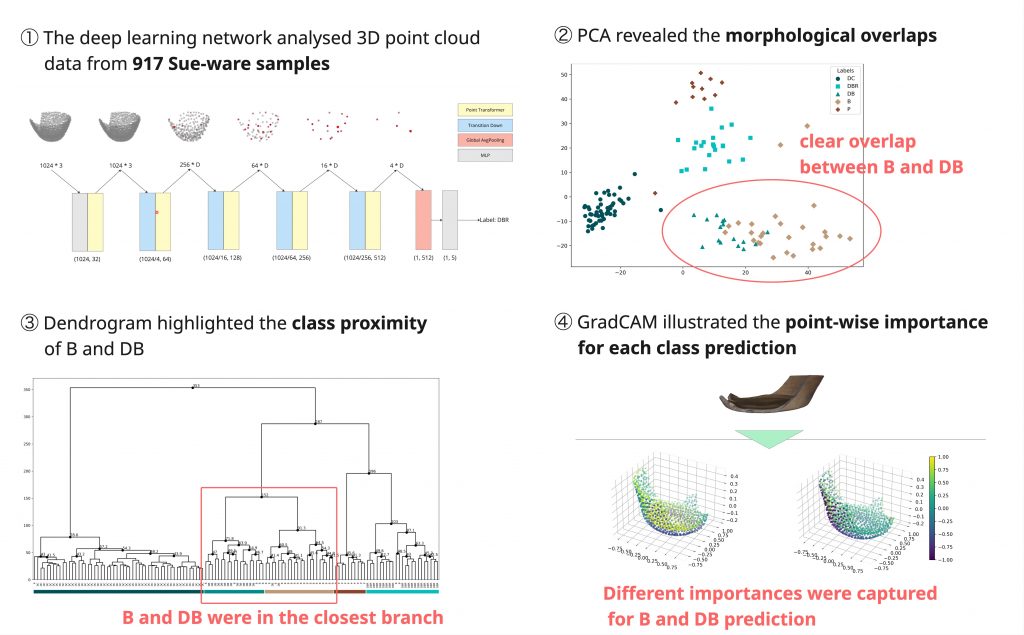
To move beyond this, the team used an architecture called Point Transformer, which processes three-dimensional point clouds directly. A point cloud maps thousands of spatial coordinates across an object’s surface to describe its shape in full. The team digitized 917 Sue ware pieces using an optical scanner and photogrammetry, represented each as 1,024 points, and had expert archaeologists assign labels. The model was then trained to recognize shape differences across five types: Dish Cap, Dish Body with Ring Base, Dish Body, Bowl, and Plate.
What the model reveals about the past
Across all five types, the model achieved an overall accuracy of 93.2%, performing almost perfectly on the most visually distinct categories. The lowest scores came from the Dish Body and Bowl types. The difficulty the model had separating them reflects a genuine overlap in their shapes, supporting the view that the boundary between these two types was not clearly defined during the transitional period.
To understand how the model reached its decisions, the researchers used a technique called Gradient-weighted Class Activation Mapping (Grad-CAM), which highlights which points on an object contributed most to a given classification. For Dish Body predictions, the model focused on the rim and the steep inner angle between the base and wall. For Bowl predictions, it concentrated on the outer surface and base. These may correspond to the regions that trained archaeologists consider important when classifying pieces by hand, though the model does not always follow the same pattern.
The team has made the dataset and code freely available, and the framework is designed to be adapted for other ceramic traditions beyond Japan. “This approach does require a reasonably large sample,” said corresponding author Wataru Tatsuda, a master’s student at University College London and a Nagoya University alumnus. “But we hope this study becomes a starting point for deep learning-based morphological classification of 3D data in archaeology worldwide.”
Publication
Wataru Tatsuda, Ryo Hori, Kimiyasu Morikawa, and Hayata Inoue. (2026). “Deep learning-based morphological classification of ceramics: A case study of 3D point cloud analysis for Sue ware, Japan.” Journal of Archaeological Science, 187. https://doi.org/10.1016/j.jas.2026.106472
Funding
This work was supported by Nagoya University Graduate School of Humanities’ 2019 Field Research Project, “3D Database Construction of Sue Ware Excavated from Sanage Kiln,” and the Konosuke Matsushita Memorial Foundation Research Grant for the “Basic Research of Typological Analysis of Archaeological Materials Using Artificial Intelligence (AI).”
Media contact
Alexander Evans
International Communications Office, Nagoya University
icomm_research@t.mail.nagoya-u.ac.jp
Expert contacts
Hayata Inoue
Nagoya University
inoue.hayata.e2@f.mail.nagoya-u.ac.jp
Wataru Tatsuda
University College London
wataru.tatsuda.25@ucl.ac.uk
Top image
An example of Sue ware, a type of pottery used in Japan mainly between the fifth and tenth centuries. Credit: Photo by Hayata Inoue / Courtesy of the Aichi Prefectural Ceramic Museum