A brain enzyme thought to have a single function builds a sugar chain on itself, is secreted from the cell, and switches off — reactivating only when the sugar is removed
A chance discovery at Nagoya University in Japan has shown a well-known brain enzyme has a hidden ability: it builds a sugar chain on itself, becomes secreted from the cell and deactivates, then switches on outside the cell once the chain is removed. The finding, published in the Journal of Biological Chemistry, overturns a decades-old assumption about how polysialic acid, a sugar chain critical for brain development and function, is produced and shows a new way an enzyme can regulate its own activity.
The brain’s sugar chains
The human brain is covered in sugar chains, or glycans, molecular structures that coat cells and regulate how they communicate. One of the most important is polysialic acid, a long chain found mainly in the brain.
Polysialic acid keeps brain cells from adhering too tightly to each other and binds to growth factors and neurotrophins to regulate the presentation of their receptors, through which it plays a key role in learning, memory, and neural development. Importantly, these sugar chains change rapidly in response to brain activity. The ability to restore them quickly is thought to be essential for normal brain function.
Until now, scientists believed only two enzymes were responsible for building polysialic acid in the brain: ST8Sia2 and ST8Sia4.
A chance discovery
ST8Sia5 was discovered in 1996 and was known only as a builder of fatty brain molecules called gangliosides. It is expressed almost exclusively in the brain and its ability to produce polysialic acid was unknown until now.
The enzyme exists in three forms, short (S), medium (M), and long (L), that differ only in the length of one structural region. Only the long form, ST8Sia5L, showed this newly discovered activity. Unlike the short and medium forms, ST8Sia5L localizes to a different intracellular compartment, which may allow it to undergo autopolysialylation. The function of the short and medium forms is not yet known.
Nagoya University’s Institute for Glyco-core Research (iGCORE) had been testing all six members of the ST8Sia enzyme family.
“We found that a third enzyme, ST8Sia5, also builds polysialic acid, but only on itself, and only in its longest form, ST8Sia5L,” said first author Fumiya Sakamoto.
Coauthor and Director of iGCORE Professor Chihiro Sato commented: “We were checking each enzyme one by one and found this activity by chance.”

Four discoveries that define this mechanism
- The enzyme builds its own off switch. Unlike most enzyme regulation, where a separate molecule switches an enzyme on or off, ST8Sia5L modifies itself. It builds polysialic acid chains directly onto its own structure, a process called autopolysialylation. No external regulator is required.
- The sugar chain is the switch. Polysialic acid is not typically known as a regulator of enzyme activity, but here it acts as one. While the chain is attached, the enzyme’s ganglioside-building function is completely suppressed. This is a new role for polysialic acid.
- Self-modification is linked to secretion. Once coated in polysialic acid, the enzyme is cut free from the cell membrane by metalloprotease enzymes and released into the fluid outside the cell. The sugar coat does not just silence the enzyme; it is also associated with its release from the cell.
- The enzyme reactivates outside the cell. The researchers showed experimentally that the secreted enzyme, collected from outside the cell, regains its ganglioside-building activity once the polysialic acid chains are removed. This could happen, for example, when sialidase enzymes are released during stress or inflammation. Reactivation does not require the enzyme to re-enter the cell.
A surprise finding for other enzymes too
The ST8Sia family are all sialic acid-building enzymes, but they differ in how long a chain they build. Most add just two or three units. ST8Sia2 and ST8Sia4 were the only ones known to build long chains of polysialic acid. ST8Sia5L has now joined that group, but with one key difference: it only builds the long chain on itself, not on other molecules.
The study also found, for the first time, that ST8Sia2 and ST8Sia4 are also secreted from cells in a polysialic acid-coated form. What this means for those enzymes is not yet known.
Broader implications
One of the most significant conceptual implications of the study is where sugar modification can happen in the body.
“It’s been assumed that the process of adding sugar chains to molecules, called glycosylation, takes place inside the cell,” said Professor Sato. “This study provides evidence that modification can also happen outside the cell.”
The research team hypothesizes that after release, the enzyme may travel to specific sites on cell surfaces and rapidly repair damaged ganglioside structures, without needing to re-enter the cell first. The conventional pathway for ganglioside repair requires the molecule to travel back inside the cell for modification. This proposed “on-site recovery” mechanism, if confirmed, would represent a much faster alternative. The hypothesis is currently being investigated.
ST8Sia5L may also play a role in regulating microglia, the brain’s immune cells. The researchers hypothesize that the polysialic acid coat on the secreted enzyme may interact with inhibitory receptor molecules called Siglecs on microglia, helping to keep immune activation in check under normal conditions.
During inflammation or stress, sialidase enzymes could remove this coat, allowing immune responses to proceed and freeing the enzyme at the same time to resume its ganglioside-building activity at cell surfaces.
“Polysialic acid abnormalities have also been associated with schizophrenia, but the mechanism behind this link is not yet understood,” said Ken Kitajima, coauthor and professor at iGCORE. “The secreted polysialylated enzyme is one candidate for further investigation in this context.”
To test these hypotheses in a living system, the team is currently generating mice in which the ST8Sia5 gene has been disabled. The researchers also intend to investigate the unknown function of ST8Sia5S and ST8Sia5M, which both localize to a different compartment within the cell.
Paper information:
Fumiya Sakamoto, Rina Hatanaka, Masaya Hane, Di Wu, Ken Kitajima, Chihiro Sato, 2026. A novel autopolysialylation activity of the ganglioside sialyltransferase ST8Sia5 regulates its secretion and enzyme activity, Journal of Biological Chemistry, 302(7). DOI: https://doi.org/10.1016/j.jbc.2026.113106
Funding information:
This research was funded by the Japan Agency for Medical Research and Development (AMED) (18ae0101069h0003, 19ae0101069h0004, 20ae0101069h0005, 20gm6410007h0001, 21gm6410007h0002, 22gm6410007h0003, and 23gm6410007h0004 ) and a Grant-in-Aid for Scientific Research from JSPS (Grant numbers 23K21291 and 25K02224). A part of this research was also funded by the CIBoG program, Nagoya University.
Expert contact:
Chihiro Sato
Institute for Glyco-core Research (iGCORE)
Nagoya University
Email: chi@agr.nagoya-u.ac.jp
Media contact:
Merle Naidoo
International Communications Office
Nagoya University
Email: icomm_research@t.mail.nagoya-u.ac.jp
Top image:
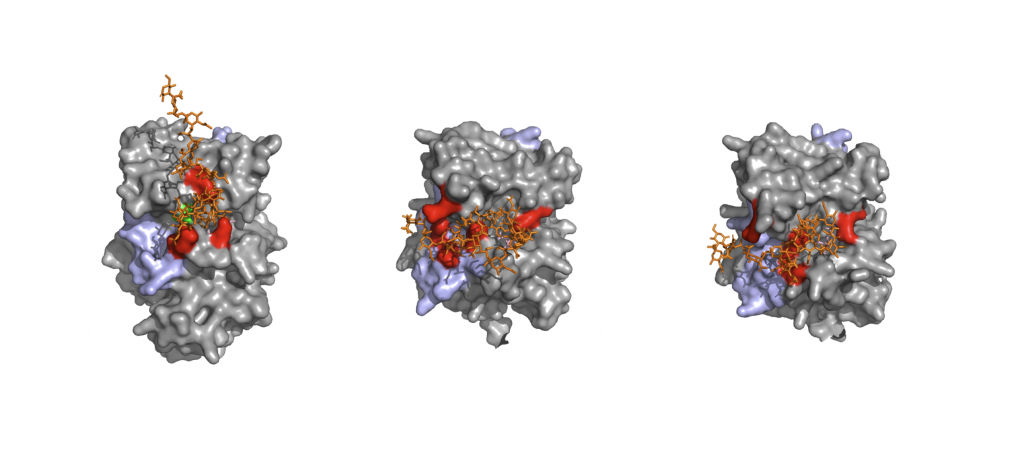
The three enzymes shown here build polysialic acid (orange), a long sugar chain important for brain development and function. ST8Sia5L (left) builds the chain only on itself, a newly discovered activity. ST8Sia2 (center) and ST8Sia4 (right) build it on other molecules. Credit: Sakamoto et al., 2026