Offering someone the right words for what they feel could play a role in how people manage their anxiety, with potential implications for classrooms, counseling, and home environments
We feel more anxious when facing uncertain or unpredictable situations, but for those who score higher on autistic traits, this anxiety tends to be stronger. Published in Scientific Reports, a new study suggests uncertainty-driven anxiety plays a role in how people manage their emotions. Researchers at Nagoya University in Japan found evidence that people with higher autistic traits may try to cope with uncertainty by labeling their feelings. Offering support, such as the right words for what they feel, could play a role in managing anxiety.
Putting a name to a feeling could reduce emotional stress
Previous research has suggested that labeling an emotion, whether by writing it down or saying it out loud, can help us calm down. While the anxiety does not disappear, it becomes less overwhelming when the emotion has a name.
Autistic traits refer to characteristics associated with autism spectrum disorder, such as differences in social communication and a preference for routine and predictability. These traits vary in degree across the general population.
A total of 505 Japanese adults aged 20 to 39 completed an online survey measuring autistic traits, discomfort with uncertainty, the tendency to put feelings into words, and anxiety levels.
“We measured autistic traits using a 50-item questionnaire called the Autism-Spectrum Quotient which covers five areas: social skills, the ability to shift attention, communication, imagination, and attention to detail,” said first author and doctoral student Akitaka Fujii from the Graduate School of Informatics at Nagoya University.
The researchers found that people who scored higher on autistic traits also experience stronger anxiety in uncertain situations. This is known as intolerance of uncertainty, a tendency to react negatively when situations feel ambiguous or beyond one’s control.
“Our findings suggest that discomfort with uncertainty is associated with a greater tendency to put feelings into words, and this is linked to lower anxiety levels,” said Masahiro Hirai, coauthor and associate professor from the Graduate School of Informatics.
Offering someone the right words to describe how they feel may help them manage their anxiety. For example, a teacher or family member might say “I think you might be feeling anxious about that” when someone struggles to express distress. This perspective could inform future approaches in classroom and counseling settings.
Limitations and next steps
The researchers caution that these are early findings and more research is needed to confirm their theory. Because the study did not involve people with a clinical diagnosis of autism, the findings cannot be directly applied to autistic people.
The Hirai Lab is currently conducting a follow-up study with adults who have a clinical diagnosis of autism to test whether similar patterns are observed. The authors highlight the need for further studies that track participants over time to determine if these patterns reflect cause and effect.
Paper information:
Akitaka Fujii and Masahiro Hirai, 2026. Autism related traits and anxiety in the general population are linked through intolerance of uncertainty and affect labeling. Scientific Reports, 16(13149). DOI: https://doi.org/10.1038/s41598-026-47237-8
Funding information:
This work was supported by JST SPRING (Grant Number JPMJSP2125).
Expert contact:
Masahiro Hirai
Graduate School of Informatics
Nagoya University
Email: hirai@i.nagoya-u.ac.jp
Media contact:
Merle Naidoo
International Communications Office
Nagoya University
Email: icomm_research@t.mail.nagoya-u.ac.jp
Top image:
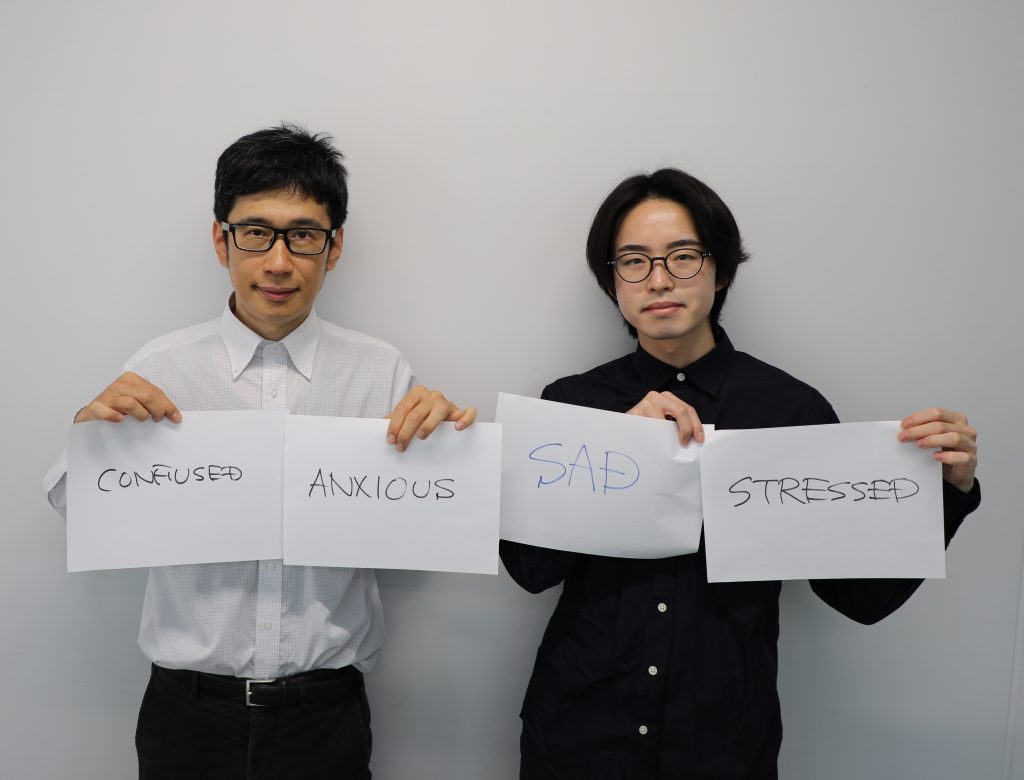
In their paper published in Scientific Reports, Masahiro Hirai (L) and Akitaka Fujii (R) from Nagoya University’s Graduate School of Informatics found evidence suggesting that people with higher autistic traits may try to cope with uncertainty by labeling their feelings. Credit: Merle Naidoo, Nagoya University