Strong magnetic fields keep the equator spinning faster than the poles and prevent a rotation flip, even as stars slow down with age
Researchers at Nagoya University in Japan have conducted the most detailed simulation of the interior of stars and disproved a theory scientists believed for 45 years: that stars switch their rotation patterns as they age, with poles rotating faster than the equator in older stars. Scientists have now found that this switch may not occur. Stars maintain solar-type rotation, spinning fast at the equator and slow at the poles throughout their lifetime. The findings were published in Nature Astronomy.
Why scientists expected the Sun to reverse its spin
Stars come in many different sizes, temperatures, and colors, ranging from red dwarfs to massive blue giants. Solar-type stars, the focus of this study, are those similar to our Sun in mass and temperature. They are medium-sized, yellow stars that provide stable conditions for billions of years, long enough for planets orbiting them to potentially develop life.
Earth rotates as one solid piece, but because the Sun is made of hot gas, it rotates differentially—different parts rotate at different speeds. The equator takes about 25 days to complete one rotation while the poles take about 35 days. This is known as solar-type differential rotation.
Stars naturally slow down as they age over billions of years. Scientists believed that this would change the pattern of how gas flows inside the star and eventually cause the Sun to switch its rotation pattern at some point, with the poles rotating faster and the equator slower (anti-solar differential rotation).
This prediction, however, proved wrong. Inside the Sun, the movements of hot gas naturally cause the equator to spin faster than the poles. Magnetic fields play a critical role in maintaining this pattern.
“We found that these two processes, turbulence and magnetism, keep the equator spinning faster than the poles throughout the star’s life, not just when the star is young,” said Hideyuki Hotta, coauthor and professor at Nagoya University’s Institute for Space-Earth Environmental Research.
“So even though stars do slow down, the switch doesn’t happen because magnetic fields, which previous simulations missed, prevent it.”
Supercomputer Fugaku corrects our understanding of the solar interior
The researchers used Fugaku, Japan’s most powerful supercomputer, to simulate the interior of solar-type stars at extremely high resolution. They divided each simulated star into 5.4 billion grid points.
Because previous simulations were conducted at low resolution, magnetic fields artificially disappeared, and their role in star rotation patterns was considered insignificant. In this study’s high-resolution simulation, magnetic fields stayed strong and prevented the rotation flip.
The simulations also showed that magnetic fields of stars weaken continuously throughout their lives, with no revival in old age. Previous studies predicted magnetic fields would strengthen again when the rotation pattern switched.
Swirling flows of hot gas inside a star. Credit: Hotta and Hatta (2026)
For decades, theoretical simulations predicted anti-solar rotation in slowly rotating stars, yet astronomers never detected it in observations. Observational techniques had significant limitations and the question remained unanswered.
Researcher and coauthor Yoshiki Hatta explained how the new simulations resolved this puzzle: “The simulation can reproduce the Sun’s observed rotation pattern almost perfectly. When we apply it to slower-rotating stars, it also matches astronomical observations and shows no anti-solar rotation.”
This corrected understanding of the interior of stars could help scientists solve stellar mysteries such as the Sun’s 11-year sunspot cycle and predict how magnetic activity affects the habitability of planets over billions of years. It could also improve star evolution models and help astronomers interpret observations of distant stars.
Supercomputer FUGAKU
The system is installed at RIKEN, a national research and development agency, in Kobe, Japan. It has been in shared use since March 2021 and has achieved world-leading performance across multiple international benchmark tests.
Paper information:
Hideyuki Hotta and Yoshiki Hatta (2026). The prevalence of solar-like differential rotation in slowly rotating solar-type stars, Nature Astronomy. DOI: https://doi.org/10.1038/s41550-026-02793-x
Funding information
This research was conducted with the following support: KAKENHI Grants-in-Aid for Scientific Research (JP20K14510, P21H04492, JP21H01124, JP21H04497, JP23H01210, JP25H00673, JP25K22031, JP23KJ0300, JP24K17087, JP24K00654);
JST Fusion Oriented Research for disruptive Science and Technology (FOREST) (JPMJFR246F), and the MEXT “Fugaku” Result Creation Acceleration Project (JPMXP1020230504, JPMXP1020230406)
This work used the computational resources of supercomputer Fugaku, provided by the RIKEN Center for Computational Science (Project ID: hp220173, hp230204, hp230201, hp240219, hp240212, hp250226 and hp250223).
Expert contact:
Hideyuki Hotta
Institute for Space-Earth Environmental Research
Nagoya University
E-mail: hideyuki.hotta.info.aaa@g.thers.ac.jp
Media contact:
Merle Naidoo
International Communications Office
Nagoya University
Email: icomm_research@t.mail.nagoya-u.ac.jp
Top image:
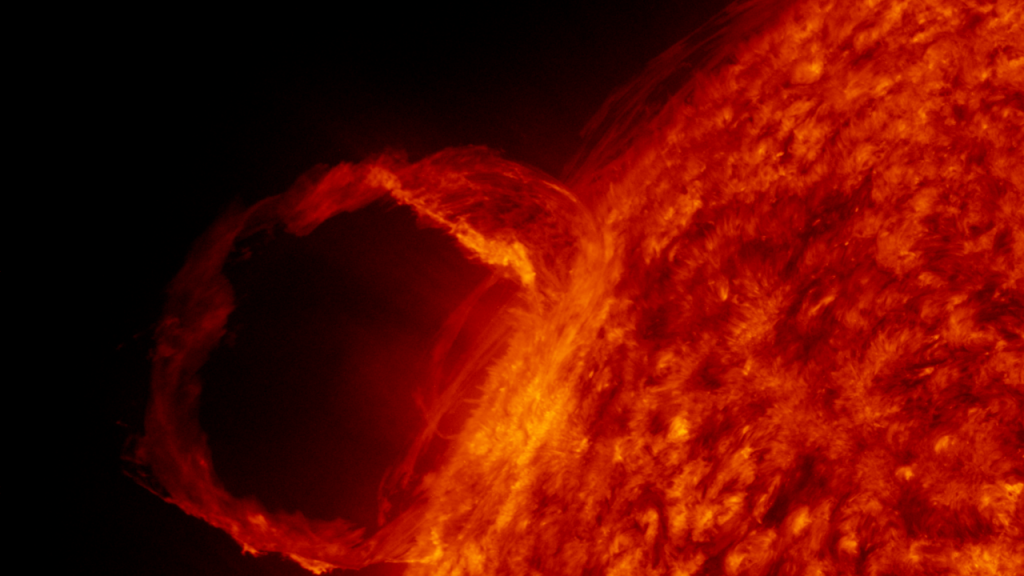
Solar magnetic activity observed by NASA’s Solar Dynamics Observatory spacecraft. Courtesy of NASA/SDO and the AIA, EVE, and HMI science teams.