
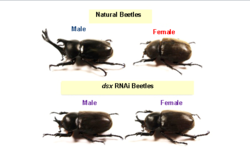
Assistant Professor Teruyuki Niimi and his co-researchers have discovered for the first time in the world that sex-determination genes control the forming of horns in rhinoceros beetles. Their paper was published online in EMBO Reports on April 23, 2013.
Most people know that the exaggerated horn is unique to male beetles, yet no-one has yet demonstrated what gene determines its formation. The group focused on a gene regulating sexual differentiation in insects,doublesex (dsx), and discovered that beetles carry the gene too. When the function of the gene is inhibited in larvae, males grow a shorter horn; females also grow a short horn, which is never observed under natural conditions. Furthermore, those beetles, both male and female, lose genital function and show intersexual phenotypes.
Their research set up a new insight into the evolution of beetle horns: first, a short horn was acquired regardless of sex, and then evolved into two different forms according to whether the beetle was male and female, due to the function of thedsx gene. The group has developed a biological agrochemical and new insect pest control method, using RNA interference (RNAi). The asexualization technology developed from the research is widely expected to contribute to pest control.
- Yuta Ito, Ayane Harigai, Moe Nakata, Akihiro Ito, Takahiro Ohde, Toshinobu Yaginuma and Teruyuki Niimi (Laboratory of Sericulture & Entomoresources, Nagoya University), Tadatsugu Hosoya, Kunio Araya (Graduate School of Social and Cultural Studies, Kyushu University), Yuichi Oba (Laboratory of Molecular Function Modeling, Nagoya University)
Message from Assistant Professor Teruyuki Niimi
Insects are rich in diversity, and have more species than any other creature on earth. I focused on the Japanese rhinoceros beetle as research material, so as to uncover the secrets of this diversity at the gene level. The number, shape and placement of horns diverge highly in closely related species. I will discover the mechanism that causes this diversity, and eventually aim to gain a further understanding of the evolutionary process of horn development.
Outlook for the Future
"I would like to discover more genes involved in the horn formation, and reveal how the well-known horn is developed at the molecular level."
Message to Young Students

"The observation of living nature can show you a variety of interesting phenomena. Why not study them with your own eyes, and enjoy the marvelous world of living creatures?