
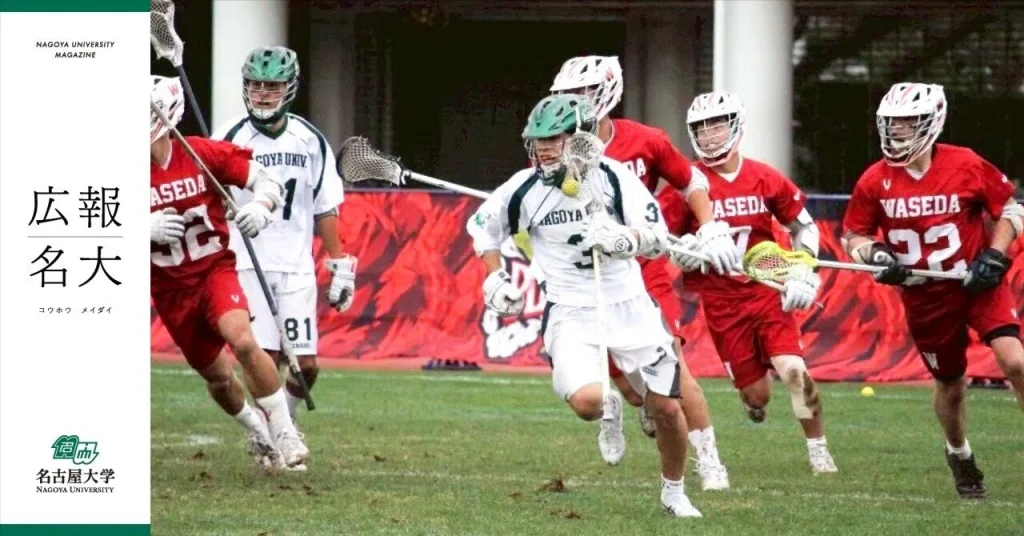
In December 2025, the Nagoya University men’s lacrosse team – the LIZARDS – became the first team from the Tokai region (Aichi, Gifu, Mie, or Shizuoka prefectures) to reach the Japan National Collegiate Lacrosse Championship final. In the match against Waseda University, the LIZARDS lost by a narrow margin and finished in second place, but their near victory put the team on the map as a force to be reckoned with. We spoke to members of the team as they reflected on their hard work over the past year.
Forging a new history
In 2025, the team resolved to “forge a new history” for themselves. To embody that strong ambition, they made “Origin” their keyword for the year. The fourth-year students, frustrated that they had been eliminated at the district finals for two consecutive years, decided to transform the club, creating a new history for the team while also holding on to its traditions.
Their first priority was to level up the team’s overall ability. The majority of the lacrosse club’s members join the team as beginners. In 2025, only nine of the club’s 50 members were fourth-year students, and so the strength of the team depended on how fast its newer members could grow as players. Taking this into account, the team sought out tough opponents in western Japan, doubling its number of friendly matches in that region. Team Captain Maeda (fourth-year undergraduate; School of Engineering) reflects on this initiative: “Not only did we gain a lot of experience, but winning every one of those friendly matches was a big confidence boost.”
An equalizing goal in the last two seconds takes the team to their first collegiate final
Strengthening the transition between offense and defense became an important part of the team’s new tactical strategy. They made sure every member prioritized winning back the ball as soon as the opponent took possession. Their efforts paid off in the semifinal of the collegiate tournament when the team went head-to-head with Meiji Gakuin University. Near the end of the match, the LIZARDS were down 3–4 when they lost the ball near the opponent’s goal, but they immediately surrounded the opponent and regained possession. They scored, leveling the game with just two seconds left on the clock. In that moment, a year’s worth of thorough practice came to fruition.

Taguchi (third-year undergraduate; School of Agriculture), leader of the offense, joined training sessions at strong schools in eastern Japan to hone his skills. Learning that these schools focused on position-specific basic drills, he proposed a similar practice regime at the Nagoya University lacrosse club. Historically, the LIZARDS has faced issues with catching, so during the off-season they dedicated time to drilling basic passing and catching skills. Taguchi explains that by reducing the number of mistakes, the team was able to dedicate more time to offense. In this way, the team overcame their weaknesses, one step at a time.
A staff of over 30 to help the team grow even stronger
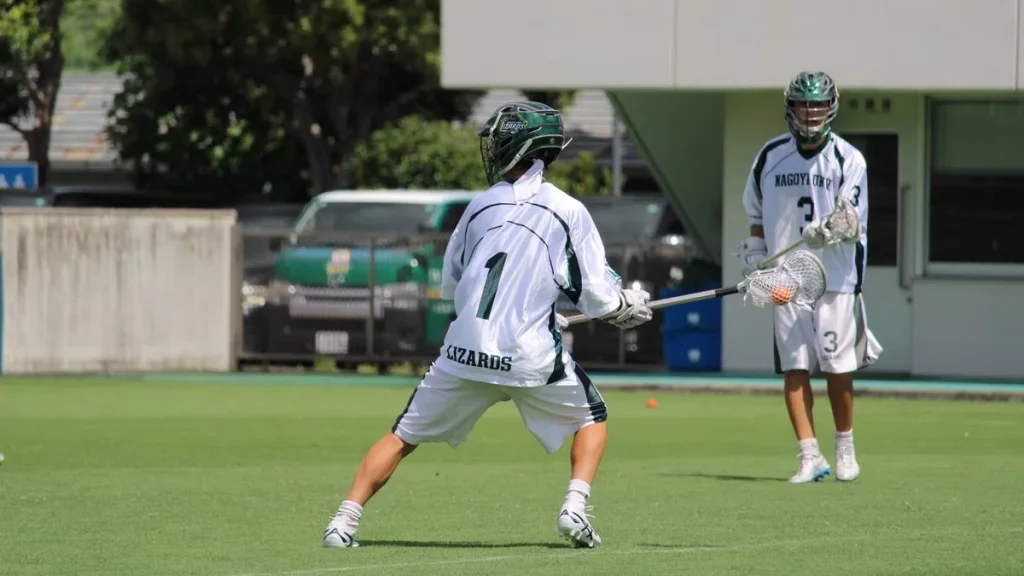
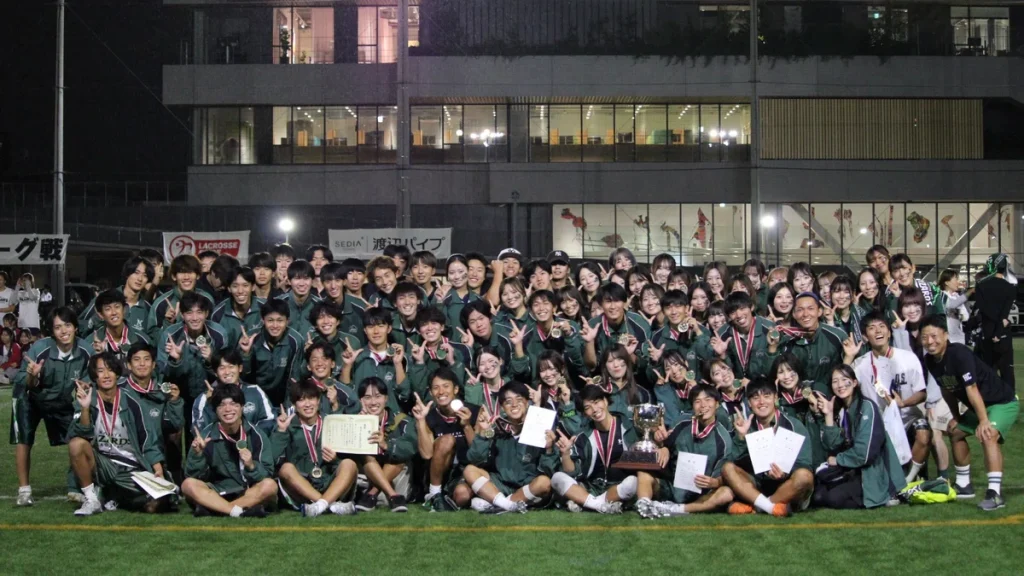
The Nagoya University men’s lacrosse club has more than 30 non-player student staff (22 managers and 11 trainers). This is a high number compared to other universities, but until this year, the LIZARDS had trouble efficiently leveraging the strength in their numbers.
In lacrosse, managers frequently serve as referees, and seven of the LIZARDS managers hold the refereeing qualification. The team’s principal manager Hiraki (fourth-year undergraduate; School of Economics) obtained the qualification when she was a first-year student and has built up her knowledge of lacrosse from a referee’s perspective. Using her extensive experience, she has hosted team workshops about the rules of the game and lectured on defensive techniques that do not result in fouls, deepening the players’ comprehension of the rules and cutting their fouls by half. Three first-year students are currently studying diligently for the qualification.

The analysis team collects detailed information about who scores in matches and how, as well as the conditions under which they lose points to the other team, using this data to identify the team’s strengths and weaknesses. They also scout out the team’s next opponent, going to watch and film their matches, analyzing their weaknesses based on the footage and incorporating those findings into team strategy.

Losing the final to Waseda, but leaving a mark
The LIZARDS, having steadily strengthened through team reforms, won the Tokai Student League for the first time in three years and secured a spot in the collegiate championship. In the first round of the championship, they narrowly beat Hokkaido University, and in the semifinals they achieved a dramatic come-from-behind victory over powerhouse Meiji Gakuin University, putting them one win away from being Japan’s number one.
Then came the fateful game against Waseda University. The LIZARDS took the opening goal, but after that the teams were neck and neck. In the end, the LIZARDS came up short, losing 5-7 to Japan’s five-time champion. Captain Maeda commented, “Ever since joining the team, it’s been my goal to be number one in Japan, so I’m still frustrated that we didn’t win the championship. Even still, we were the first team from the Tokai region to ever reach the final, and so we definitely left our mark.”

To be a beloved team
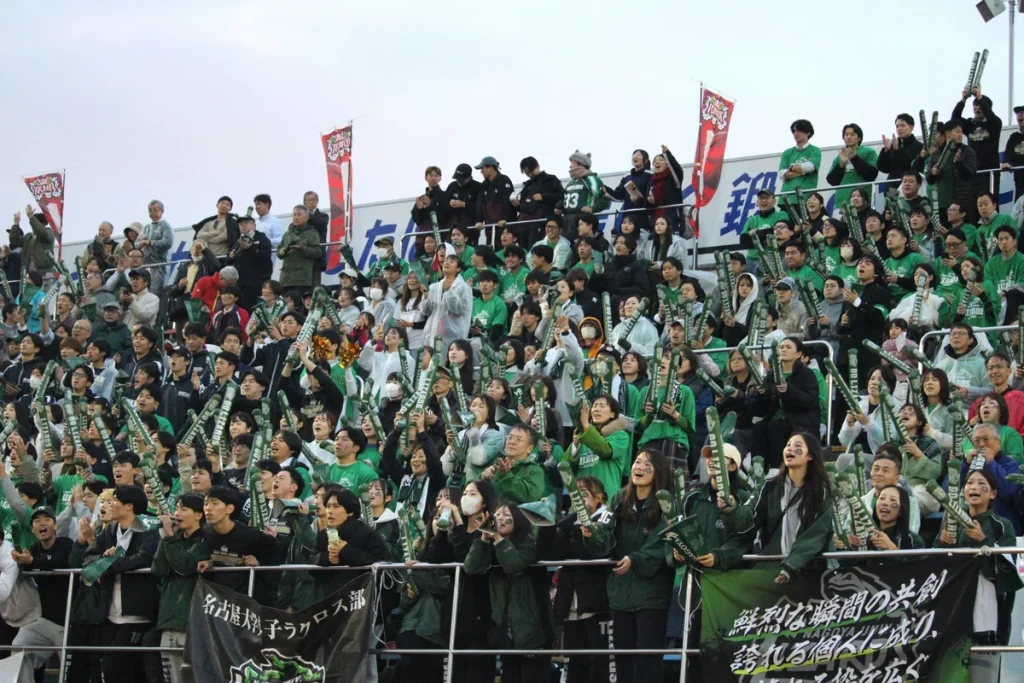
Another strength of the team is that the managers are invested in making the LIZARDS a team loved by all. The managers work to expand the team’s fanbase and make cheering paraphernalia for the games.
The managers regularly send match information and results via LINE (a messaging/social networking app) to alumni and family members, sustaining a feeling of connectedness to the team. As a result, many alumni and family members travelled to Tokyo to support the LIZARDS in the collegiate final against Waseda. But there were other supporters in the stands, too. Nagoya University’s local rivals from Nanzan University, Meijo University, and Shinshu University also travelled to Tokyo to cheer the LIZARDS on, and the stands were full of Nagoya University colors.
Funding travel for newer members of the team to attend the final was initially a point of concern, but the team received generous support from alumni and family members. Maeda said, “I’m glad the younger students could experience the atmosphere of a national tournament firsthand. I felt just how indebted we are to graduates of the team and to our families,” expressing gratitude for the support. It was this very support that saw the LIZARDS through to their historic breakthrough.
Originally published in Japanese on March 17, 2026.