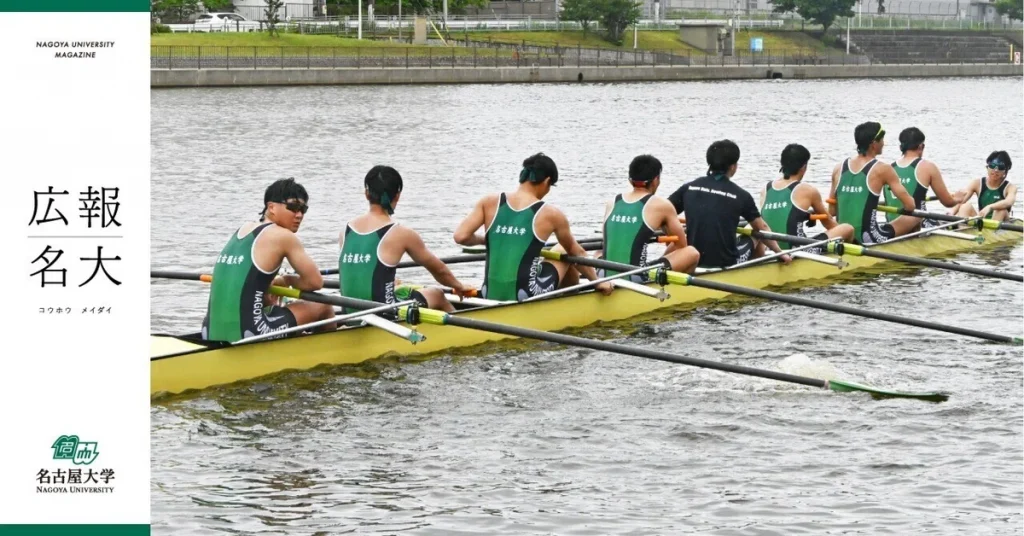
The intercollegiate Meihan Regatta between the rowing clubs of Nagoya University and the University of Osaka was held on June 15, 2025, on Nagoya’s Nakagawa Canal. The tournament first took place in 1947 and boasts the second longest history in university rowing after the Sokei Regatta (between Waseda and Keio Universities) held on the Sumida River in Tokyo. This year marks the 79th anniversary of the tradition. Over the years, Nagoya University men’s division has won 36 times and lost 42, and in the most recent games they have suffered three consecutive losses to the University of Osaka. In 2025, Nagoya row in home waters—will they be able to put this to their advantage?
Competitive rowing:
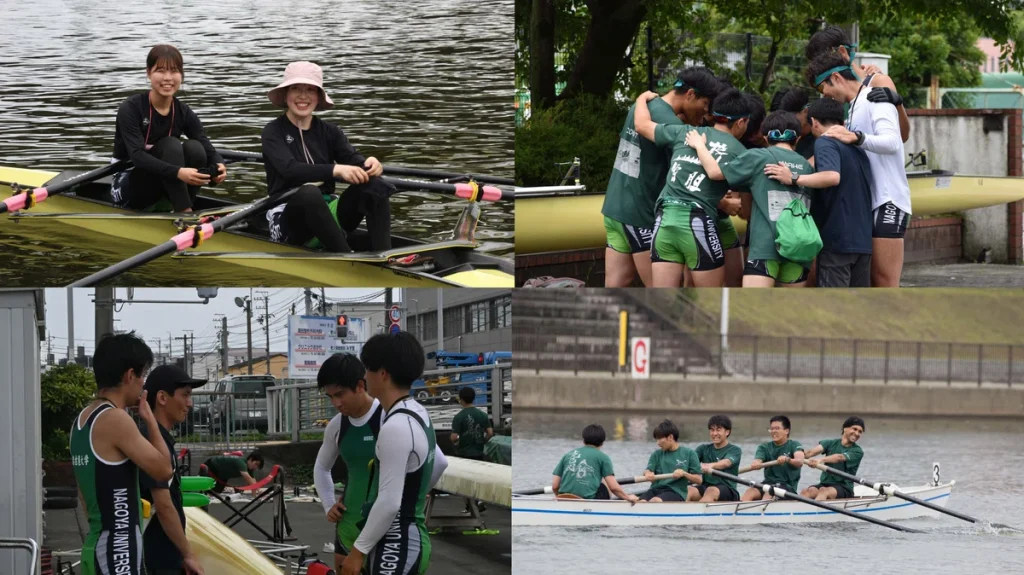
The players board long, narrow boats measuring between 8 to 17 meters depending on the number of people, and they race towards the goal, using oars to row. There are two types of competition: “sculling,” where each rower uses two oars, and “sweep rowing,” where each rower uses a single oar. Sculling events include single, double, and quadruple sculls, while sweep events include double and quadruple boats, as well as the prestigious eight, with eight rowers and one coxswain.
Training-filled days at the riverside boathouse
The Nagoya University Rowing Club takes pride in the volume of their training. Members of the club live together year-round in the club’s boathouse located on the shores of the Shonai River in the suburbs of Nagoya. They row from 5 to 7am, eat a breakfast prepared by the student managers, go to university, and, after finishing classes, they return home—to the boathouse, that is. In the evenings they train again, this time on terra firma.
This boatcentric lifestyle typically involves rowing between 14 and 16km a day, sometimes as many as 20km, and is only possible because of the bonds and mutual support that the team share. Team Captain Kondo (fourth-year undergraduate0 says, “You can’t keep up momentum just by giving it your all in training. I try to create a good atmosphere by being proactive in talking to my teammates and creating opportunities for us to socialize with each other,” showing care for the mental well-being of his team.
One member, Kato (third-year undergraduate), says “I decided to join the Rowing Club because it has a great atmosphere. After living together with the team, I actually find myself feeling lonely on our days off (laughs),” expressing how he enjoys life with his teammates, both when it’s plain sailing but also when the going gets tough.
Student club manager Goto (fourth-year undergraduate) also decided to join the club because of its atmosphere. She plays an important role in the team: “While I don’t exert myself physically like the athletes, I support the team in other ways by cooking meals and keeping track of times during practice.”
In the heat and in the cold, even if the team are tired and would rather stay in bed, they go out on the river. Of course they have their days off too, so that all members can have a balanced student life. Onda (third-year undergraduate) works a part-time job on Mondays and Fridays when there is no practice, maintaining a connection with wider society while also balancing his university classes with his life at the Rowing Club. He says, “Having too much free time makes life monotonous, so this lifestyle is just right.”
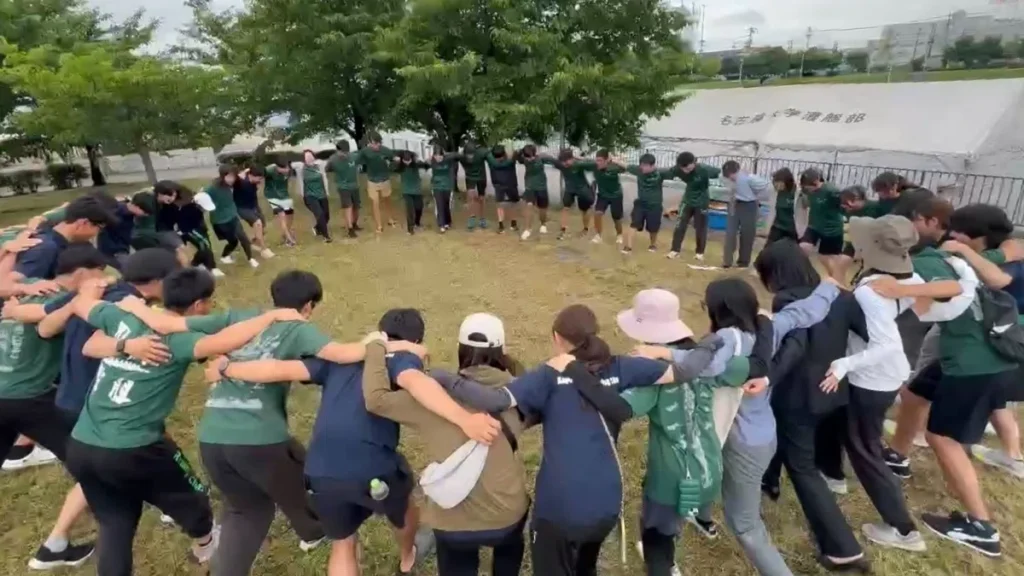
The decisive race is the “Eight,” with eight rowers and one coxswain per boat
In the 2025 tournament, Nagoya University struggled as the stronger University of Osaka dominated in every event. And then came the final race. The outcome of the Meihan Boat Race is determined by the “Intercollegiate Eight,” which consists of eight players from each university and one coxswain.
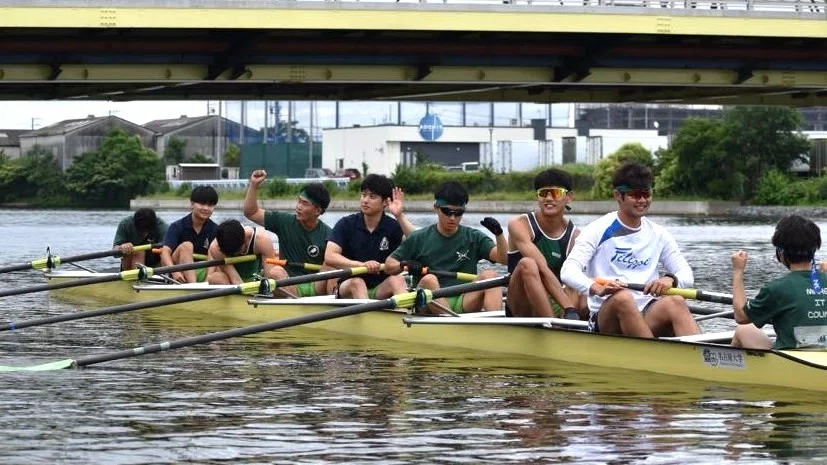
The course is a 2km straight line. For the spectators and other club members gathered near the finish line, the start line is too far to see. The club members and supporters wait near the end of the course, listening to live commentary from the tournament HQ who receive radio communication from the chase boats of both teams.
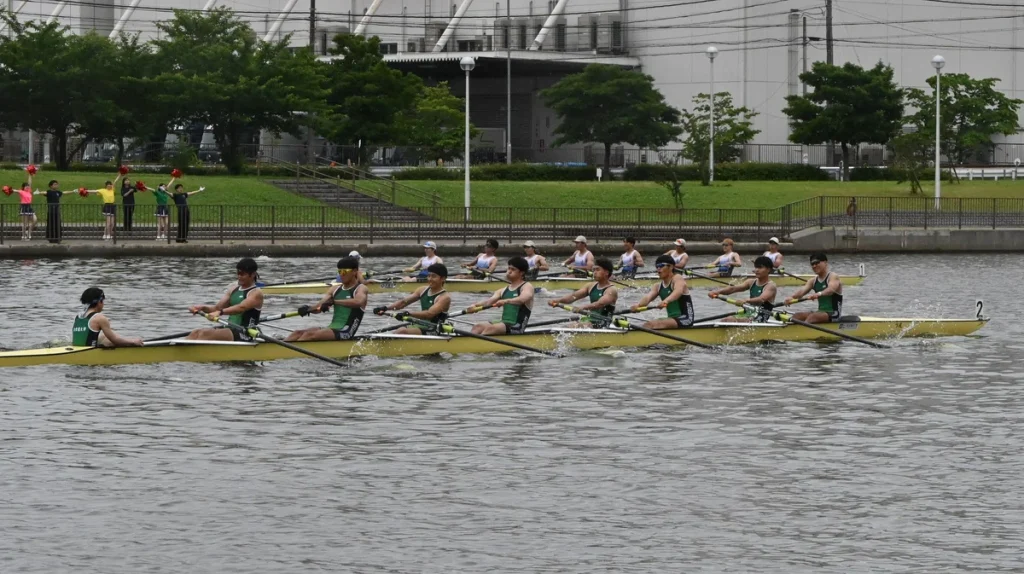
About four minutes after the scheduled start time of 14:30, the boats of both teams coming into view from afar appeared to be evenly matched. The cheers from both schools grew passionate. As the boats came closer, it seemed that the University of Osaka was holding a slight lead. The two teams rapidly approached and glided away, with about the length of one boat separating them.
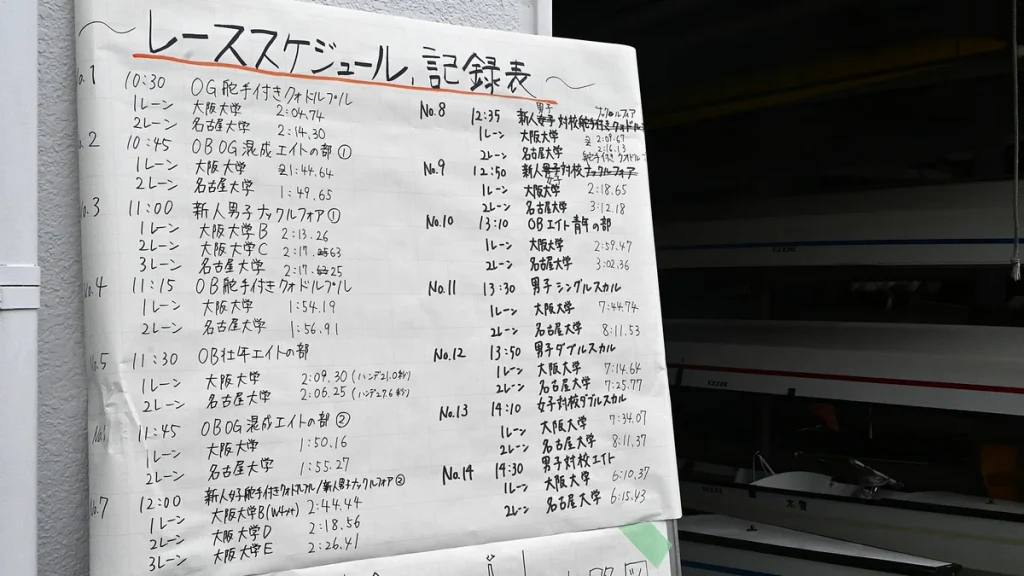
The finish times were 6 minutes 10.37 seconds for the University of Osaka and 6 minutes 15.43 seconds for Nagoya University. Nagoya University lost by a margin of 5.06 seconds.
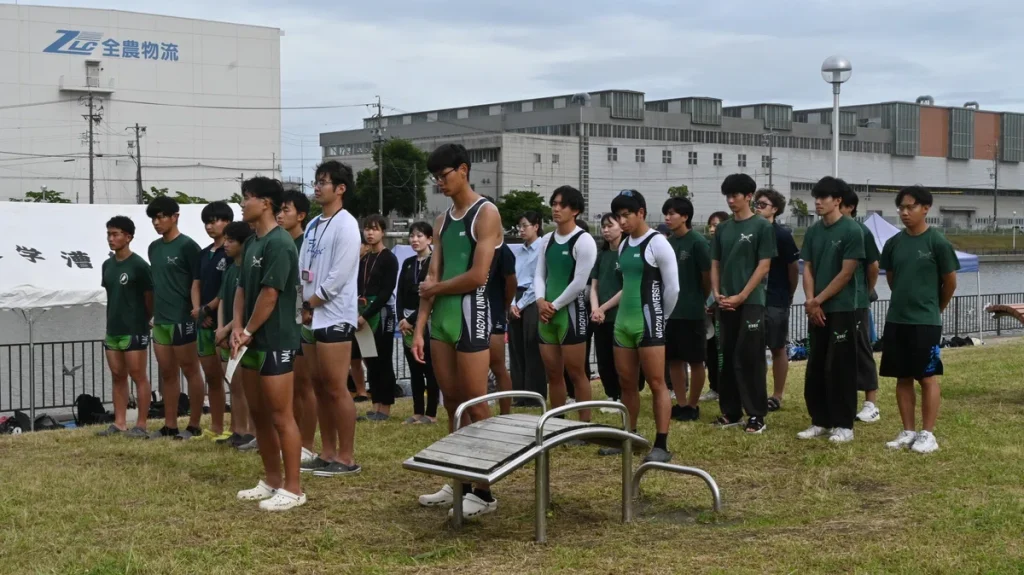
Mentally and physically exhausted, but vowing revenge for next year
The Meihan Boat Race ended with a disappointing result for Nagoya University. After the goal, club director Hidenori Aiki (a professor at the Institute for Space-Earth Environmental Research) choked up as he reported the result, explaining that Osaka had had a wide lead. Professor Aiki, himself an alumnus of the Nagoya University Rowing Club, said with hope, “a victory next year is definitely possible if we can refine our strategy and improve our ability to adapt to natural conditions like wind and waves.”
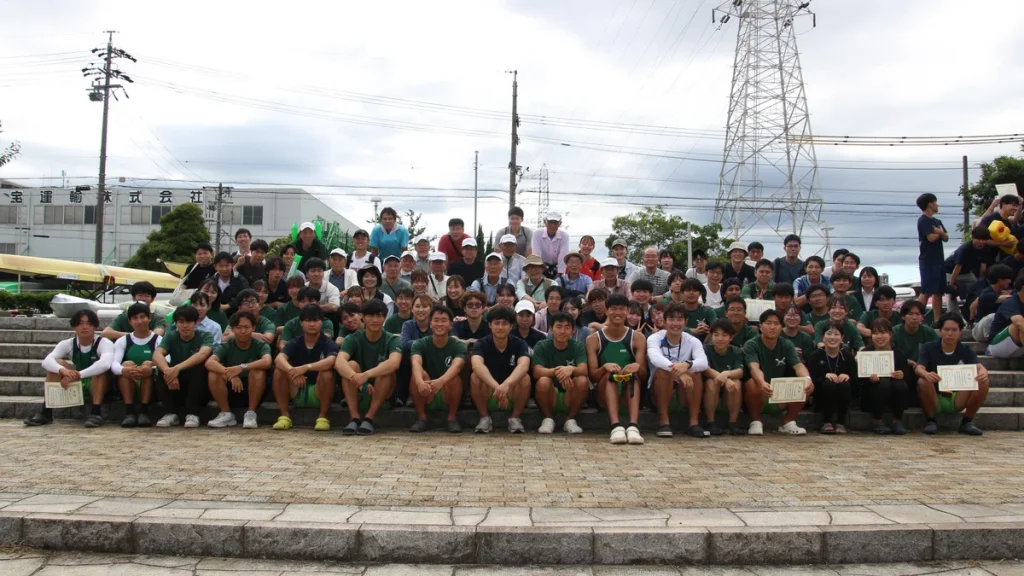
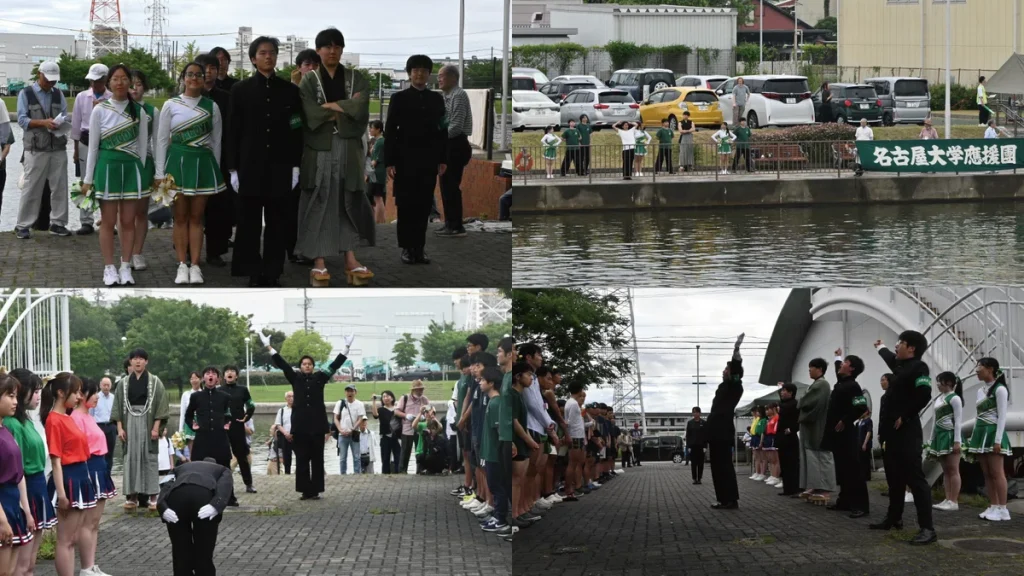
After the race, all the club members lined up in front of the club alumni who had come to watch, and delivered an address. The club had trained hard for this day, getting faster with each practice; they felt they had a real chance at victory. However, they were unable to match the skill of their competitors at the University of Osaka.
“First, we will improve our physical fitness. We will train so that we can maintain bigger, longer, and more powerful movements; we will aim for a better race than today,” said Team Captain Kondo. The alumni erupted into enthusiastic applause.
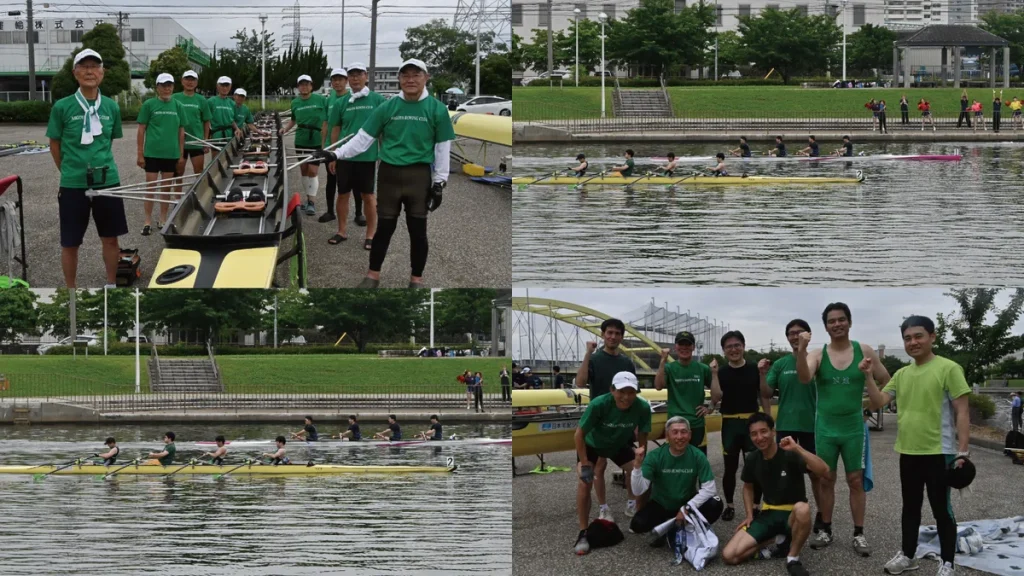
One more Meihan race
The alumni races are another important aspect of the tournament. Recalling their own days in the club, the alumni come to the races with a fighting spirit and determination that rivals that of the current members. In particular, the alumni men’s team was in especially good form. The average age of the members who participated in the “OB Eight Senior” category was an impressive 74.25 years, with its oldest member being 82. Even still, they crushed the University of Osaka team, whose team’s average age was 68.57. The winning team gave a victorious cheer.
Nagoya University’s cheering squad, which recently restarted activities after a gap of over ten years, came to support the club on the day of the tournament. At the opening ceremony, they cheered with the University of Osaka cheering squad to encourage the athletes of both schools, and at the race venue, they gave their all in supporting the athletes, boosting morale and energizing the event.
Originally published in Japanese on July 15, 2025.