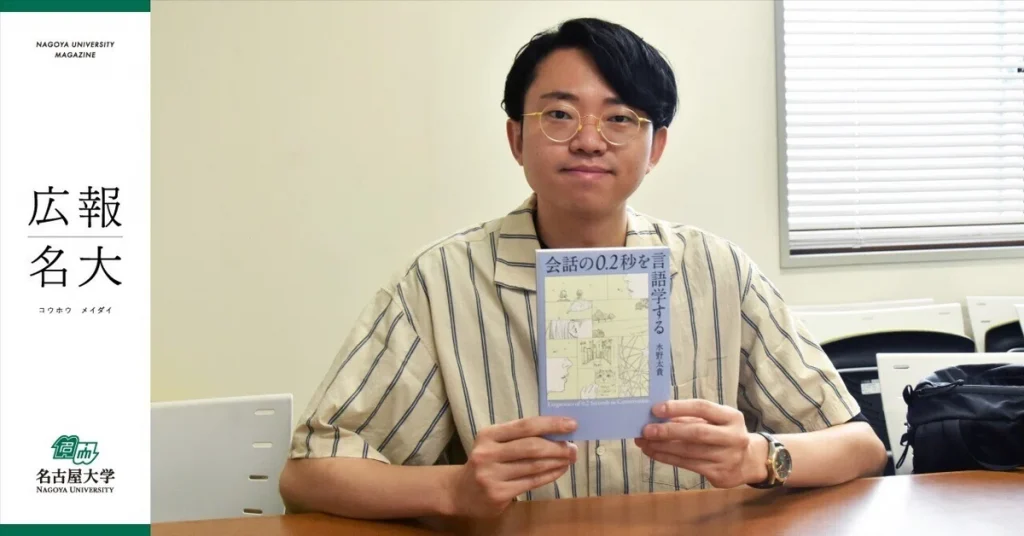
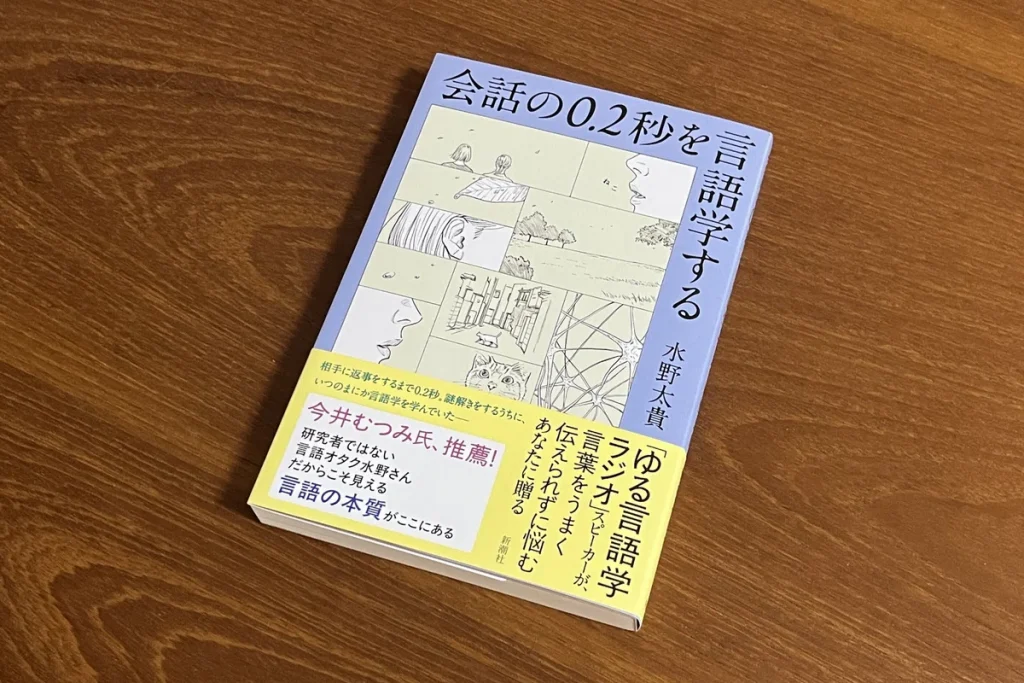
A book about linguistics published in August 2025, Kaiwa no 0.2 byō o gengogaku suru (“Doing Linguistics on 0.2 Seconds of a Conversation”), quickly surpassed 40,000 copies sold. Its author, Daiki Mizuno, hosts the YouTube channel Yuru Gengogaku Rajio (Laidback Linguistics Radio), which has over 400,000 subscribers and has gained attention for its enthusiastic “language nerd” content.
But who is Daiki Mizuno? Is he a freelance writer? A YouTuber? It turns out that he mainly works as an editor at a publishing company. We interviewed Mizuno to learn about how his linguistics-filled life took off after he graduated from Nagoya University’s School of Humanities in 2018.
Getting hooked on linguistics and reading
Daiki Mizuno has always been fascinated with language, developing a special interest in difficult kanji characters while he was in elementary school. He went on to pass Level 2 of the Kanji Kentei Examination when he was in junior high. In high school, he was greatly affected by a book he found in the library: Gengogaku ga suki ni naru hon (“A Book That Will Make You Fall in Love With Linguistics”) by Ken Machida (Emeritus Professor at Nagoya University).
As he turned the pages, Mizuno learned that “all linguistic signs are arbitrary.” This “arbitrariness” refers to the fact that written language and sounds (linguistic signs) bear no inherent relation to their meanings. Mizuno realized that everyday language feels so commonplace that it is easy to overlook, but on deeper reflection, he noticed that language contains some of the greatest discoveries of humankind, and he became fascinated. At the time, Machida was a professor at the Nagoya University Graduate School of Humanities, so Mizuno felt that it was the only place for him to continue his education.
Mizuno was accepted to Nagoya University and, as he had hoped, was able to study under Professor Machida, but he confesses that he mainly spent his student days having fun. As he started looking for jobs, he felt a sense of crisis about the way he was spending his student days, and so he started up a routine where he and a friend would each buy a book and exchange opinions when they were done reading. “I came across Baka ni minshu-shugi ha muri nano ka? (“Is Democracy Impossible for Fools?”) at one of the bookstores on campus and got hooked on “shinsho” books [which offer introductory overviews on a variety of topics],” he said, describing how his voracious reading habit began. Sometimes reading over 70 books a month, this was the beginning of a relationship with reading that would become the foundation of his present lifestyle.

Conveying the appeal of academic study
Mizuno worked part-time at a cram school when he was a university student, enjoying the job because he could talk with his students between lessons, sharing trivia and conveying the appeal of studying. He devoted himself to his job, collecting fun facts that he could share with his classes. However, Mizuno ultimately ended up applying for roles at publishing companies, knowing that as a cram school instructor he could only speak with a few dozen high school students, but in the world of book publishing he could reach a much wider audience. Competition is tough when it comes to finding work in the publishing world, but Mizuno was able to secure a job offer, winning the interview panel over by explaining his love for dictionaries.
Mizuno currently works as a magazine editor at a publishing company in Tokyo. He mainly works on black-and-white feature pages, which involves planning articles and interviewing experts. He enjoys his current role, explaining, “Since my interests change frequently, I feel that working as a magazine editor suits me well, since I am able to take on a variety of projects.”

Starting the Laidback Linguistics Radio channel
Mizuno set up the YouTube channel Laidback Linguistics Radio with freelance writer Ken Horimoto in March 2021. The channel covers a variety of language-related topics such as onomatopoeia and language acquisition in infants, and its content also includes book reviews and quizzes. The channel’s popularity lies in its light-hearted tone that allows viewers to learn about linguistics while having fun.
Mizuno has been captivating people with his speaking skills ever since he was in elementary school. He explains, “When I ran for student council president and gave a speech in front of the entire school, all the other candidates read from their scripts monotonously. I was the only one who spoke without looking at a script, hitting the desk for emphasis, and I was selected to become the student council president.”
About two months after starting the channel, one of the videos got a lot of traction and the number of subscribers grew rapidly. However, a factual error was soon discovered in the video. Mizuno explains that this became an impetus for him to rededicate himself to his studies, working harder than he had when he was a student. He feels that having an audience on YouTube has allowed him to engage with linguistics in earnest.

A dream of publishing comes true
In a conversation, there is a gap averaging 0.2 seconds when the speaker and listener switch roles. “Doing Linguistics on 0.2 Seconds of a Conversation” describes what happens in the mind during that moment. The book was an immediate hit, receiving more than 13,000 preorders and selling 30,000 copies in the first week after its release. As of mid-October, many stores have sold out of copies, and the book is set to go through a fourth print run.
Mizuno decided to donate a portion of the royalties from the book sales to aid a graduate student conducting research in the field of linguistics after he learned that there are many students who have no choice but to give up on graduate education, studying abroad, or attending international conferences due to financial difficulties. He invited applications via “Laidback Linguistics Radio,” and a project was carried out to donate one million yen to one of the applicants.
“Since I’m not an expert in linguistics and have disseminated incorrect information, I felt that I had inconvenienced the linguistics community and wanted to give back in some way,” Mizuno said.
In defense of the humanities
Recently, Mizuno was shocked to learn from his old high school teacher that many parents oppose their children studying the humanities at university. “People may think that subjects such as economics are more useful for finding jobs since they teach ‘practical skills,’ but personally I don’t agree. Studying the humanities doesn’t put you at a disadvantage when it comes to finding employment, and what you learn is in fact useful in society. Someday, I’d like to make a video about why studying the humanities at university is so great!” says Mizuno.

Originally published in Japanese on October 21, 2025.